In Short: The Strategy Is Vertical Integration on Top of Your Data
Microsoft's AI strategy in 2026 is best understood as vertical integration: own the silicon, own frontier models, own the data platform, and make intelligence a built-in layer of every product rather than a separate destination. Five pillars carry the whole thing - and every one of them assumes your data estate is in order.
This is our synthesis of what Microsoft shipped and signalled through Build 2026 and the months since, drawn from our detailed coverage of each announcement.
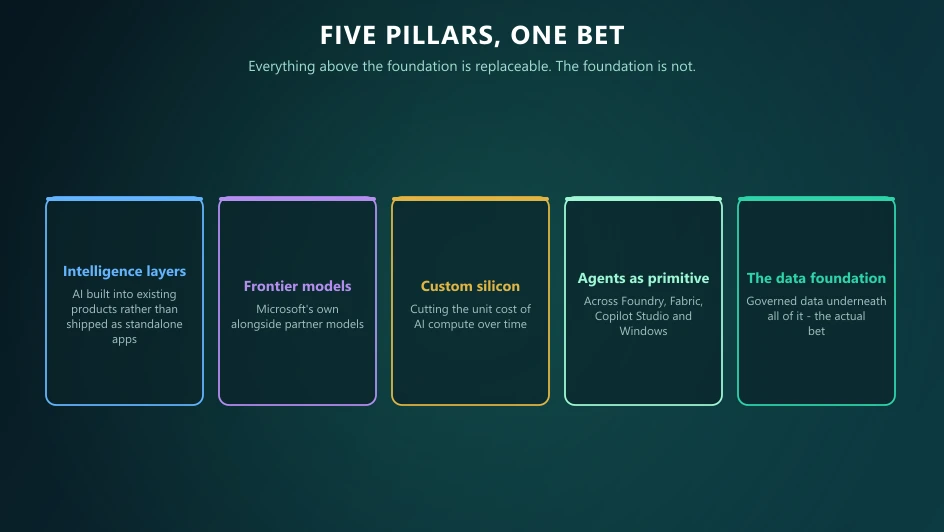
Pillar 1: Intelligence Layers, Not AI Apps
Microsoft is not building a separate "AI app" for the enterprise. It is embedding intelligence layers into the platforms you already run - a portfolio we map for buyers in our executive guide to the Microsoft AI stack: Microsoft IQ grounds agents in enterprise and world knowledge, and its Fabric IQ pillar - the semantic foundation over your structured business data - is what lets Microsoft 365 Copilot answer data questions in the Teams chat and Outlook inbox your executives already live in. Copilot Cowork extends that same surface from answers to multi-step execution.
The strategic point: the interface to data is becoming conversation, and the quality of the answers depends entirely on the quality of the semantic models underneath.
Pillar 2: Its Own Frontier Models
With MAI-Thinking-1, Microsoft joined the frontier-model race under its own name rather than relying solely on partners. Azure now offers MAI models alongside GPT-5 and Claude - which is less about beating partners on benchmarks and more about ensuring Microsoft controls a full-stack option end to end.
For customers, the practical consequence is choice with a tiering strategy: flagship models for the hard 20% of tasks, cheaper models for the routine 80%.
Pillar 3: Custom Silicon to Bend the Cost Curve
Maia 200 and Cobalt 200 exist to lower the cost of AI compute on Azure over time. Microsoft is following the hyperscaler playbook: own the chips, cut the unit economics, and pass enough of the saving through to keep workloads on Azure.
The planning implication: do not lock long-term AI cost assumptions at today's prices, and favour shorter capacity commitments in a falling-price environment.
Pillar 4: Agents as a Platform Primitive
The agent push runs through every layer: Foundry Agent Service for production agents, Fabric Data Agents exposed over MCP so any AI system can query governed data, Copilot Studio for low-code assistants, Rayfin so coding agents can generate application backends that deploy to Fabric, and Windows as a local agent runtime for on-device execution. Foundry's Fabric integration is what ties the agents to governed data.
Microsoft is betting that agents become how work gets done - and that the winner is whoever owns the governed context agents need.
Pillar 5: The Data Foundation Is the Whole Bet
Every pillar above lands on the same dependency: governed, unified data. Fabric IQ amplifies whatever sits beneath it. Agents act on what they can reach. Copilot answers from your semantic models. As we argued in the context bottleneck, the constraint on enterprise AI has moved from models to context - and Microsoft's strategy is engineered around being the company that owns the context layer, through Fabric.
That is why Fabric investment is AI strategy, not a separate line item.
What This Means for Your 2026-2027 Roadmap
- Sequence foundation before intelligence. Organisations skipping to agents and Copilots on fragmented data get confident wrong answers at scale.
- Model costs are falling - design for it. Build business cases that work at today's prices and improve on the curve.
- Treat semantic model quality as a product. Conversational interfaces make model naming, definitions and governance visible to executives.
- Start agents narrow. One governed use case that works beats an ambitious platform nobody trusts.
For the full announcement-by-announcement detail, start with our Microsoft Build 2026 recap.
What This Means for the Next Twelve Months
Five pillars is a useful map and a poor plan. Translated into sequencing for a mid-market organisation, Microsoft's direction implies a fairly specific order of work.
Months one to three - establish where you actually stand. Not an AI strategy document: an honest assessment of whether your data is unified enough for any of this to function. Most organisations discover the gap is here rather than in model access.
Months three to nine - build the foundation the use cases need. Not the whole estate; the parts your first two or three use cases depend on. Every pillar above assumes governed data underneath it, and none of them degrade gracefully without it.
Months six to twelve - ship narrow, measurable use cases. A policy-question agent grounded in your documents, an intelligent document intake, a data agent over governed data. Each with a named user and a measurable saving. Expand what works rather than launching broadly.
The sequencing matters more than the tooling. Organisations that invert it - licences first, foundation later - produce the stalled pilots that make the second attempt harder to fund.
What to Ignore For Now
Being clear about what does not require action is as useful as the roadmap.
Silicon announcements. Maia and Cobalt matter to Microsoft's margins and, eventually, to your bill. They change nothing about what you should build this year. The reasonable response to a falling price curve is shorter capacity commitments, not delay.
Model benchmarks. Which frontier model leads this quarter is close to irrelevant for enterprise workloads, because the models are the most commoditised layer in the stack and the differentiators are your data, use-case selection and guardrails.
Anything requiring a data foundation you do not have. If the pitch assumes governed, unified data and you do not have it, the honest read is that the announcement is not yet available to you - whatever the licence says.
The Pattern Underneath the Five Pillars
Strip out the product names and Microsoft's bet is singular: that the winning position in enterprise AI is owning the governed data layer everything else reasons over, and that intelligence embedded in existing tools beats standalone AI products.
Whether or not that bet is right, it has a clear implication for buyers. The investment that retains its value regardless of which model or vendor leads in two years is the data foundation. Everything above it is replaceable; that is not.
Sources and Further Reading
Frequently asked
Vertical integration across five pillars: intelligence layers built into existing products (Microsoft IQ, Fabric IQ), its own frontier models (MAI-Thinking-1) alongside partner models, custom silicon (Maia 200, Cobalt 200) to cut AI compute costs, agents as a platform primitive across Foundry, Fabric, Copilot Studio and Windows, and the Fabric data foundation underneath it all.
Rayfin is Microsoft's open-source SDK and CLI, announced at Build 2026, that lets developers and coding agents generate enterprise-grade application backends deployed to Fabric - putting application data into governed OneLake from day one. The natural-language intelligence over governed data comes from Fabric IQ and Fabric Data Agents.
Maia 200 (AI accelerator) and Cobalt 200 (ARM CPU) reduce Microsoft's dependency on third-party silicon and lower the unit cost of AI compute on Azure over time. For customers, the practical effect is a falling AI price curve - which argues for shorter capacity commitments and business cases that improve over time.
Sequence the work: data foundation first (unified, governed data in Fabric), then intelligence layers, then agents. Every Microsoft AI capability assumes governed data underneath - organisations that skip the foundation get confident wrong answers at scale.
No - Azure offers MAI-Thinking-1 alongside GPT-5 and Claude. The strategy is choice plus control: Microsoft wants a full-stack option it owns end to end, while customers tier models by task - flagships for hard problems, cheaper models for routine work.