In Short: There Is No Single Best Model
MAI-Thinking-1, Claude Opus 4.6, and GPT-5 are all frontier-grade AI models capable of handling complex enterprise tasks. The question is not which is best in absolute terms - all three score competitively on standard benchmarks - but which fits your specific use case, integration requirements, cost tolerance, and governance constraints.
The model selection decision in 2026 is a substantive architectural choice, not a default. This guide breaks down what each model is, where it excels, what it costs, and how to build a decision framework for your enterprise AI applications.
Update, 1 October 2026: This comparison predates OpenAI's GPT-6 series and Anthropic's Claude 5.5 models, and we have left it as written. In Microsoft Foundry, GPT-6 Astra became generally available on 3 September 2026, GPT-6 Sol and GPT-6 Luna on 22 September, and GPT-6.1 Sol on 30 September; Claude Opus 5.5 arrived on 22 September and Claude Sonnet 5.5 on 28 September. Microsoft now recommends starting with GPT-6 Astra for the most demanding reasoning, using GPT-6.1 Sol as the default for production agents and complex workflows, and scaling high-volume tasks with GPT-6 Luna. The decision framework below still applies; for what each new model is for and what it costs, see GPT-6 in Microsoft Foundry: Astra vs Sol vs Luna.
Update, 8 October 2026: The catalogue has moved again since then. Anthropic's Claude Fable 5.1 arrived on 1 September 2026. In Foundry it is in public preview and hosted on Anthropic's infrastructure, and it is rolling out to eligible users in Copilot Cowork and Copilot Studio. Claude Haiku 5.5 followed on 7 October and is generally available in Foundry in both Azure-hosted and Anthropic-hosted versions. Grok 4.7 from SpaceXAI became generally available in Foundry on 6 October at $2 input and $6 output per million tokens (Global Standard, under 200K tokens of context). Our guide to Claude in Microsoft Copilot and Foundry covers the Claude line-up. For the current selection framework, see choosing models in Microsoft Foundry.
The Three Models
MAI-Thinking-1
MAI-Thinking-1 is Microsoft's first in-house reasoning model, announced at Build 2026 and available through Microsoft Foundry. A sparse mixture-of-experts design with 35B active parameters and a 256K context window, it is designed specifically for complex, multi-step analytical reasoning - tasks that require breaking a problem into sequential steps, evaluating intermediate conclusions, and revising reasoning based on results.
MAI-Thinking-1 is optimised for the Azure ecosystem. For the broader selection framework across the Foundry catalogue, see choosing models in Microsoft Foundry. It integrates natively with Azure AI Foundry, Microsoft Fabric data sources, and Microsoft 365 Copilot. For organisations building AI applications that live primarily within the Microsoft stack, this native integration removes the friction that cross-vendor architectures introduce - authentication, data access controls, governance logging, and monitoring all work within the existing Azure framework.
Its primary strengths are analytical depth and Microsoft ecosystem integration. Its list pricing is aggressive for a reasoning model - roughly $2 per million input tokens and $8 per million output - though extended reasoning chains consume more tokens per task, so the cost shows up in volume rather than unit price.
Claude Opus 4.6
Claude Opus 4.6 is Anthropic's top-tier model, available through Azure AI (via the Azure AI model catalogue) or directly through the Anthropic API. It is consistently strong across long-context tasks - processing and reasoning over very large documents, complex codebases, and multi-document research - and has a measured advantage in instruction-following fidelity and reduced hallucination rates on factual extraction tasks.
For enterprise AI applications that involve processing large, unstructured documents - legal contracts, research papers, lengthy technical specifications, audit reports - Claude Opus 4.6 frequently benchmarks ahead of the alternatives. It is also available through Amazon Bedrock, giving organisations with AWS infrastructure a native deployment path.
Its primary strengths are long-context accuracy and instruction following. Its cost is comparable to GPT-5, meaning the decision between Claude Opus 4.6 and GPT-5 is often made on ecosystem fit rather than pure performance difference.
GPT-5
GPT-5 is OpenAI's latest model, available through Azure OpenAI and the OpenAI API directly. It represents the current peak of OpenAI's general-purpose capability, with particular strengths in code generation, structured output formatting, and creative language tasks.
Update, 1 October 2026: GPT-5 is no longer OpenAI's latest model. The GPT-6 series, including GPT-6.1 Sol, is now generally available in Microsoft Foundry - see the update at the top of this post.
GPT-5 benefits from the largest installed base of any frontier model and the broadest ecosystem of third-party tooling built around the OpenAI API format. More libraries, more community examples, and more pre-built integrations exist for GPT-5 than for either MAI-Thinking-1 or Claude Opus 4.6. For organisations with existing OpenAI API integrations, moving to GPT-5 is a lower-friction upgrade path than switching vendors.
Its primary strengths are ecosystem breadth and code generation. Its cost is at the premium end of the market - comparable to Claude Opus 4.6.
Where Each Model Excels
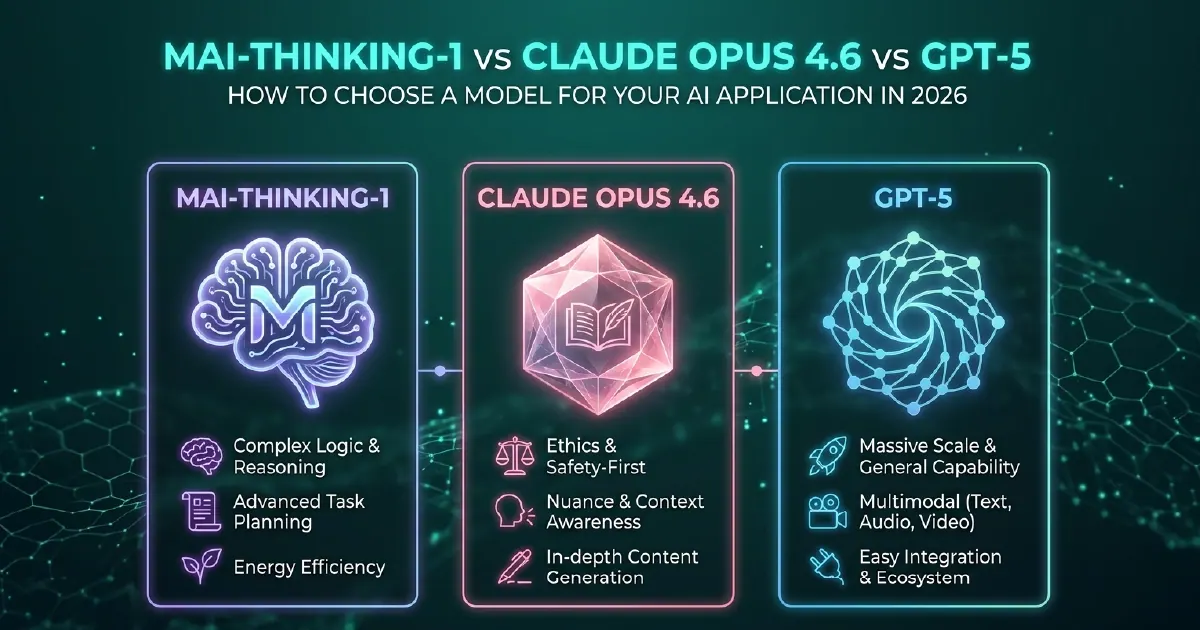
Use MAI-Thinking-1 when:
- The application lives natively on Azure, Fabric, or Microsoft 365
- The primary task requires multi-step analytical reasoning - financial modelling, complex data analysis, multi-document synthesis
- Governance, audit logging, and data residency requirements are most easily met within the Azure security boundary
Use Claude Opus 4.6 when:
- The primary task involves processing large, dense documents - contracts, technical specifications, research papers
- Instruction-following fidelity is critical and hallucination on factual extraction is a known risk
- The organisation has existing AWS infrastructure or Bedrock commitments
Use GPT-5 when:
- Code generation, debugging, or code review is a primary use case
- The organisation has existing OpenAI API integrations and tooling
- Access to the broadest third-party ecosystem of libraries and pre-built integrations is a priority
The Cost Consideration
Claude Opus 4.6 and GPT-5 are priced at the premium end of the market - roughly $10-60 per million tokens depending on input/output mix and variant - while MAI-Thinking-1 undercuts both at roughly $2 input and $8 output per million. Even so, the cost difference for a specific task is usually less important than the architectural implications of vendor choice. (Anthropic has also shipped newer Claude releases since this comparison was written; the framework here applies to whichever point release is current.)
The more important cost decision is knowing when not to use a flagship model. Routing, classification, summarisation, and structured extraction tasks rarely require frontier-model reasoning depth. Mixing a cheaper model (today that means GPT-6 Luna at $0.10 input and $0.50 output per million tokens, Claude Haiku 5.5, or a small open model) for the 80% of tasks that are routine, and reserving a flagship model for the 20% that genuinely require it, typically reduces model costs by 50-70% with no meaningful quality degradation on the simpler tasks.
A Decision Framework
When choosing between these models for an enterprise application, work through four questions:
Where does the application live? Microsoft-native (Fabric, M365, Azure AI Foundry) - start with MAI-Thinking-1. AWS-native or cross-cloud - consider Claude Opus 4.6. Existing OpenAI integrations - consider GPT-5.
What is the primary task type? Multi-step analytical reasoning - MAI-Thinking-1. Long document processing and extraction - Claude Opus 4.6. Code generation or structured output formatting - GPT-5. High-volume, simpler tasks - none of the above, use a smaller model.
What do compliance and governance requirements look like? Azure compliance, data residency, and audit logging requirements are most straightforward with Azure-hosted models (all three are available on Azure). Direct OpenAI API or Anthropic API calls require separate governance framework consideration.
What does your team's ecosystem look like? Existing tooling, libraries, and engineering familiarity matter for implementation speed and ongoing maintainability.
For most organisations building on Microsoft Fabric and Azure, the default starting point should be MAI-Thinking-1 for reasoning tasks and a small model such as GPT-6 Luna or Claude Haiku 5.5 for high-volume, lower-complexity tasks - with Claude Opus 4.6 as the preferred alternative for long-document use cases where it benchmarks higher.
Our AI Solutions team runs model evaluations on your specific use case data before you commit to a vendor choice for production deployments.
What Model Choice Means in Practice
For most enterprise workloads the model is the least differentiated part of the stack. What separates an AI project that ships from one that stalls is the data foundation, the use case and the guardrails around it.
If that is where you are, our automation and AI practice is the work we do, and the four ways AI initiatives quietly die covers the background.
Sources and Further Reading
- Azure AI Foundry
- Microsoft Copilot Studio documentation
- GPT-6 Astra, Sol, and Luna: For production agents in Microsoft Foundry (Microsoft Azure Blog)
Frequently asked
MAI-Thinking-1 is Microsoft's first in-house reasoning model, announced at Build 2026 and available through Microsoft Foundry. A sparse mixture-of-experts design with 35B active parameters and a 256K context window, it is designed for complex, multi-step analytical reasoning and integrates natively with Foundry, Microsoft Fabric, and Microsoft 365 Copilot - particularly well-suited to applications that live within the Microsoft stack.
Yes. Claude Opus 4.6 is available through the Azure AI model catalogue, allowing organisations to access Anthropic's top-tier model within the Azure security and compliance boundary. It is also available directly through the Anthropic API and through Amazon Bedrock for organisations with AWS infrastructure.
GPT-5 represents the current peak of OpenAI's general-purpose capability, with particular advances in code generation, structured output formatting, and reasoning across complex multi-step tasks. It benefits from the largest installed base and third-party ecosystem of any frontier model, making it the lowest-friction upgrade path for organisations with existing OpenAI API integrations. Update, 1 October 2026: GPT-5 is no longer OpenAI's latest model - the GPT-6 series, including GPT-6.1 Sol, is now generally available in Microsoft Foundry.
No - and for most enterprise AI applications, you should not. The most cost-effective and performant architectures use multiple models: a smaller, cheaper model for high-volume routing, classification, and extraction tasks, and a frontier model only for the subset of tasks that genuinely require its reasoning depth. This model tiering approach typically reduces overall model costs by 50-70% compared to using a single frontier model for all tasks.
MAI-Thinking-1 is the natural starting point for AI applications built natively on Microsoft Fabric and Azure AI Foundry. Its native integration with Azure, Fabric data sources, and Microsoft 365 Copilot reduces the friction of cross-vendor authentication and governance that using Claude or GPT-5 from a non-Azure endpoint would introduce. For specific use cases like long-document processing, Claude Opus 4.6 may benchmark higher regardless of ecosystem fit.