In Short: Five Announcements That Matter
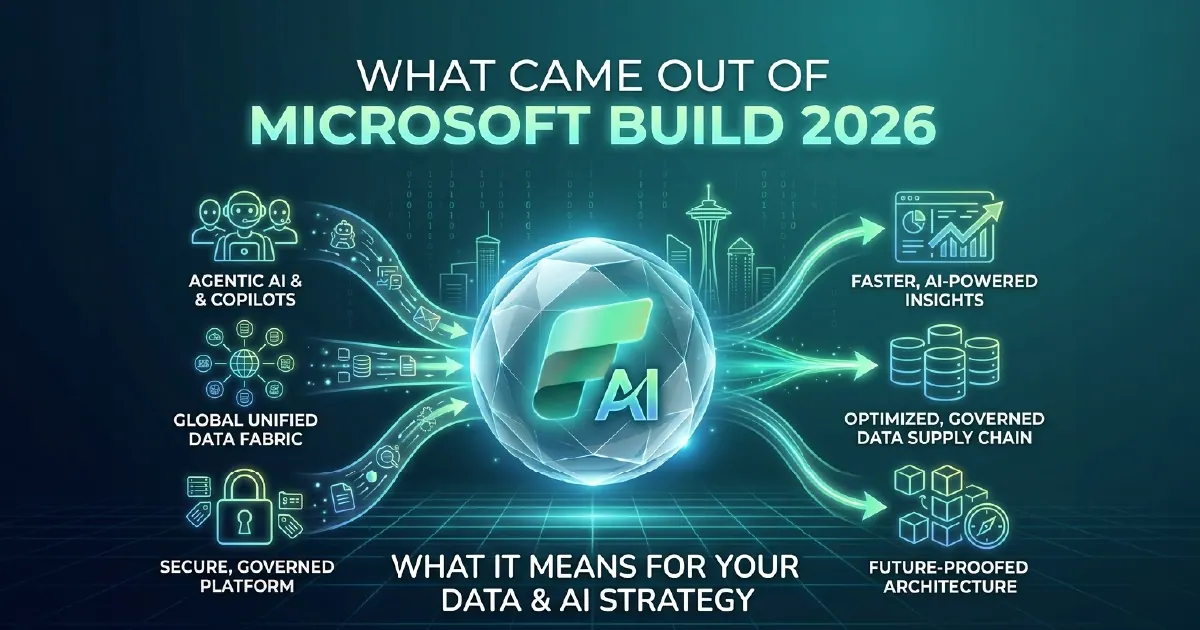
Microsoft Build 2026 continued the pattern set at Build 2025 - less focus on raw model capability announcements and more focus on the infrastructure, tooling, and governance that turns AI capability into business value. For organisations running Microsoft Fabric, Power BI, and Azure AI, the announcements cluster around five themes: intelligence layers for existing data estates, Microsoft's new reasoning model, custom silicon reducing AI infrastructure costs, Frontier Tuning as a new approach to model customisation, and Windows becoming a first-class agent execution environment.
This post summarises the key announcements, what they mean in practice, and where you should focus your attention and investment over the next twelve months. For how the announcements fit Microsoft's wider direction, see Microsoft's AI strategy in 2026.
Theme 1: Intelligence Layers for Fabric and Power BI
The most significant announcements for data platform customers are Microsoft IQ and Rayfin. Microsoft IQ is the new context layer that grounds agents in enterprise and world knowledge, and its Fabric IQ pillar - now generally available - is the semantic foundation over structured business data: OneLake data, semantic models and ontologies, consumed by Copilot and agents alike. Rayfin is different in kind: an open-source SDK and CLI that lets developers and coding agents generate enterprise-grade application backends - database, authentication and all - deployed to Fabric, with the application data landing in OneLake.
Microsoft IQ's other pillars complete the picture: Work IQ (workplace intelligence across Microsoft 365, with public APIs GA from 16 June), Foundry IQ (retrieval planning across enterprise knowledge and the live web) and Web IQ (an MCP-native, AI-first web search stack for live grounding).
The implication is consistent across all three announcements: organisations with well-governed Fabric estates - clean medallion architecture, properly structured semantic models - can activate these features and see immediate value. Organisations with poorly governed data will find the AI layers amplify their data quality problems rather than solving them.
Theme 2: Microsoft's New Reasoning Model - MAI-Thinking-1
Microsoft announced MAI-Thinking-1, its first in-house reasoning model, available through Microsoft Foundry - a sparse mixture-of-experts design with 35B active parameters and a 256K context window, announced alongside four sibling MAI models covering image, voice, transcription and coding. It is designed for complex, multi-step analytical tasks - financial modelling, complex data analysis, multi-step planning - where extended reasoning chains produce materially better outputs than standard completion models.
MAI-Thinking-1 joins GPT-5 and Claude Opus 4.6 as the frontier-tier model options available through Azure AI. Our model comparison guide covers when to use each and how to build a decision framework for your AI applications.
The model selection decision is now a substantive architectural choice, not a default. For Microsoft-native applications running on Fabric and Azure, MAI-Thinking-1's native ecosystem integration is a meaningful advantage. For long-document processing or cross-cloud deployments, other models may benchmark higher.
Theme 3: Custom Silicon and AI Cost Economics
Maia 200 and Cobalt 200 represent Microsoft's custom silicon programme for Azure. Maia 200 - announced in January 2026 and reinforced throughout Build - is an AI accelerator built specifically for inference; Cobalt 200 is Microsoft's second-generation ARM-based general compute chip.
For customers, the significance is commercial: as Microsoft's Maia 200 production scales, AI inference costs on Azure are likely to decline. When modelling future costs, we treat a 30-50% reduction in inference cost per token by 2028 as a reasonable planning range rather than a forecast. This has implications for AI use cases that are currently economically marginal - they may become clearly viable over a 2-3 year horizon without any improvement in the application itself.
Theme 4: Frontier Tuning
Frontier Tuning is Microsoft's new approach to enterprise model customisation: reinforcement learning applied to the MAI models inside your own compliance boundary, so agents learn how your business actually works while your data and the tuned model stay in your environment. Microsoft's headline result: tuned for McKinsey's standards, MAI achieved the highest win rate of any model tested at roughly ten times lower cost.
It is most valuable where general-purpose models consistently need expert rework for reasoning and process errors rather than missing facts - financial analysis, regulatory compliance, engineering assessment - and it is delivered as a managed capability through Azure AI Foundry.
Theme 5: Windows as a Local Agent Runtime
Microsoft announced significant investment in Windows as a local agent execution environment. Windows Copilot Runtime enables AI agents to run locally on Windows PCs using on-device NPUs, with full access to local system state, files, and applications.
For engineering teams, this enables agent skills for GitHub Copilot CLI that query Power BI datasets, trigger Fabric pipelines, and interact with Fabric workspaces from the command line. For enterprise architects, it opens new patterns for latency-sensitive and data-residency-constrained workloads.
What to Prioritise Over the Next Twelve Months
- Immediate (0-3 months): Audit your Fabric semantic models for Fabric IQ readiness. Poorly named measures and undefined relationships now propagate into every agent that grounds itself through the semantic layer. This is the foundation for every AI feature announced at Build 2026.
- Near-term (3-6 months): Evaluate the Microsoft IQ layers - Work IQ APIs for workplace context, Foundry IQ for retrieval - against your first agent use cases, and identify the governance gaps blocking activation.
- Medium-term (6-12 months): Build your first Foundry agent over Fabric data. Use the improving Maia 200 cost economics to revisit agent use cases that were previously marginal.
- Longer-term (12+ months): Evaluate Frontier Tuning for use cases where general-purpose models consistently require domain expert correction for reasoning errors.
Our Microsoft Fabric team and AI Solutions practice can help you map these announcements to your specific data estate and build a prioritised roadmap.
Sources and Further Reading
Frequently asked
The five most significant announcements for data and AI customers were: Microsoft IQ (the context layer for agents, with Fabric IQ as its semantic foundation over business data), Rayfin (an open-source SDK and CLI that generates application backends deployed to Fabric), MAI-Thinking-1 (Microsoft's first in-house reasoning model), Frontier Tuning (reinforcement learning on MAI models inside your compliance boundary), and Windows as a local agent runtime - with the January Maia 200 silicon announcement reinforcing the falling AI cost curve.
Rayfin is Microsoft's open-source SDK and CLI, announced at Build 2026, that lets developers and coding agents describe what to build and get an enterprise-grade application backend - database, authentication and more - generated into the code and deployed to Microsoft Fabric, with the application data landing in OneLake.
MAI-Thinking-1 is Microsoft's first in-house reasoning model, announced at Build 2026 and available through Microsoft Foundry - a sparse mixture-of-experts design with 35B active parameters and a 256K context window, built for complex, multi-step analytical reasoning and integrated with Foundry, Fabric and Microsoft 365 Copilot.
Frontier Tuning is Microsoft's new approach to enterprise model customisation, announced at Build 2026. It applies reinforcement learning to Microsoft's MAI models inside your own compliance boundary so agents learn how your business works, with your data and the tuned model staying in your environment. It is delivered as a managed capability through Azure AI Foundry.
Windows as a local agent runtime means Windows PCs can now execute AI agent workflows locally using on-device neural processing units (NPUs) through Windows Copilot Runtime, without sending data to the cloud for every interaction. This enables developer tooling like GitHub Copilot CLI agent skills for Fabric, and opens new patterns for latency-sensitive and data-residency-constrained enterprise applications.