In Short: A Framework for AI Agent Maturity
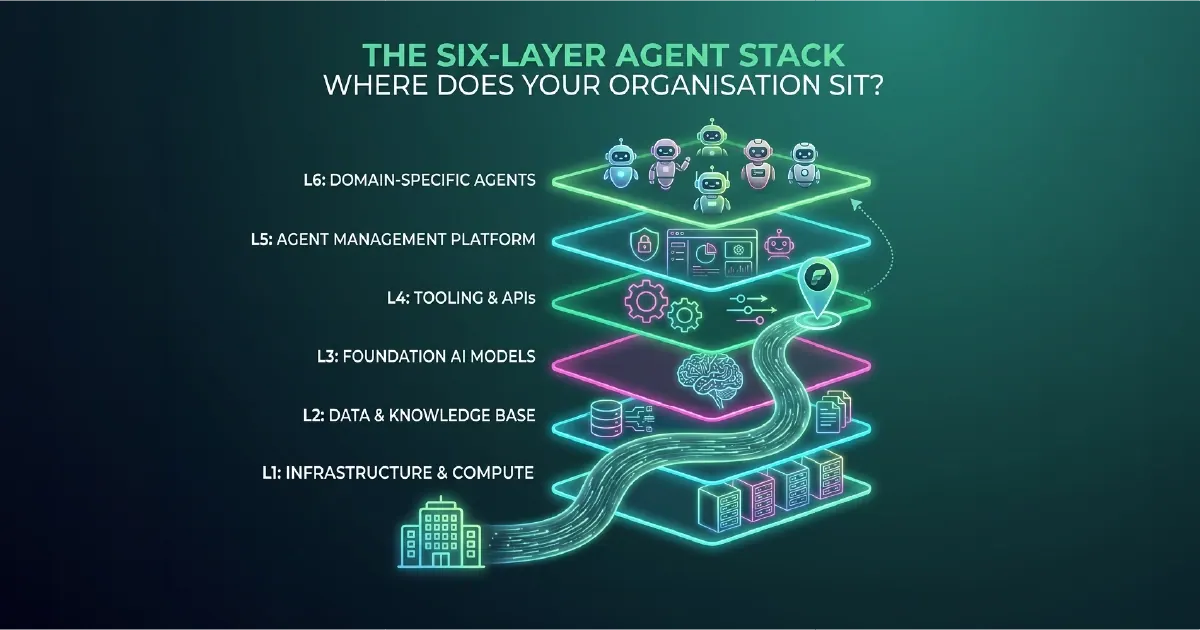
The six-layer agent stack is a framework for mapping where an organisation sits in its AI agent capability journey. It describes six capability states - from having data available but not AI-accessible, to running fully autonomous AI operations that monitor, reason, and act without human initiation.
The framework is not a technology prescription. But for organisations running on Microsoft, each layer maps naturally to specific Fabric, Azure, and Microsoft 365 capabilities. Knowing which layer you are at tells you what to build next, what capabilities you are not yet ready to unlock, and where your next investment will create the most leverage.
Layer 1: Data Foundation
What it means: Your organisation has data in databases, data warehouses, or cloud storage, but it is not yet in a state where AI can reliably reason over it. Data is siloed across systems, definitions are inconsistent, and there is no unified layer that AI can query with confidence.
What "stuck at Layer 1" looks like: Multiple source systems with no unified storage layer, different definitions of "revenue" across teams, no medallion architecture, no governed semantic models, analysts spending most of their time reconciling data rather than analysing it.
What to build: A unified data layer using Microsoft Fabric and OneLake with Bronze-Silver-Gold medallion architecture. Governed semantic models with clearly defined measures. A Microsoft Purview governance framework. Without this, every layer above will produce unreliable outputs.
Layer 2: Intelligence Layer
What it means: Your data is structured and governed, and AI can answer questions about it - but only through human-initiated queries against pre-built reports or dashboards. There is no natural language access and no proactive intelligence.
What "stuck at Layer 2" looks like: Well-maintained Power BI dashboards that answer the questions they were designed to answer. Business users asking BI developers for one-off queries that the dashboards do not cover. No Copilot integration and no Fabric IQ grounding.
What to build: Power BI semantic models optimised for AI querying (clearly named measures, complete metadata), Fabric IQ activation over your Fabric estate, and Fabric Data Agents for natural-language access. The goal is to make your data answerable in natural language by anyone in the organisation.
Layer 3: Tool Layer
What it means: AI can query your data and answer questions, but agents cannot yet take actions in external systems. Intelligence is advisory, not executable. The agent can tell you what is happening but cannot respond to it.
What "stuck at Layer 3" looks like: A data agent or Copilot correctly identifies that a KPI is below target. A human reads the output, decides what to do, and manually triggers the response - creates a task, sends a notification, updates a record. The AI found the insight; a human took the action.
What to build: Function tools in Azure AI Foundry that allow agents to call operational systems - Power Automate flows, REST APIs, Dataverse write operations, ERP system connectors. Each tool should be well-defined, reliable, and independently testable.
Layer 4: Memory Layer
What it means: Agents can take actions, but they have no memory of prior interactions. Each session starts fresh. The agent cannot learn from past outcomes, maintain context across conversations, or build a persistent understanding of a situation over time.
What "stuck at Layer 4" looks like: An agent that correctly handles a customer query but has no recollection of the previous three queries from the same customer. An agent that starts every pipeline monitoring session without context about what was found and actioned yesterday.
What to build: Thread persistence in Azure AI Foundry (cross-session conversation history), Azure AI Search vector stores for semantic retrieval over knowledge bases and historical records, and OneLake-backed memory schemas for structured agent state. Memory design decisions affect both capability and cost - size memory to actual need, not theoretical maximum.
Layer 5: Orchestration Layer
What it means: Multiple specialised agents can work together on complex tasks. A planning agent decomposes goals, execution agents handle subtasks, and results are combined. This enables tasks that are too complex or context-rich for any single agent.
What "stuck at Layer 5" looks like: Individual agents handle bounded tasks reliably. Multi-agent patterns have been prototyped but are not in production for business-critical workflows. Orchestration failures are hard to diagnose and recover from.
What to build: Multi-agent orchestration patterns in Azure AI Foundry (sequential, parallel, hierarchical), agent evaluation frameworks with test sets for quality assurance, Azure Monitor instrumentation for agent trace observability, and human-in-the-loop escalation for edge cases.
Layer 6: Autonomous Operations
What it means: AI agents monitor your data continuously, detect events of significance, reason over multiple datasets to determine the appropriate response, and take action - all without human initiation of each cycle.
What "at Layer 6" looks like: Fabric Data Agents monitoring operational KPIs across your business. When an anomaly is detected, the agent cross-references causal factors, determines severity, notifies the right team or triggers a corrective workflow through Power Automate - and logs what it did and why for audit. This runs continuously, at scale, across business domains.
What to build: Production Fabric Data Agents with defined monitoring scope and clear action boundaries, Fabric IQ-grounded reasoning chains, Power Automate action libraries, comprehensive audit logging for autonomous actions, and human override mechanisms for high-stakes decisions.
Where Most Organisations Sit
Based on our work with organisations across the UK, US, and South Africa, most sit between Layer 1 and Layer 3. They have data, some governance, and possibly some prototype agents - but the foundations for reliable, production-grade agent operations are not fully in place.
The most common barrier to moving from Layer 2 to Layer 3 is not technology - it is data quality. Agents that cannot get reliable answers from your data will not reliably take the right actions in operational systems. Every layer above Layer 1 depends on the quality of what sits beneath it.
Layer 4 (memory) is the layer most organisations underestimate. The difference between an agent that handles bounded tasks and an agent that builds context and learns from past interactions is the memory layer - and getting it right requires deliberate architecture decisions before the agent goes to production.
If you want an honest assessment of which layer your organisation is at and a specific roadmap for moving to the next one, our Microsoft Fabric team and AI Solutions practice run structured maturity assessments that map your current state to concrete next steps. To test whether your foundation layers are ready, work through our AI-ready data estate checklist.
Sources and Further Reading
Frequently asked
The six-layer agent stack is a maturity framework for AI agent capability. The six layers are: (1) Data Foundation - unified, governed data in OneLake; (2) Intelligence Layer - AI-queryable data through Fabric IQ and Copilot; (3) Tool Layer - agents that can take actions in external systems; (4) Memory Layer - agents with persistent context across sessions; (5) Orchestration Layer - multiple specialised agents working together; (6) Autonomous Operations - continuous monitoring, reasoning, and action without human initiation.
Most organisations we work with sit between Layer 1 and Layer 3. They have data, some governance, and possibly prototype agents - but the data quality, semantic model structure, and tool integration needed for reliable production-grade agent operations are not fully in place. Layer 4 (memory) is the layer most organisations underestimate.
To reach Layer 3 (Tool Layer), you need: a well-governed data foundation (Layer 1 - OneLake with medallion architecture), natural language querying over your data (Layer 2 - Fabric IQ and governed semantic models), and function tools in Azure AI Foundry that allow agents to call operational systems and take actions. The most common barrier is data quality - agents that cannot get reliable answers from data will not reliably take the right actions.
Layer 6 autonomous operations means AI agents continuously monitor your enterprise data, detect significant events, reason over multiple datasets to determine the appropriate response, and take actions - all without human initiation. Fabric Data Agents at this level detect a KPI anomaly, cross-reference causal factors, determine severity, and trigger corrective workflows through Power Automate, with full audit logging of what was found and why the action was taken.
Layer 1: Microsoft Fabric (OneLake, Lakehouse, medallion architecture), Microsoft Purview. Layer 2: Power BI semantic models, Fabric IQ, Fabric data agents. Layer 3: Azure AI Foundry function tools, Power Automate, REST API connectors. Layer 4: Foundry thread persistence, Azure AI Search vector stores. Layer 5: Foundry multi-agent orchestration, Azure Monitor, Application Insights. Layer 6: Fabric IQ, Fabric Data Agents, Microsoft Foundry, Power Automate action libraries.