In Short: Context Is Now the Binding Constraint
For the last three years, the binding constraint on enterprise AI adoption was access to capable models. That constraint is resolved. MAI-Thinking-1, OpenAI's GPT-6 series, Anthropic's Claude Opus 5.5 and Claude Sonnet 5.5, and their mid-tier counterparts are all capable of handling complex reasoning tasks across a wide range of enterprise use cases. The capability gap that prevented meaningful AI deployment in 2022 has closed. (Updated 1 October 2026: this paragraph originally named GPT-5 and Claude Opus 4.6, which have since been succeeded in Microsoft Foundry.)
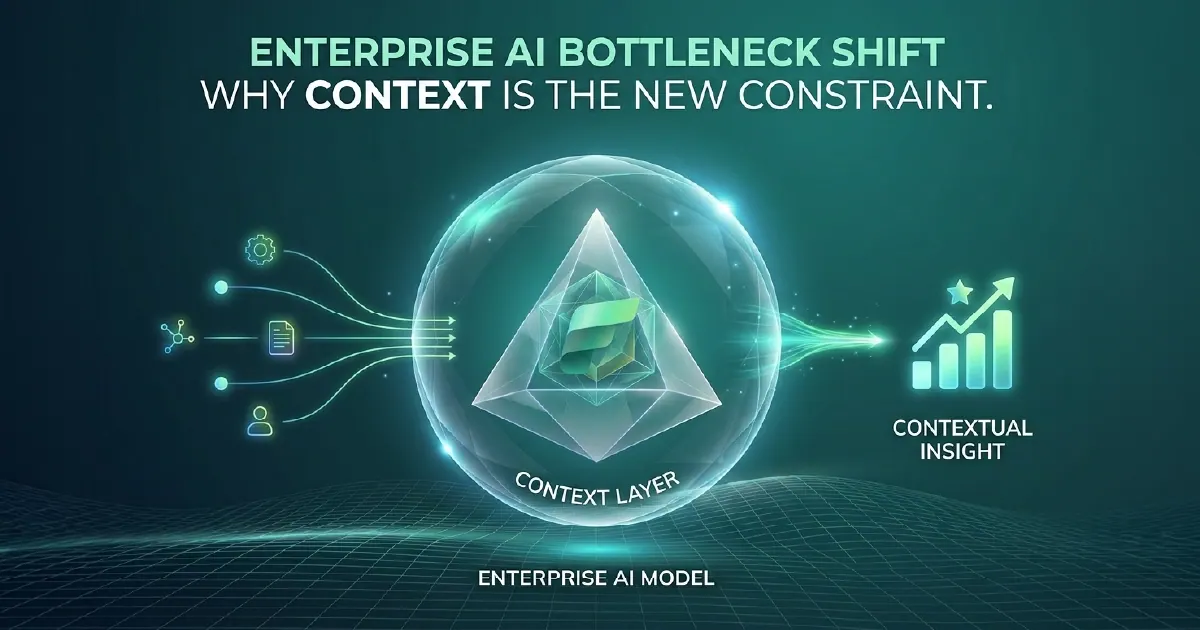
The constraint has moved. For most organisations trying to scale AI beyond a handful of proof-of-concept applications, the bottleneck is now context - specifically, the ability to give AI agents accurate, governed, sufficiently rich context about the organisation's situation at the moment of inference.
This shift changes what organisations should invest in, what problems are worth solving, and what good enterprise AI architecture looks like in 2026.
A Brief History of AI Bottlenecks
Enterprise AI adoption has been bottlenecked at different layers at different points:
2019-2021: Model capability. Pre-transformer or early transformer models were not capable enough for complex language tasks. Enterprise NLP required significant custom development and produced brittle, narrow results.
2022-2023: Model access and cost. Capable models existed but access was limited, costs were high, and enterprise deployment required navigating complex procurement and security approval. GPT-4 was an API most enterprise organisations could not get production access to quickly.
2024-2025: Tooling and integration. Models were capable and accessible, but the tooling for reliable, production-grade agent applications - orchestration, memory management, tool integration, evaluation frameworks - was immature. Most organisations built fragile prototypes that collapsed under production loads.
2026: Context. Tooling has caught up. Models are capable and accessible. Production-grade agent infrastructure exists in Azure AI Foundry. The remaining constraint is organisational: do you have the context - governed, accurate, sufficient - to give AI agents what they need to produce correct, useful outputs?
What Context Means in Practice
Context for an AI agent is not a single thing. It has three dimensions:
Breadth
Does the agent have access to all the data sources it needs to answer the question or complete the task? An agent assessing customer churn risk needs transaction history, support ticket data, product usage telemetry, and contract data. If any of those sources are absent or inaccessible, the agent's assessment is incomplete - and incompleteness in agent outputs is rarely visible as "incomplete" to the end user. It looks like a confident wrong answer.
The OneLake model in Microsoft Fabric is designed to address breadth. A single unified data lake that all Fabric workloads read from eliminates the data silos that limit what agents can access.
Accuracy
Is the data the agent accesses correct, consistent, and up-to-date? Stale data, inconsistent metric definitions across systems, and unresolved data quality issues produce agent outputs that are wrong in ways that are often hard to detect without domain expertise. An agent confidently applying incorrect data produces confident, incorrect outputs.
Medallion architecture and semantic model governance address accuracy: Bronze captures raw source data, Silver standardises and resolves conflicts, Gold presents clean, business-logic-enriched data. Agents operating over well-maintained Gold layers produce accurate outputs. Agents operating over Bronze or Silver data produce inconsistent ones.
Relevance
Does the agent receive the right context for the specific question - not just everything available on the topic? Context window management - deciding what to include in each agent turn and what to retrieve from external memory - is the mechanism for relevance.
As context windows have grown (many frontier models now support 128k-1M+ tokens), the naive solution of "include everything" has become technically feasible but economically prohibitive. A 1M token context costs approximately $2.50 in input tokens at current GPT-4o pricing per agent call. Relevance-optimised retrieval - returning the specific context needed rather than everything available - remains the cost-effective approach even as window sizes increase.
Why This Changes What You Should Invest In
The implication of context being the bottleneck is that investments in AI capability - model selection, agent framework sophistication, prompt engineering - are subject to diminishing returns if the underlying data context is not addressed first.
An organisation with poor data governance and a sophisticated AI agent framework will produce poorly-governed AI outputs that reflect the poor governance of the data beneath them. An organisation with a well-governed Fabric estate - clean OneLake, accurate Gold layer, properly structured semantic models - and a competent agent implementation will produce reliably useful AI outputs.
This is why Microsoft Fabric investment is not separate from AI strategy. It is the foundation that determines how much of your AI investment translates into AI capability. The context you can give your agents is bounded by the quality of your data estate. No amount of model selection sophistication, prompt engineering, or agent orchestration complexity closes a data quality gap.
The Practical Implications for 2026
For organisations planning AI investment in 2026:
If your data estate is fragmented or poorly governed: Invest in data foundation first. A Fabric implementation with clean medallion architecture, governed semantic models, and Purview governance will deliver more AI value than any model or agent framework investment on top of a poor data foundation.
If your data estate is reasonably governed but not AI-ready: Focus on semantic model quality for Fabric IQ activation. The investment in measure naming, metadata completeness, and relationship correctness pays off in AI output quality across every AI feature you deploy.
If your data estate is well-governed: You are in a position to build production agents on Azure AI Foundry with confidence that the context layer will not be your limiting constraint. Focus on tool design, memory architecture, and orchestration patterns.
The organisations that will extract the most value from the AI models and tooling available in 2026 are those with the data foundations that make rich, accurate, governed context possible. That is what changes when the bottleneck moves from model capability to context quality.
Sources and Further Reading
- Azure AI Foundry
- Fabric data agents
- OneLake overview
- GPT-6 Astra, Sol, and Luna: For production agents in Microsoft Foundry (Microsoft Azure Blog)
Frequently asked
Model capability, model access, and AI tooling - the constraints that blocked enterprise AI adoption in 2022-2025 - have all improved significantly. Frontier models are capable and accessible. Production-grade agent infrastructure exists. The remaining constraint is whether organisations can give AI agents accurate, complete, and relevant context about their specific situation at inference time. Poor data governance, siloed data sources, and inconsistent metric definitions all limit context quality - and context quality limits AI output quality regardless of model capability.
Context breadth means having all the data sources an agent needs to answer a question or complete a task. An agent assessing customer churn needs transaction history, support tickets, usage telemetry, and contract data - if any source is missing or inaccessible, the assessment is incomplete. Microsoft Fabric's OneLake addresses breadth by providing a single unified data lake that all workloads read from, eliminating the data silos that limit what agents can access.
Data governance directly determines AI agent output quality. Stale data, inconsistent metric definitions, and unresolved data quality issues produce incorrect agent outputs - often presented with high confidence. Medallion architecture (Bronze-Silver-Gold) and semantic model governance ensure that agents operate on clean, accurate, business-logic-enriched data. Agents operating over well-maintained Gold layers produce accurate outputs; agents over ungoverned data produce confident, incorrect ones.
Yes, directly. OneLake addresses context breadth by providing a unified data lake that eliminates silos. Medallion architecture addresses context accuracy by providing clean, governed data at the Gold layer. Power BI semantic models address context relevance by defining the business logic and measures that agents query against. Rayfin and Fabric Data Agents then operate over this foundation to provide natural language intelligence and autonomous actions.
If your data estate is fragmented or poorly governed, invest in data infrastructure first. A well-governed Fabric estate with clean OneLake, accurate Gold layer, and properly structured semantic models will deliver more AI value than any model or agent sophistication on top of poor data quality. The context your agents can access is bounded by your data foundation - no model selection or prompt engineering closes a data quality gap.