In Short: What Is Frontier Tuning?
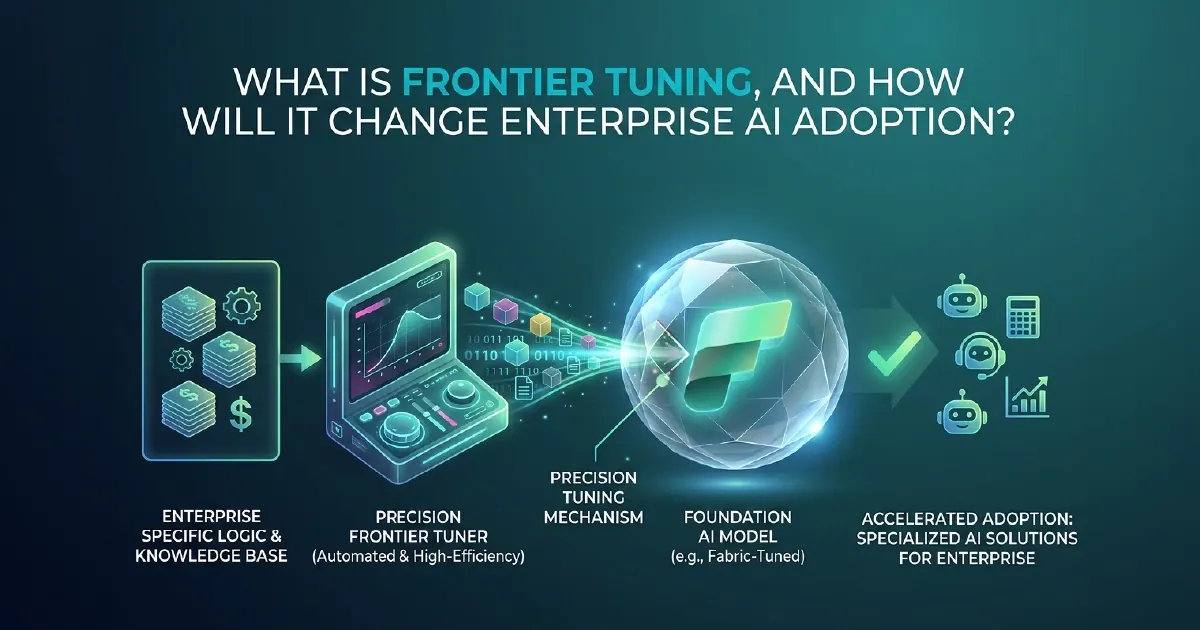
Frontier Tuning is Microsoft's approach to enterprise model customisation, announced at Build 2026. It applies reinforcement learning to Microsoft's MAI models inside your own compliance boundary, so an agent learns how your business actually works - your workflows, your standards, your way of reasoning - while the tuned model, your data and your intellectual property stay in your environment.
It is a different idea from both traditional fine-tuning and retrieval-augmented generation: rather than feeding a model labelled examples or retrieving documents at question time, Frontier Tuning teaches behaviour, using reinforcement learning against how work is really done in the organisation.
Why the Existing Options Fall Short
Traditional fine-tuning
Standard fine-tuning trains a model further on a labelled dataset for a specific task. It works for narrow, stable problems - a classifier, an extractor - but it demands expensive dataset curation, and the result generalises poorly. For the broad, judgement-heavy work enterprises want agents to do, task-level fine-tuning rarely moves the needle.
Retrieval-augmented generation (RAG)
RAG keeps knowledge outside the model and retrieves it at inference time. It is the right tool when the gap is missing facts. It does nothing about how the model reasons: a general model with perfect retrieval still applies generic reasoning to your domain, which is why RAG-equipped agents so often produce answers that are well-sourced and subtly not how your organisation would decide.
The gap between them
Most enterprise quality gaps are behavioural, not factual: the agent does not follow the firm's workflow, does not apply the house standard, does not weigh the considerations a trained employee would. That is the gap Frontier Tuning targets.
How Frontier Tuning Works
Three properties define the approach:
Reinforcement learning on your workflows. Instead of labelled input-output pairs, the model is tuned with reinforcement learning against organisational tasks and standards, learning the behaviour that earns approval in your environment - in Microsoft's words, "so agents can learn how the business actually works".
Your compliance boundary, not Microsoft's. The tuning runs within your environment. Proprietary data, workflow definitions and the resulting model customisations stay yours; nothing leaks into a shared model.
Applied to the MAI family, managed through Foundry. Frontier Tuning targets Microsoft's own MAI models - the family that includes MAI-Thinking-1 - and is delivered as a managed capability through Azure AI Foundry, so you provide the domain expertise rather than the ML engineering.
The early result Microsoft cites is striking: tuned for McKinsey's enterprise standards, the MAI model achieved the highest win rate of any model they tested, at roughly ten times lower cost.
When Frontier Tuning Is the Right Choice
It is most valuable when:
- Agent outputs consistently need reworking by your experts for reasoning and process errors, not missing facts. If people correct how the answer was reached, that is a behavioural gap.
- Your organisation has real, expressible standards - a methodology, a review bar, a house style of analysis - that an agent could be trained against.
- The workload is high-volume enough that per-token economics matter. A tuned mid-size MAI model that matches a frontier model on your tasks at a fraction of the cost changes the business case for scaling agents.
It is the wrong tool when the quality gap is retrieval (fix it with RAG and better knowledge bases), when better prompting closes it, or when the task is narrow enough for conventional fine-tuning.
The evaluation ladder we recommend has not changed: prompt a strong general model properly first; add retrieval if the gap is knowledge; reach for tuning only when the residual gap is genuinely behavioural.
The Cost and Effort Involved
The customer-side effort concentrates on expressing the standards - defining the workflows, the review criteria and the examples of good judgement the reinforcement learning trains against. That is knowledge-intensive work for your domain experts, not an ML engineering project; Foundry carries the training infrastructure.
The honest framing on cost: this is an investment for use cases where reasoning quality carries real money - compliance exposure, expert review time, decision quality at volume. For workloads where a well-prompted general model is good enough, it is over-engineering, and the ladder above will tell you which side you are on.
Our AI Solutions team helps organisations run that evaluation honestly before committing - including concluding, where it is true, that you are not ready for tuning because the data and workflow foundations are not yet expressible.
Where This Fits an Enterprise Roadmap
Frontier tuning is a capability question long before it is a budget question. An organisation that cannot yet state its workflows and standards cleanly has nothing to tune against - and usually has a data foundation gap to close first.
If you would like a straight assessment of where your estate stands, book a free 30-minute consultation. Tuning is one lever among several; our guide to choosing models in Microsoft Foundry sets out when to tune and when to route. For how Microsoft's approach compares with the other managed options, see our reinforcement fine-tuning services comparison.
Sources and Further Reading
Frequently asked
Frontier Tuning is Microsoft's approach to enterprise model customisation, announced at Build 2026. It applies reinforcement learning to Microsoft's MAI models inside your own compliance boundary, so agents learn how your business actually works - your workflows, standards and ways of reasoning - while your data and the tuned model stay in your environment.
Traditional fine-tuning trains a model on labelled examples for a narrow task and needs expensive dataset curation. Frontier Tuning uses reinforcement learning against organisational workflows and standards to teach behaviour rather than task mappings, and it is delivered as a managed capability rather than an ML engineering project.
RAG retrieves knowledge at question time but does not change how the model reasons - a general model with perfect retrieval still applies generic reasoning to your domain. Frontier Tuning changes the behaviour itself, so the model approaches problems the way your organisation does. RAG fixes missing facts; Frontier Tuning fixes missing judgement.
Microsoft's own MAI model family, including MAI-Thinking-1, with the tuning managed through Azure AI Foundry. The headline early result: tuned for McKinsey's enterprise standards, MAI achieved the highest win rate of any model they tested at roughly ten times lower cost.
No - that is the core design constraint. The tuning runs within your compliance boundary, and your proprietary data, workflow definitions and the resulting model customisations stay in your environment.
When agent outputs consistently need expert rework for reasoning and process errors rather than missing facts, when your organisation has real expressible standards to train against, and when volume makes the per-token economics of a tuned mid-size model attractive. Try strong prompting first, then RAG; reach for tuning only when the residual gap is behavioural.