In Short: What Is Microsoft IQ?
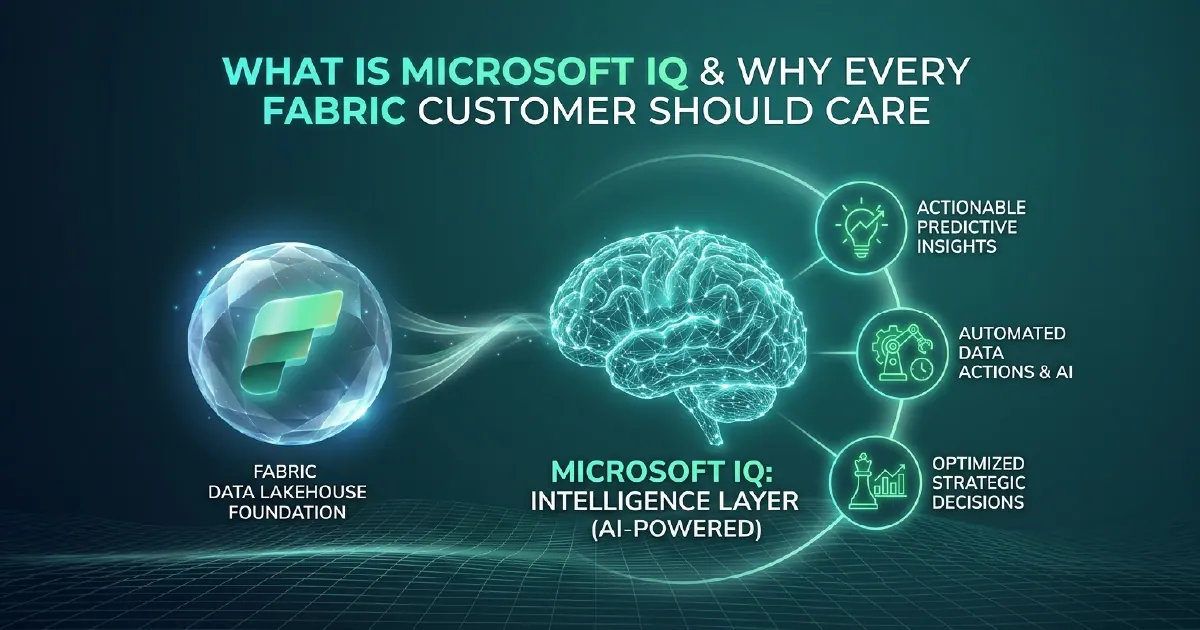
Microsoft IQ, announced at Build 2026 and generally available since June 2026, is Microsoft's context layer for AI agents: the service that grounds agents in both world knowledge and your organisation's own knowledge, with permissions intact. It is not a chatbot and not an analytics product - it is the layer that answers the question every enterprise agent project eventually hits: "how does this agent know what our business knows?"
For Microsoft Fabric customers it matters because one of its four pillars, Fabric IQ, is the semantic foundation over your structured business data - which makes the quality of your semantic models and ontologies the ceiling on what every agent in the company can understand.
The Problem Microsoft IQ Addresses
Enterprise agents fail for a consistent reason: they act without context. A model can reason impressively and still not know which of your three revenue definitions is authoritative, who reports to whom, which document is current, or what your returns policy actually says. Teams have been solving this per agent - one retrieval pipeline here, one data connection there - and every agent's grounding fragments a little differently.
Microsoft IQ is Microsoft's answer: a shared context layer that any agent - Microsoft-built, partner-built, or your own - can draw on through standard interfaces, with the organisation's permissions enforced underneath.
The Four Layers
Work IQ
The workplace intelligence layer: a semantic understanding of how work actually happens across Microsoft 365 - people, emails, documents, meetings, chats, and how they connect - inside the Microsoft 365 trust boundary. The Work IQ APIs (A2A, MCP and REST) became generally available on 16 June 2026, which is what lets non-Microsoft agents use the same workplace context Copilot uses.
Fabric IQ
The semantic foundation over structured business data, and the pillar that concerns data teams most. Fabric IQ unifies three things: the data itself in OneLake, business meaning from Power BI semantic models, and operational intelligence expressed as ontologies. Generally available, with ontology capabilities continuing to roll out. Our Fabric IQ guide covers what it demands of your semantic models.
Foundry IQ
The retrieval layer that ties it together: knowledge bases that plan retrieval across enterprise knowledge and the live web behind a single endpoint, consumed by agents built in Azure AI Foundry. Generally available, with a serverless tier in preview.
Web IQ
An AI-first web search stack - model-agnostic and MCP-native - that gives agents fast, live grounding in the outside world to sit alongside the enterprise context.
What It Means for Fabric Customers
The practical consequence is blunt: your semantic models just became infrastructure for every agent in the organisation.
Before Microsoft IQ, a badly named measure or an ambiguous relationship inconvenienced report builders. Now the same defect propagates into every agent that grounds itself through Fabric IQ - a fluent, confident agent answering from a muddled semantic layer produces fluent, confident, wrong answers at scale.
The readiness work is unglamorous and familiar:
- Semantic models named in business language, with descriptions and correct relationships - the discipline our semantic modelling guide describes.
- A governed Gold layer so the data under the semantics is actually right - see data quality as a system.
- Security that holds under agent access - row-level security and Purview policies apply to agent queries exactly as they do to people, which is only reassuring if they were configured correctly.
How This Fits the Wider Stack
A clean way to hold the pieces: Fabric is where governed data lives. Microsoft IQ is how agents understand it - Work IQ for the workplace, Fabric IQ for business data, Foundry IQ for retrieval, Web IQ for the live web. Foundry is where production agents run, and Copilot is where people meet them.
Every layer assumes the one beneath it. Organisations that skipped the data foundation will find that Microsoft IQ, like every intelligence layer before it, amplifies what is actually there. Our AI-readiness checklist is a practical way to test where you stand.
Getting Ready Without Waiting
None of the preparation is speculative. Cleaning semantic models, agreeing definitions, tightening RLS and building the Gold layer pay off in ordinary reporting today and become agent infrastructure tomorrow.
That is the work we do - see our Fabric practice and AI readiness work. If you would like a straight assessment of where your estate stands, book a free 30-minute consultation.
Sources and Further Reading
Frequently asked
Microsoft IQ is the context layer Microsoft announced at Build 2026 that grounds AI agents in both world knowledge and your organisation's own knowledge, with permissions enforced. It brings together four pillars: Work IQ (workplace intelligence across Microsoft 365), Fabric IQ (a semantic foundation over structured business data), Foundry IQ (retrieval across enterprise knowledge and the live web) and Web IQ (AI-first web grounding).
Yes. Microsoft IQ became generally available in June 2026, with the Work IQ APIs reaching GA on 16 June 2026, Fabric IQ and Foundry IQ generally available, and some capabilities such as the Foundry IQ serverless tier still in preview.
Fabric IQ is one of Microsoft IQ's four pillars - the semantic foundation over structured business data, unifying OneLake data, Power BI semantic models and ontologies. Microsoft IQ is the umbrella context layer that also covers workplace intelligence (Work IQ), retrieval (Foundry IQ) and live web grounding (Web IQ).
Fabric is where governed data lives; Microsoft IQ is how agents understand it. The Fabric IQ pillar grounds agents in your semantic models and ontologies, which makes semantic model quality - naming, relationships, definitions - the ceiling on what every agent in the organisation can answer correctly.
Yes - grounding is permissioned. Agents drawing on Work IQ operate inside the Microsoft 365 trust boundary, and Fabric IQ queries respect row-level security and Purview policies exactly as human access does. That is only reassuring if those controls were configured correctly, which is worth verifying before wide agent rollout.
The unglamorous foundations: semantic models named in business language with correct relationships, a governed Gold layer so the data under the semantics is right, and row-level security that holds under agent access. All of it pays off in ordinary reporting today and becomes agent infrastructure as IQ adoption grows.