In Short: The Business Case Is About Cost Reduction and Decision Speed
A business case for Microsoft Fabric is not a technology pitch - it is a financial and operational argument. Decision-makers want to know what it costs, what it replaces, and what it enables that is currently impossible or impractical.
The organisations that win board approval make three things clear: the current state is costing them money or slowing decisions, Fabric eliminates specific costs or unlocks specific capabilities, and the implementation path is realistic. This guide gives you the framework to make that case.
Why Data Platform Investments Stall
Most Fabric business cases fail not because the technology is unconvincing, but because the case is pitched at the wrong level.
Presenting Fabric as a platform consolidation story lands with architects. Presenting it as a cost reduction and decision acceleration story lands with CFOs and CEOs.
The strongest business cases connect Fabric capabilities to problems the leadership team already recognises and is already paying to work around. That means starting with the current-state cost, not the future-state features.
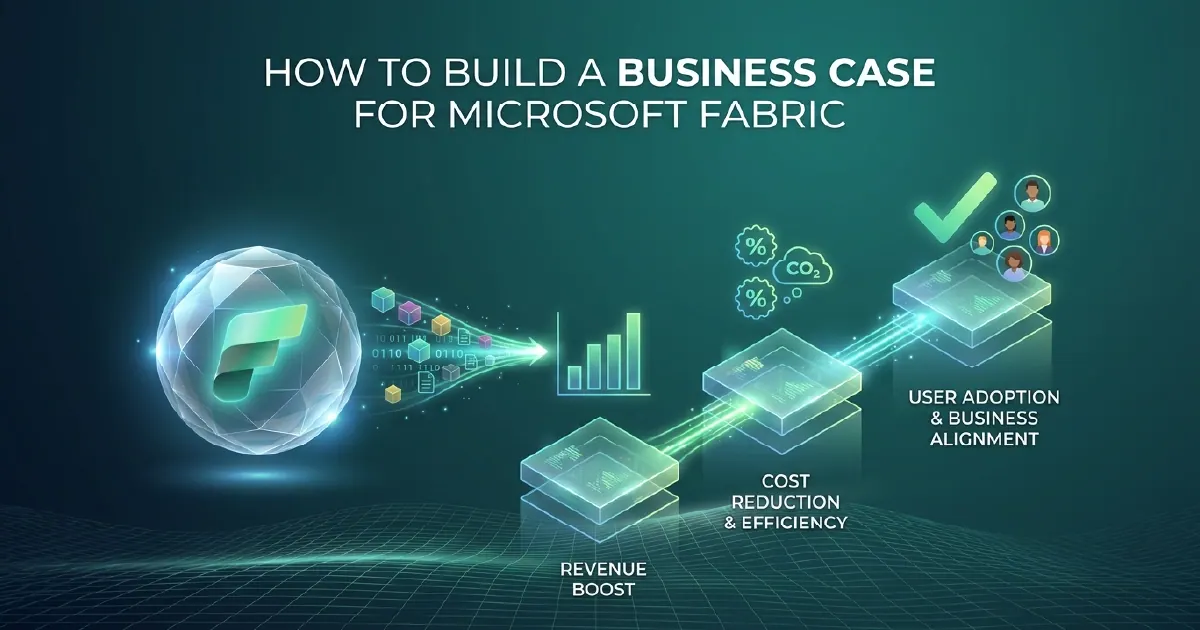
Four ROI Levers to Quantify
1. Licence Consolidation
List every data platform tool your organisation currently pays for: Azure Synapse, Azure Data Factory, Azure Data Lake Storage, Power BI Premium, third-party ETL tools, separate BI platforms. Fabric's capacity licence (F-SKU) replaces most of them under a single billing unit.
Calculate the current combined annual spend and compare it to the equivalent Fabric capacity cost. For most mid-market organisations, the consolidation saving alone justifies the migration cost within twelve to eighteen months.
2. Engineering Time Spent on Plumbing
How many engineering hours per week go into maintaining data pipelines, managing credentials, debugging ETL failures, and reconciling data between separate platforms? Fabric's unified architecture - one copy of data in OneLake, one set of pipelines, one lineage graph - reduces that maintenance burden significantly.
Estimate conservatively: even four hours per engineer per week, at a blended rate of $600 per day, is over $30,000 per year for a two-person team. For larger teams the number scales quickly.
3. Decision Latency
How long does it take from a business question arising to an answer being trusted and acted on? In environments with disconnected data sources, the answer is often days or weeks - while someone reconciles exports, runs queries across systems, and produces a one-off report.
Fabric shortens that cycle by putting governed, current data in one place. Use examples from your own organisation: a pricing decision delayed by two weeks, an operational issue that was not caught until month-end reporting. These are the stories that land with leadership.
4. AI Readiness
Fabric is the data foundation for Microsoft's AI stack - Rayfin, Copilot Studio, Azure AI Foundry, and Fabric Data Agents all run on OneLake. Organisations without a Fabric estate cannot use these capabilities at scale against their own data.
The business case for Fabric increasingly includes the value of AI capabilities it unlocks. Frame this as optionality: Fabric does not require an AI roadmap, but it makes one possible. Organisations that skip the foundation work will pay a higher cost to catch up later.
Calculating the Implementation Cost
A Fabric implementation has three cost components:
- Capacity licence - Fabric runs on F-SKU capacity, billed per compute unit. A typical mid-market implementation starts at F8 or F16.
- Implementation services - architecture design, data migration, pipeline build, report migration, training. This varies significantly with scope and existing estate complexity.
- Ongoing management - capacity monitoring, governance maintenance, and platform evolution.
The right way to frame the investment is total cost of ownership over three years: current-state costs (licences plus engineering time plus technical debt servicing) versus future-state costs (Fabric capacity plus implementation amortised plus reduced engineering overhead). Most organisations find the three-year TCO case is compelling even when the year-one case is tighter.
Framing for Different Stakeholders
Different decision-makers need different framings of the same case.
CFO: Total cost of ownership comparison, licence consolidation saving, engineering time recovered. Lead with numbers and payback period.
CIO or CTO: Platform consolidation, reduced vendor surface, governance improvement, AI readiness. Lead with strategic risk reduction and technical debt elimination.
CEO or MD: Decision speed, data they currently cannot access, the competitive cost of staying on fragmented infrastructure. Lead with business outcomes, not platform features.
Avoid the temptation to lead with technology features in a board setting. "OneLake gives you a single copy of your data" lands with architects. "Your finance team will stop arguing about whose number is right" lands with CEOs.
Common Objections and How to Answer Them
"We already have Azure Synapse - why change?" Microsoft's investment in new capabilities is concentrated on Fabric, not Synapse. Staying on Synapse means missing Direct Lake, Rayfin, Fabric Data Agents, and the expanding AI integrations. The migration is not urgent, but the longer you wait, the larger the capability gap becomes.
"We do not have the internal skills." Most organisations implementing Fabric do so with external implementation support for the initial build, then transition to internal teams for ongoing management. A well-designed Fabric estate is significantly easier for internal teams to operate than a fragmented multi-tool environment.
"What if Microsoft changes the product again?" Fabric is Microsoft's consolidated data platform - not an experiment. With over $2 billion in annual recurring revenue and deep integration across Microsoft 365, Azure, and Dynamics, it is the most strategically committed Microsoft data investment in a decade. The adoption numbers back that up.
What a Strong Business Case Looks Like
A one-page executive summary covering: current-state cost, identified saving, implementation investment, payback period, and three business outcomes that become possible. Supported by a three-year TCO model and a phased implementation plan that de-risks the investment.
The business case that gets approved is not the most comprehensive one - it is the one that makes the decision feel safe for the person signing it.
Building the Case for Your Own Board
A business case stands or falls on numbers specific to your estate: current licence spend, engineering hours lost to pipeline maintenance, and the decisions delayed by slow reporting.
If that is where you are, Microsoft Fabric consulting is the work we do, and the full Fabric pricing guide covers the background.
Sources and Further Reading
Frequently asked
ROI varies by organisation, but the three primary levers are licence consolidation (often 20-40% reduction in data platform spend), reduced engineering time spent on maintenance, and faster decision-making from unified data. Most mid-market organisations see payback within twelve to twenty-four months.
A foundational Fabric implementation - OneLake setup, core pipelines, initial Power BI migration - typically takes three to six months. Full migration from a complex existing estate can take twelve to eighteen months. A phased approach is recommended, starting with the highest-value use cases.
Fabric consolidates Azure Data Lake Storage, Azure Synapse Analytics, Azure Data Factory, Power BI Premium, and several other Azure data services under a single unified platform and capacity billing model. This consolidation is a primary driver of the cost saving in most business cases.
Lead with a three-year total cost of ownership comparison: current-state platform licences plus engineering maintenance time versus Fabric capacity plus implementation cost. Licence consolidation savings and engineering time recovery typically produce a compelling payback period of twelve to twenty-four months.
Fabric capacity pricing starts at F2 for small workloads and scales through F4, F8, F16, F32, F64, and beyond. Most mid-market analytics workloads start at F8 or F16. Exact pricing is available on the Microsoft Azure pricing page and varies by region.
Yes. Fabric's SaaS model removes much of the infrastructure management burden that made enterprise data platforms difficult for mid-market teams. F-SKU capacity starts at a level accessible to smaller organisations, and the consolidation of multiple tools into one platform reduces overall complexity.