In Short: FabCon Europe 2026 Put Fabric Into Copilot
FabCon Europe 2026 is running in Barcelona this week, alongside SQLCon, with Microsoft saying nearly 5,000 data professionals are attending more than 130 sessions. Microsoft announced at FabCon Europe 2026 (29 September 2026) a long list of Fabric updates, and the theme is clear: the data foundation you build in Fabric now reaches Microsoft Copilot and agents directly.
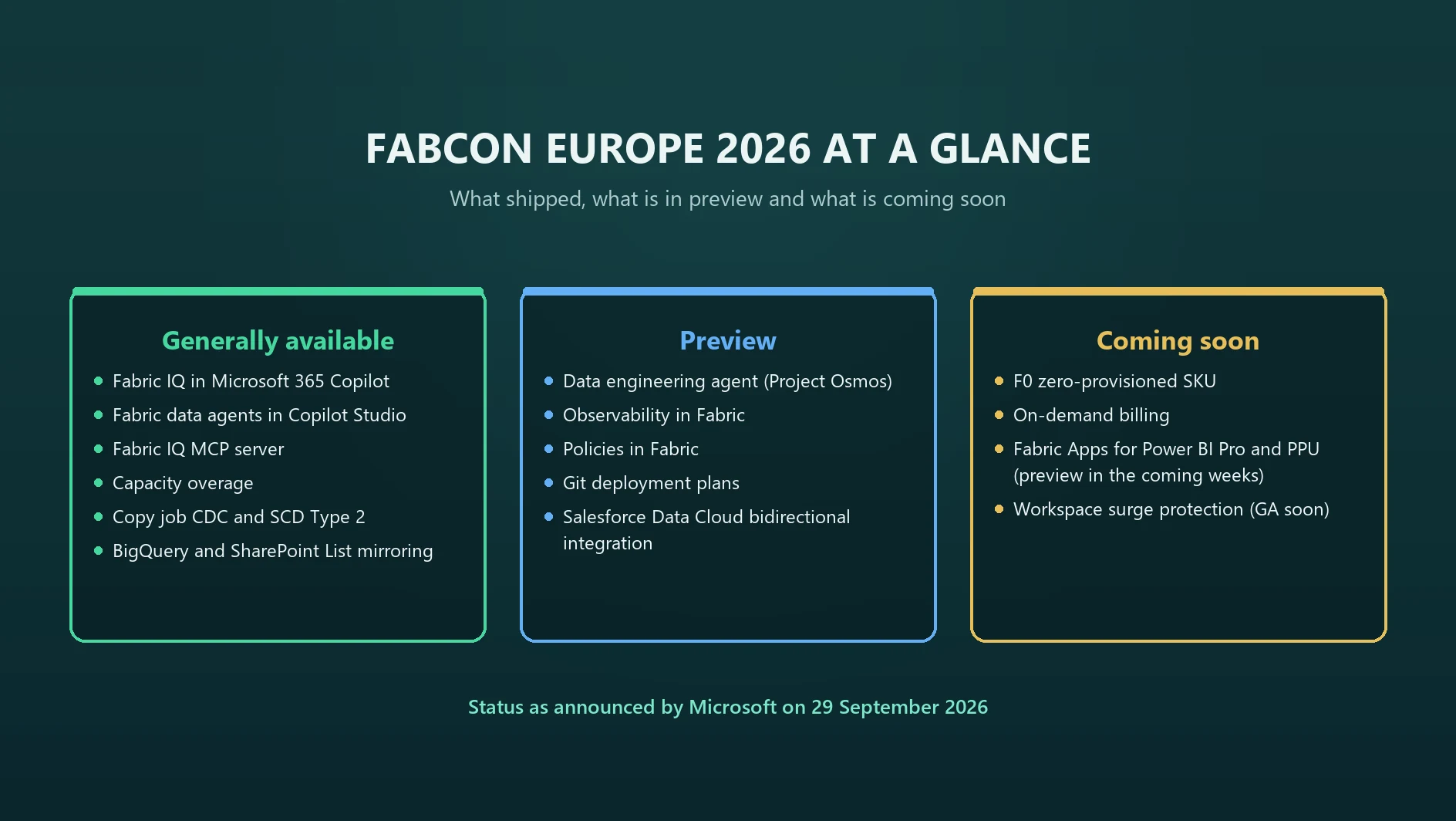
The headline is that Fabric IQ in Microsoft Copilot Chat and Cowork is generally available. Alongside it: apps in Power BI coming to Power BI Pro and Premium Per User in preview, a zero-provisioned F0 SKU and on-demand billing coming soon, and a data engineering agent in preview. This post is the hub for the event - what was announced, the status of each item, and what to do about it. If you followed the spring event, our FabCon 2026 Atlanta recap covers what came before.
Copilot, Fabric IQ and Agents
Fabric IQ in Microsoft Copilot (generally available). Users can ask business questions in Copilot Chat and get answers grounded in governed Power BI reports and semantic models, with Copilot inferring which model fits the question; in Cowork, Power BI content takes part in long-running tasks. Microsoft says this comes "without additional AI token costs". Integration into the new Code experience is coming soon through the Frontier program. We explained the concept in what Fabric IQ means for Power BI users.
- Fabric IQ MCP server - generally available, so creators can use the same conversational analytics from development tools and external MCP clients
- Fabric data agents in Copilot Studio - generally available, with visualisations in data agents also generally available and topics in data agents in preview
- Expansion of Fabric IQ to include answers from data agents and ontologies - preview
- Ontologies - a new agentic experience to create ontologies from semantic models, OneLake data and documents, plus the ability to bring Power BI DAX measures into an ontology
If you have been waiting to put an agent in front of users, building a Fabric data agent now has a generally available route into Copilot Studio.
Power BI and Fabric Apps
Microsoft announced agentic app creation in Power BI Desktop: start from a semantic model, describe the application in natural language, then preview, edit and publish it to Fabric. These apps can accept inputs, write back data and keep shared state, using Fabric Apps to give each one a SQL database, authentication and security.
The licensing point matters most. Microsoft says apps in Power BI will be available in preview in the coming weeks to Power BI Pro and Premium Per User customers, as well as Fabric capacity customers, at no additional cost - including Fabric Database capabilities up to 1 GB per app. The Power BI post says the Desktop experience arrives "in the coming months". Our dedicated post on Fabric Apps for Power BI Pro covers what that does and does not include.
Microsoft also shared an early look at semantic views - governed metrics defined where data lives in OneLake - and affirmed its commitment to Apache Ossie (incubating), an open standard for exchanging semantic metadata.
Capacity and Billing
F0 and on-demand billing (coming soon). On-demand billing extends consumption-based billing across Fabric workloads, building on Autoscale Billing for Spark (now renamed On-demand billing for Apache Spark, generally available and unchanged). F0 is a zero-provisioned SKU with no upfront compute charge and on-demand billing on by default; on F2 or higher you can move individual billing categories onto on-demand. Microsoft says these will be available "in the coming weeks" and lists them as coming soon. Usage is measured in CU-hours without smoothing, with spend limits over a rolling 24-hour window. Pricing has not been published - the on-demand multiplier and F0 costs are not yet known. Our F0 and on-demand billing explainer goes deeper.
- Capacity overage - generally available: extra paid compute with spending thresholds and notifications
- Workspace-level surge protection - generally available soon, isolating runaway workspaces with mission-critical workspaces exempt
- F4096 and F8192 SKUs - generally available
- Capacity metrics app enhancements - generally available, with Capacity Insights and Actions in Monitor Hub in preview
None of this changes today's F SKU list prices; our Fabric pricing guide remains current.
Data Engineering, Integration and Operations
ADF and Synapse upgrade path. Microsoft has streamlined the route from Azure Data Factory and Synapse to Fabric Data Factory in three steps: a View in Fabric experience brings existing environments into a Fabric workspace while ADF remains the source of truth; a built-in assessment shows which pipelines are ready, need review or depend on planned capabilities; and supported pipelines can then be upgraded incrementally. The feature summary does not attach a status label, so check the upgrade documentation for what is supported. Our Synapse to Fabric migration runbook covers the wider move.
Data engineering agent (preview). Built on technology from the Osmos acquisition and referred to as Project Osmos, it takes on long-running work such as migrations, schema harmonisation and ETL: engineers set the outcome and guardrails, and it plans, executes and validates on Fabric Spark. It can be steered from GitHub Copilot, VS Code, Codex and Claude Code.
- Observability - preview: unified workspace monitoring into a shared Eventhouse, a refreshed Monitor Hub, Activator job alerts and operations agent investigations (pipeline failures at first)
- Copy job - change data capture, SCD Type 2 and audit columns all generally available
- Mirroring - Google BigQuery and SharePoint List mirroring generally available, extended mirroring capabilities generally available, Salesforce Data Cloud 360 bidirectional integration in preview, and IQ sharing in preview
- Git and CI/CD - deployment plans and file-level commits in preview; compare and commit, selective branching and bulk import/export APIs generally available, which strengthens the patterns in our Fabric CI/CD and Git guide
- Warehouse - GPU-accelerated query execution in public preview, custom SQL pools generally available, Teradata support in Migration Assistant in preview, and a new node-based billing model whose pricing has not been published
Governance for AI
As Fabric content flows into Copilot, the governance announcements carry as much weight as the features. Sensitivity labels, DLP policies and information protection controls now flow into Microsoft Copilot experiences, and Restrict from Copilot lets administrators decide which semantic models take part in AI experiences.
- DLP restrict access - generally available: Purview DLP policies can restrict access to Fabric items when sensitive data is detected
- Policies in Fabric - preview: attribute-based controls, with item creation and workspace security at launch and external data sharing coming soon
- OneLake catalog Govern experience - generally available
- Outbound access protection for OneLake shortcuts - generally available
What FabCon Europe 2026 Means for Your Organisation
Three practical next steps:
- Prepare your semantic models for Copilot. Fabric IQ is generally available, so your Power BI models are now an AI surface for Microsoft 365 users. Clear names, descriptions, certified measures and sensible security decide the quality of the answers. Start with our guide to preparing a semantic model for AI, and decide which models to hold back with Restrict from Copilot.
- Review your capacity strategy once pricing is published. F0 and on-demand billing could suit spiky, experimental or early-stage workloads, but without the multipliers nobody can model the cost. Gather capacity metrics now so you can compare quickly when the numbers arrive, and do not cancel reservations on the strength of an announcement.
- Assess your ADF and Synapse estate. The View in Fabric and assessment steps let you see readiness without touching production, so it is a low-risk way to build a migration plan.
Where Solv Systems Comes In
We help organisations turn announcements like these into decisions: which semantic models are ready for Copilot, whether F0 or on-demand billing changes your capacity plan, and which ADF or Synapse pipelines to upgrade first. If you want a clear view of what to act on now and what to wait for, our Microsoft Fabric consulting team can review your estate against the FabCon Europe 2026 announcements.
Sources and Further Reading
- FabCon and SQLCon 2026 in Barcelona: Building the data foundation for Microsoft Copilot and agents - Arun Ulag
- Build, deploy, and govern Microsoft Fabric at scale - Kim Manis
- Bringing governed analytics into the flow of work - Bogdan Crivat
- Power BI's next chapter: The evolution of business intelligence - Mohammad Ali
- Fabric September 2026 Feature Summary
- Upgrade your Azure Data Factory pipelines to Fabric Data Factory
Frequently asked
Microsoft announced on 29 September 2026 that Fabric IQ is generally available in Microsoft Copilot Chat and Cowork, that apps in Power BI (built on Fabric Apps) will reach Power BI Pro and Premium Per User customers in preview, and that on-demand billing and the zero-provisioned F0 SKU are coming. It also announced a data engineering agent (preview), observability (preview), capacity overage (generally available) and a streamlined Azure Data Factory and Synapse upgrade path.
Yes. Microsoft says Fabric IQ in Copilot Chat and Cowork is generally available, answering business questions grounded in governed Power BI semantic models and reports without additional AI token costs. Integration into the new Code experience is coming soon through the Frontier program.
They will be able to. Microsoft says apps in Power BI will be available in preview in the coming weeks to Power BI Pro and Premium Per User customers as well as Fabric capacity customers, at no additional cost, including Fabric Database capabilities of up to 1 GB per app. The Power BI Desktop app-building experience is due in the coming months.
Pricing has not been published. Microsoft says on-demand usage is measured in CU-hours without smoothing and priced as a multiplier of the pay-as-you-go capacity price that can vary by billing category, but the multipliers and any F0 pricing were not published at announcement. Both capabilities are coming soon rather than available today.
Microsoft has streamlined the upgrade path: a View in Fabric experience brings existing ADF and Synapse environments into a Fabric workspace while ADF remains the source of truth, a built-in assessment shows which pipelines are ready, and supported pipelines can then be upgraded incrementally. Existing ADF workloads keep running while you evaluate.
Three things: prepare your Power BI semantic models for Copilot, because Fabric IQ now surfaces them to Microsoft 365 users; review your capacity strategy once F0 and on-demand pricing is published; and run the new assessment over any Azure Data Factory or Synapse estate to see what is ready to move.