In Short: What Fabric F0 and On-Demand Billing Change
Microsoft announced at FabCon Europe 2026 (29 September 2026) that Microsoft Fabric is getting on-demand billing across its workloads and a new zero-provisioned SKU, F0. Together they end the rule that every Fabric workload must run inside a capacity you have paid for in advance: F0 has no upfront compute-capacity charge, and on an F2 or larger capacity you can move individual billing categories outside the shared capacity and pay for what they consume.
The important caveat is timing. Both are listed as coming soon, in preview "in the coming weeks", and Microsoft's feature summary says plainly: "Availability and timelines are subject to change." Prices have not been published. This post sets out what was announced, the status of each piece, and what it means for whether you reserve an F SKU now or wait. For the wider conference picture, see our FabCon Europe 2026 recap.
What Was Announced, and the Status of Each Piece
Microsoft's own status words matter here, because several of these items are easy to mistake for things you can switch on today:
- On-demand billing across Fabric - coming soon, in preview in the coming weeks
- Fabric zero-provisioned (F0) - coming soon, in preview in the coming weeks, with on-demand billing on by default
- On-demand billing for Data Warehouse - coming soon
- On-demand billing for Apache Spark - generally available; this is Autoscale Billing for Spark under a new name, and Microsoft says it "functions as before" with pricing unchanged
- Capacity overage - generally available now
- Workspace-level surge protection - generally available soon
- F4096 and F8192 capacity SKUs - generally available, extending the range beyond F2048
Nothing in the announcements changes existing pay-as-you-go or reserved F SKU prices. The current list prices in our Microsoft Fabric pricing guide still apply.
How On-Demand Billing Works
On-demand billing is applied at the billing category level, and it behaves the same across every workspace on the capacity. A capacity administrator enables it per category from the On-demand billing section of the capacity's Details tab. That category then sits outside the shared capacity's CU limit and is billed on actual usage, while everything else keeps running on the provisioned capacity.
Three details change how you should think about it:
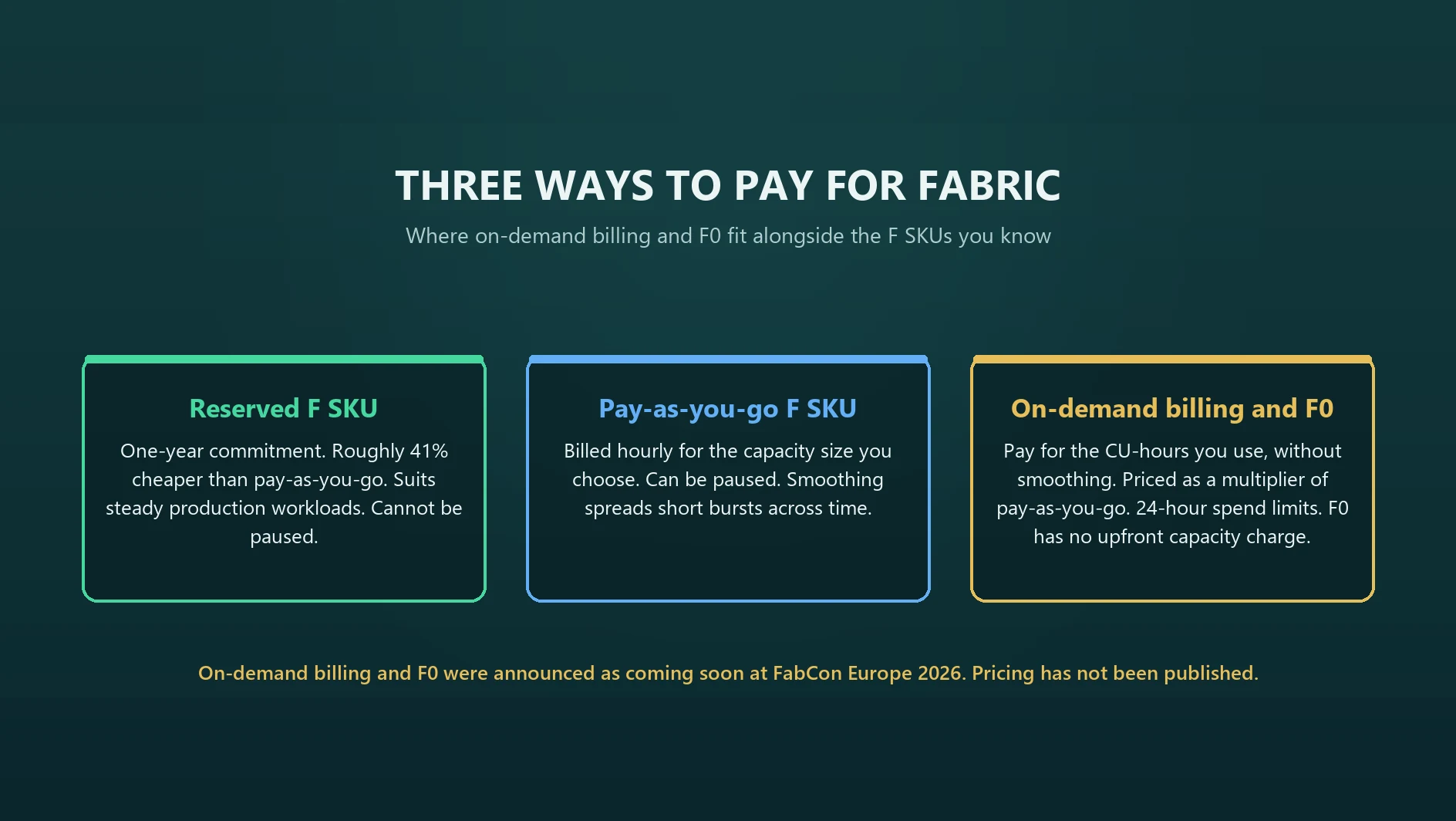
- No smoothing. On-demand consumption is measured in CU-hours without smoothing. On a provisioned capacity, smoothing spreads a burst across a window so the capacity can absorb it - explained in our guide to how Fabric measures usage. On-demand work is simply metered as it happens.
- Priced off pay-as-you-go. The price is a multiplier of the pay-as-you-go capacity price, and the multiplier can vary by billing category. Microsoft has not published the multiplier. Storage stays a separate charge.
- Spend limits. Administrators set a limit in CU-hours over a rolling 24-hour window. When it is reached, new operations are paused, in-flight operations continue to completion, and billing resumes automatically once the window resets.
Consumption is visible per billing category in a new On-demand compute tab in the Capacity Metrics app - the same app that anchors any sensible capacity administration routine.
Microsoft's example is a capacity running Data Warehouse and Data Factory workloads that moves the Data Warehouse category to on-demand billing during a seasonal promotion, then returns it to the shared capacity when demand settles. The announcements do not list every billing category that will be supported at launch, so check the documentation when the preview opens.
F0: Fabric Without a Provisioned Capacity
Microsoft describes Fabric zero-provisioned as "a new entry point to Fabric and OneLake that removes the need to provision compute before getting started." There is no upfront compute-capacity charge; supported categories use on-demand billing by default. Microsoft positions it for evaluation, development, early production and workloads whose capacity needs are not yet predictable.
That fills a real gap. Until now the choices for a new team were a time-limited trial or a paid F2 at the bottom of the price list - see what is and is not free in Fabric. F0 adds a third route: pay only for consumption from day one.
What the announcements do not say is as important. They give no F0 price, and they say nothing about Power BI licensing on F0. Free viewers on F64 and above are covered in our F64 guide; until Microsoft documents otherwise, assume F0 does not change the need for Power BI Pro below that threshold.
Warehouse, Spark and the Other Capacity Controls
Data Warehouse gets its own on-demand model, listed as coming soon. Warehouse, SQL analytics endpoints, warehouse snapshots and notebooks running T-SQL will scale compute with demand, each workspace bursting up to a configured compute ceiling. Microsoft says customers pay for actual CU consumption, "never for the ceiling", and that new and migrated workspaces start with a ceiling tuned to the existing SKU. Separately, Microsoft mentions a new node-based billing model for Data Warehouse; its pricing has not been published.
Spark already has this model: On-demand billing for Apache Spark (formerly Autoscale Billing for Spark) is generally available and unchanged.
Around the billing changes, three capacity controls matter. Capacity overage is generally available, letting you use additional paid compute with configured spending thresholds and notifications instead of sizing for rare peaks. Workspace-level surge protection will be generally available soon, letting you set a workspace consumption limit that isolates runaway or non-critical work, with mission-critical workspaces marked exempt. And F4096 and F8192 give sustained high-demand estates more headroom.
Should You Wait for F0 or Buy a Reserved F SKU Now?
The answer depends on how steady your workload is and how much a preview timeline can cost you.
Wait for F0 if you are evaluating Fabric beyond a trial, standing up a first development environment, or running small workloads with unpredictable demand and no fixed production date. Paying a reservation for a capacity that sits mostly idle is exactly what F0 is designed to avoid.
Buy or keep a reserved F SKU if you run steady production, need F64 or above for free Power BI viewers, are migrating from a P SKU with a renewal date, or have a deadline that cannot move with a preview. A reservation is roughly 41% cheaper than pay-as-you-go for the same SKU, and on-demand is priced off the pay-as-you-go rate, so a workload that runs all day is likely to stay cheapest on a reservation. Until the multiplier is published that is a judgement, not a calculation.
Plan for both. Microsoft's stated direction is to combine consumption-based pricing with reserved or provisioned capacity. For most estates the end state is a reserved baseline sized for steady demand, with bursty categories moved to on-demand billing behind a spend limit. Model the baseline today in the Fabric pricing calculator; leave the on-demand line blank until Microsoft publishes a rate.
How This Changes Capacity Sizing
The classic sizing dilemma was to size for the peak and pay for idle headroom, or size for the average and accept throttling. Capacity overage (now) and on-demand billing (coming soon) give a third option: size the reserved capacity for sustained demand and let genuine peaks spill into paid compute you have capped.
That also retires a line we have used on this blog: that overusing a Fabric capacity costs performance, not money. With overage or on-demand billing enabled, it can cost money - bounded by the thresholds and spend limits you set. Those limits become as much a design decision as the SKU.
The method in our capacity sizing guide still holds: run representative workloads, read the Capacity Metrics app, fix inefficiency before buying more. What changes is the question you answer at the end - not only which SKU, but which categories stay on it.
Where Solv Systems Comes In
The next few weeks are a good moment to review commitments rather than extend them automatically. Our Microsoft Fabric consultants read your capacity metrics, separate steady demand from bursts, and recommend a reserved baseline plus the categories worth moving to on-demand billing once it reaches preview - with spend limits set before anything runs.
Sources and Further Reading
- FabCon and SQLCon 2026 in Barcelona: Building the data foundation for Microsoft Copilot and agents
- Build, deploy, and govern Microsoft Fabric at scale
- Fabric September 2026 Feature Summary
- Bringing governed analytics into the flow of work: Fabric Analytics at FabCon Europe 2026
Frequently asked
F0, which Microsoft calls Fabric zero-provisioned, is a new capacity SKU with no upfront compute-capacity charge. Supported billing categories use on-demand billing by default, so you pay for the compute you consume rather than for a provisioned capacity. Microsoft announced it at FabCon Europe 2026 on 29 September 2026 as coming in the coming weeks, in preview.
Microsoft has not published prices. On-demand consumption is measured in CU-hours without smoothing and priced as a multiplier of the pay-as-you-go capacity price, and the multiplier can vary by billing category - but the multiplier itself has not been published. Storage is charged separately from compute.
Not yet. Microsoft lists on-demand billing and F0 as coming soon, in preview in the coming weeks, and notes that availability and timelines are subject to change. On-demand billing for Data Warehouse is also listed as coming soon. The one part already generally available is On-demand billing for Apache Spark, the renamed Autoscale Billing for Spark, with pricing unchanged.
Administrators can set a spend limit in CU-hours over a rolling 24-hour window for each on-demand billing category. When the limit is reached, new operations are paused, in-flight operations run to completion, and billing resumes automatically once the window resets. Usage per category appears in a new On-demand compute tab in the Capacity Metrics app.
Wait if you are evaluating Fabric, building a first development environment or running small, unpredictable workloads with no production deadline. Buy or keep a reserved F SKU for steady production, for F64 free-viewer licensing, or where a deadline cannot absorb a preview feature whose timing may change. Many estates will end up combining both.
The announcements do not mention any change to existing pay-as-you-go or reserved F SKU prices, and Microsoft states that On-demand billing for Apache Spark pricing is unchanged. Microsoft also made F4096 and F8192 generally available, extending the SKU range beyond F2048. Always confirm current rates on the Azure pricing page.