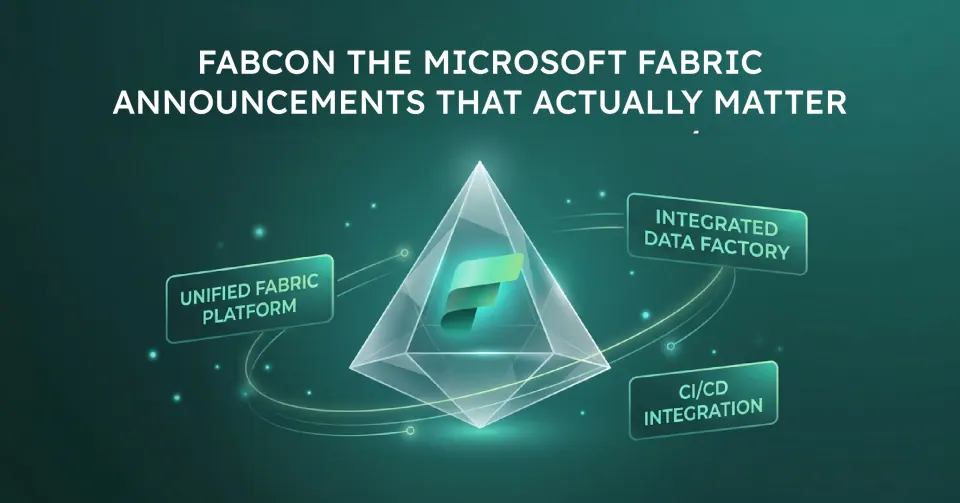
In Short: What actually were the major Fabric announcements at FabCon 2026 ?
FabCon 2026 ran March 16–20 in Atlanta, co-located with SQLCon for the first time. With around 8,000 attendees and nearly 300 workshops, it was the largest Microsoft Fabric conference to date. Here are the announcements that carry real strategic weight, and what they mean for organisations running Fabric today.
Why FabCon 2026 Was Different
FabCon has historically been a Fabric-specific event. This year's co-location with SQLCon was not just a scheduling decision. It was a strategic signal: Microsoft is positioning Fabric as the home of its entire data platform (comprising analytics, engineering, and now database management) under one roof.
The announcement volume at FabCon 2026 reflects that ambition. The March 2026 Feature Summary alone covered governance, developer tooling, data engineering, real-time intelligence, AI, warehousing, and data movement. Below are the announcements most likely to affect how your organisation operates.
1. Database Hub: A Unified Control Plane for Your Entire Database Estate
What it is: A single management interface within Fabric for Azure SQL, Cosmos DB, PostgreSQL, SQL Server (via Arc), MySQL, and Fabric Databases.
Why it matters: Most enterprises manage their database estate across multiple portals, creating fragmented visibility and inconsistent governance. Database Hub consolidates this into one surface with Copilot-powered insights and agent-assisted monitoring.
Current status: Early access. No confirmed GA date.
2. Fabric Runtime 2.0: Apache Spark 4.0, Python 3.12, Delta Lake 4.0
What it is: A major upgrade to the Spark runtime underpinning Fabric's data engineering workloads.
Why it matters: Runtime 2.0 brings Spark 4.x performance improvements, Python 3.12 language features, and Delta Lake 4.x, which includes improved performance on large table operations and better interoperability with external systems. Teams running compute-heavy engineering workloads will see the most immediate benefit.
Current status: Preview.
3. Fabric Remote MCP Server: AI Agents Can Now Connect to Fabric at Scale
What it is: A cloud-hosted Model Context Protocol server that allows AI agents to interact with Fabric data and workloads through a standardised interface.
Why it matters: Connecting AI agents to enterprise data environments has required significant custom engineering. The Remote MCP Server provides a governed, standardised path that integrates with Fabric's existing access controls automatically.
Current status: Preview.
4. Fabric CLI v1.5: CI/CD Is Now a First-Class Citizen
What it is: Version 1.5 of the Fabric command-line interface, including a new deploy command.
Why it matters: Teams can now run Fabric deployments directly from their terminal, GitHub Actions workflows, or Azure DevOps pipelines. This brings Fabric in line with modern software delivery practices and removes a longstanding friction point for teams managing Fabric environments through code.
Current status: Generally available.
5. OneLake Mirroring Expansion: SAP, Oracle, SharePoint, MySQL, and Dremio
What it is: Mirroring, which is the ability to replicate external data into OneLake without pipelines, now supports SAP Datasphere and Oracle (GA), SharePoint Lists, MySQL, and Dremio (all Preview).
Why it matters: Every new mirroring source reduces the number of custom connectors and data pipelines that need to be built and maintained. For organisations with SAP or Oracle as core systems of record, this is a significant reduction in integration complexity.
Current status: SAP and Oracle GA; SharePoint Lists, MySQL, and Dremio in preview.
6. AutoML Generally Available: Low-Code Machine Learning in Fabric
What it is: A low-code interface for building, evaluating, and deploying machine learning models within Fabric, powered by the FLAML library with automated model selection.
Why it matters: It removes the requirement for specialist ML engineering skills to build and deploy models on Fabric data. Data analysts and data scientists with limited ML experience can now produce and deploy models without writing training infrastructure from scratch.
Current status: Generally available.
7. Fabric Data Agents GA: Natural Language Access to Your Data Estate
What it is: Virtual analysts that answer natural language questions by querying across multiple Fabric data sources, such as lakehouses, warehouses, and KQL databases, and returning synthesised, contextual answers.
Why it matters: Business users can get answers from complex, multi-source data environments without needing to know SQL, understand data models, or wait for analyst capacity. The GA release includes advanced security controls for governing what each agent can access.
Current status: Generally available.
What Is the Strategic Point Most Organisations Miss?
The volume of announcements at FabCon 2026 can make it difficult to identify where to focus. The underlying pattern is consistent: Microsoft is maturing Fabric from a data platform into operating infrastructure: the layer that governs data movement, AI agent access, developer workflows, and database management for the entire enterprise.
Organisations that treat each announcement as an individual feature to evaluate will spend significant energy without a coherent implementation path. Organisations that use this moment to assess how Fabric fits their broader data operating model will be better positioned to act on the right things first.
Why work with Solv Systems on Microsoft Fabric?
At Solv Systems, we implement Microsoft Fabric as a strategic data operating model, not just a collection of analytics tools.
Strategy Before Build
We start with business outcomes to determine where Fabric fits into your broader data architecture and lakehouse strategy.
Patterns That Scale
We design modular implementation patterns that respect platform limits while enabling rapid deployment of new analytics capabilities.
Proactive Engineering
We proactively engineer around common Fabric constraints like capacity management and data movement so you don't hit blockers as you scale.
Governance and Adoption
We establish clear ownership of data assets so your Fabric foundation becomes a governed, reusable asset across the organization.
Sources and Further Reading
Frequently asked
It is published on the Microsoft Fabric Blog, released March 18, 2026.
Microsoft announced savings plans offering up to 35% cost reduction for committed Fabric capacity. No changes to the F-SKU pricing structure were announced.
Key announcements included Business Events (Preview) for event-driven applications on database changes, Eventstream SQL Operator reaching GA, and Copilot for Dashboards (Preview).
Yes. FabCon Europe 2026 is scheduled for September 28 – October 1 in Barcelona.
Microsoft reported 31,000+ customers at FabCon 2026, describing Fabric as the fastest-growing data platform in Microsoft's history.