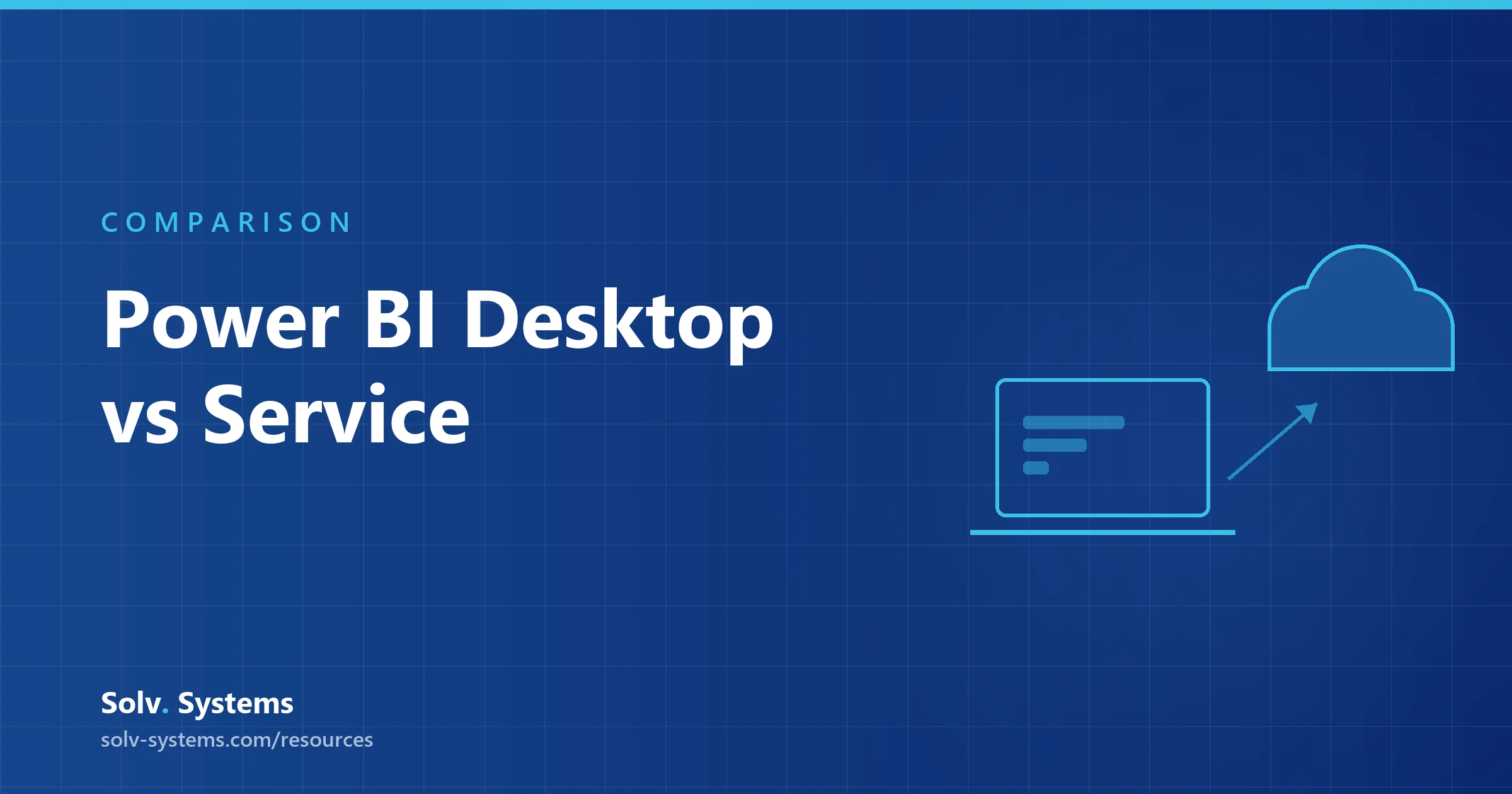
In Short: Power BI Desktop vs Service Is Build vs Run
The Power BI Desktop vs Service question comes up in almost every first Power BI project, and the answer is simpler than the menus suggest. Power BI Desktop is the free Windows application where you build: connect to data, shape it, model it, write the calculations and design the report pages. The Power BI Service (app.powerbi.com) is where that work runs: it is published, secured, refreshed on a schedule and shared with the people who need it.
Think of Desktop as the workshop and the Service as the shop floor. You can now do some building in the browser, but the division of labour still holds for most organisations. If Power BI itself is new to you, start with what Microsoft Power BI is and how the pieces fit.
What Is Power BI Desktop?
Power BI Desktop is Microsoft's authoring tool, and it costs nothing to download. Inside it you do four jobs:
- Get and shape data with Power Query, the transformation engine that cleans, joins and reshapes source data before it lands in the model
- Model the data - tables, relationships, data types, date tables and hierarchies
- Write calculations in DAX, Power BI's formula language for measures, calculated columns and security rules
- Design reports - pages of visuals, filters, bookmarks and drill-throughs
Work is saved as a .pbix file (or as a Power BI project folder, which suits source control). Nothing you build in Desktop is visible to anyone else until you publish it.
A few practical facts worth knowing in 2026:
- It is Windows only. The minimum requirement is Windows 10 or Windows Server 2016 or later, with at least 2 GB of available memory and 4 GB or more recommended. There is no native Mac version. Mac users typically run it in a Windows virtual machine, or on Azure Virtual Desktop or Windows 365, both of which Microsoft fully supports.
- It is on the Microsoft Store. You can install it from the Store, which updates it automatically and does not need admin rights, or as a direct 64-bit download. The 32-bit version is no longer supported.
- It updates monthly, and only the latest version is supported. Keep a team on the same version, because files saved in newer releases cannot be opened by older ones.
What Is the Power BI Service?
The Service is the cloud platform, reached in a browser at app.powerbi.com. It is where Power BI becomes an organisational tool rather than a personal one. Its main jobs:
- Workspaces - shared containers where teams publish and collaborate on content, with roles controlling who can edit and who can only view. Workspace governance deserves a decision rather than a default.
- Apps and sharing - packaging reports into an app for a wider audience, or sharing individual items
- Scheduled refresh - re-importing data from source on a timetable. On shared capacity a semantic model can have up to eight scheduled refreshes a day; on Premium, PPU or Fabric capacity it can have up to 48.
- Gateways - the on-premises data gateway lets the Service reach data sitting inside your network, such as an on-premises SQL Server. Cloud sources usually connect without one. Most refresh failures trace back to credentials, gateways or source changes rather than the report itself.
- Dashboards, subscriptions and alerts - dashboards (a Service-only item, distinct from reports - see dashboards vs reports), scheduled email subscriptions and data alerts
- Security enforcement - row-level security roles are defined in the model, but users are assigned to them and the rules are enforced in the Service. Sensitivity labels, usage metrics and audit logs also live here.
- Copilot - Copilot in Power BI works against content in the Service and needs paid capacity behind it; check Microsoft's current requirements before planning a rollout.
What Is a Power BI Dataset? Now It Is a Semantic Model
Search for "what is a Power BI dataset" and you will find two names for one thing. The dataset was the model a report reads from: the imported tables, relationships, measures and security roles you built in Desktop. When you publish a .pbix file, the Service splits it into two items - the report and the model underneath it.
In November 2023 Microsoft renamed datasets to semantic models. The reasons were sensible: "dataset" was too generic, especially once Power BI sat inside Microsoft Fabric alongside many other data items, and "semantic model" better describes what it is - an Analysis Services model with business logic built in. It was a rename only; nothing broke. You will still see "dataset" in the Power BI REST APIs, in activity logs, and for paginated report and real-time streaming datasets, which is why both terms persist.
The model is the most important thing you publish. One well-built model can serve many reports, and it is what Copilot and AI agents read too. We explain why in what a semantic model is.
Power BI Desktop vs Service: The Comparison
Side by side, the two compare like this:
- Cost - Desktop: free. Service: free for personal use; sharing needs Pro, PPU or capacity.
- Where it runs - Desktop: Windows PC. Service: any modern browser.
- Power Query and data shaping - Desktop: full. Service: available for import and DirectQuery models, with listed limitations.
- Modelling and DAX - Desktop: full. Service: most modelling, measures and RLS roles, with some gaps Microsoft still lists.
- Report design - Desktop: full. Service: report editing in the browser.
- Dashboards - Desktop: no. Service: yes.
- Publishing, workspaces and apps - Desktop: publish only. Service: yes.
- Scheduled refresh and gateways - Desktop: manual refresh only. Service: yes.
- Subscriptions and alerts - Desktop: no. Service: yes.
- RLS - Desktop: define and test roles. Service: assign users and enforce.
- Audience - Desktop: builders. Service: builders and consumers.
Can You Build Without Desktop?
More than you used to. Microsoft now lets you create and edit semantic models in the Service: get data and transform it in Power Query, manage relationships, write DAX measures and calculated columns, define row-level security roles and build reports, with several people able to work on the same model. Changes save automatically, and version history lets you recover from mistakes.
It is not yet a full replacement. Microsoft still lists gaps, including the View as dialog for testing roles, Q&A synonym setup and some table features, and web editing does not support models with live connections, automatic aggregations, or Power Query on incremental refresh models. For professional development - source control, performance tuning, external tools - Desktop remains the better workbench. Our usual pattern: Desktop for builds, the browser for small fixes and for colleagues on Macs.
Where Power BI Report Server Fits
If data must stay on premises, Power BI Report Server is the alternative to the Service. It is an on-premises report server with a web portal that hosts Power BI reports, paginated reports and Excel files inside your own environment, with no gateway needed for on-premises sources. It uses its own Report Server version of Desktop, installable side by side with the standard one, and it is released three times a year rather than monthly.
It is licensed through Fabric F64-or-larger reserved instances or qualifying SQL Server core licences, and it does not get the full Service feature set: Microsoft's comparison lists no dashboards, apps, Q&A, data alerts, sensitivity labels or email subscriptions for Power BI reports (paginated report subscriptions are supported). Check that comparison before choosing it.
Licensing Touchpoints
Desktop is free. Licences start when content is shared:
- A free user can use the Service for their own content but cannot share or collaborate
- Pro users can publish to shared workspaces and share with other Pro users
- PPU users get Pro plus most Premium features, but share only with other PPU users
- Content in a workspace on Premium or Fabric F64-or-larger capacity can be viewed by free-licence users
The full picture, with prices, is in our Power BI licensing guide for 2026.
A Typical Workflow From Desktop to Service
- 1. Build in Desktop - connect, shape in Power Query, model, write measures, design pages
- 2. Define RLS roles and test them in Desktop
- 3. Publish to a development workspace
- 4. Configure the model in the Service - credentials, gateway connection, refresh schedule
- 5. Assign RLS members and set workspace roles
- 6. Promote through test and production, ideally with deployment pipelines
- 7. Distribute through an app, and add subscriptions for regular readers
- 8. Iterate - change in Desktop, republish, refresh
Where Solv Systems Comes In
Most Power BI problems we are asked to fix are not in Desktop or the Service alone but at the handover between them: models published straight into production, refresh schedules nobody owns, security roles defined but never assigned. Our Power BI consulting team sets up that workflow properly - models built to scale in Desktop and a Service estate that is governed, secured and refreshed reliably.
Sources and Further Reading
- What is Power BI? (Desktop vs the Power BI service)
- Download Power BI Desktop
- New name for Power BI datasets
- Edit semantic models in the Power BI service
- Power BI service features by license type
- What is Power BI Report Server?
Frequently asked
Power BI Desktop is Microsoft's free Windows application for building Power BI content. You connect to data, shape it with Power Query, build a semantic model with relationships and DAX measures, and design report pages. It is updated monthly and installs from the Microsoft Store or as a direct download.
A dataset was the old name for the model a Power BI report reads from: the tables, relationships, measures and security roles. In November 2023 Microsoft renamed datasets to semantic models. The concept did not change, although the REST APIs and some older features still use the word dataset.
Yes. Desktop costs nothing to download and use. Licensing starts when you share: publishing to shared workspaces and sharing content in the Power BI Service needs a Pro or Premium Per User licence, or content hosted on a Premium or Fabric F64-or-larger capacity for free-licence viewers.
Not natively. Desktop requires Windows 10, Windows Server 2016 or later. Mac users can run it in a Windows virtual machine, Azure Virtual Desktop or Windows 365, or do a growing share of authoring in the browser, where the Service now supports Power Query, modelling, DAX measures and report editing with some limitations.
For most professional work, yes. Web editing covers a lot, but Microsoft still lists gaps against Desktop, and Desktop remains the better home for version-controlled development, performance tuning and external tools. Many teams use the browser for quick changes and Desktop for real builds.
Power BI Report Server is the on-premises option: a report server with a web portal that hosts Power BI reports, paginated reports and Excel files inside your own environment. It uses its own Report Server version of Desktop and is licensed through Fabric F64-or-larger reserved instances or qualifying SQL Server licensing.