In Short: How Should Power BI Workspaces Be Structured?
By business domain and lifecycle stage, not by person. A workable default is one workspace per domain per stage - development, test, production - with consumers receiving published apps rather than workspace access. Add certified datasets so people build on trusted foundations, a naming convention applied from the start, and named business ownership per domain.
How Estates Become Unmanageable
Nobody decides to create ninety workspaces. It happens the same way everywhere.
Someone creates a workspace for a project. Someone else creates one for their team. A consultant creates one for a proof of concept that becomes production. Two years later there are dozens, most named after people or long-finished projects, several containing near-identical reports, and nobody willing to delete anything in case it matters.
The symptoms are recognisable: people ask colleagues where to find a report rather than searching, the same metric appears with different values in different places, and onboarding a new analyst takes weeks because the estate has to be explained rather than navigated.
Structure by Domain and Stage
Two axes, and both matter.
Domain - Finance, Sales, Operations, HR. This mirrors how the business is organised, how ownership works, and how access should be granted.
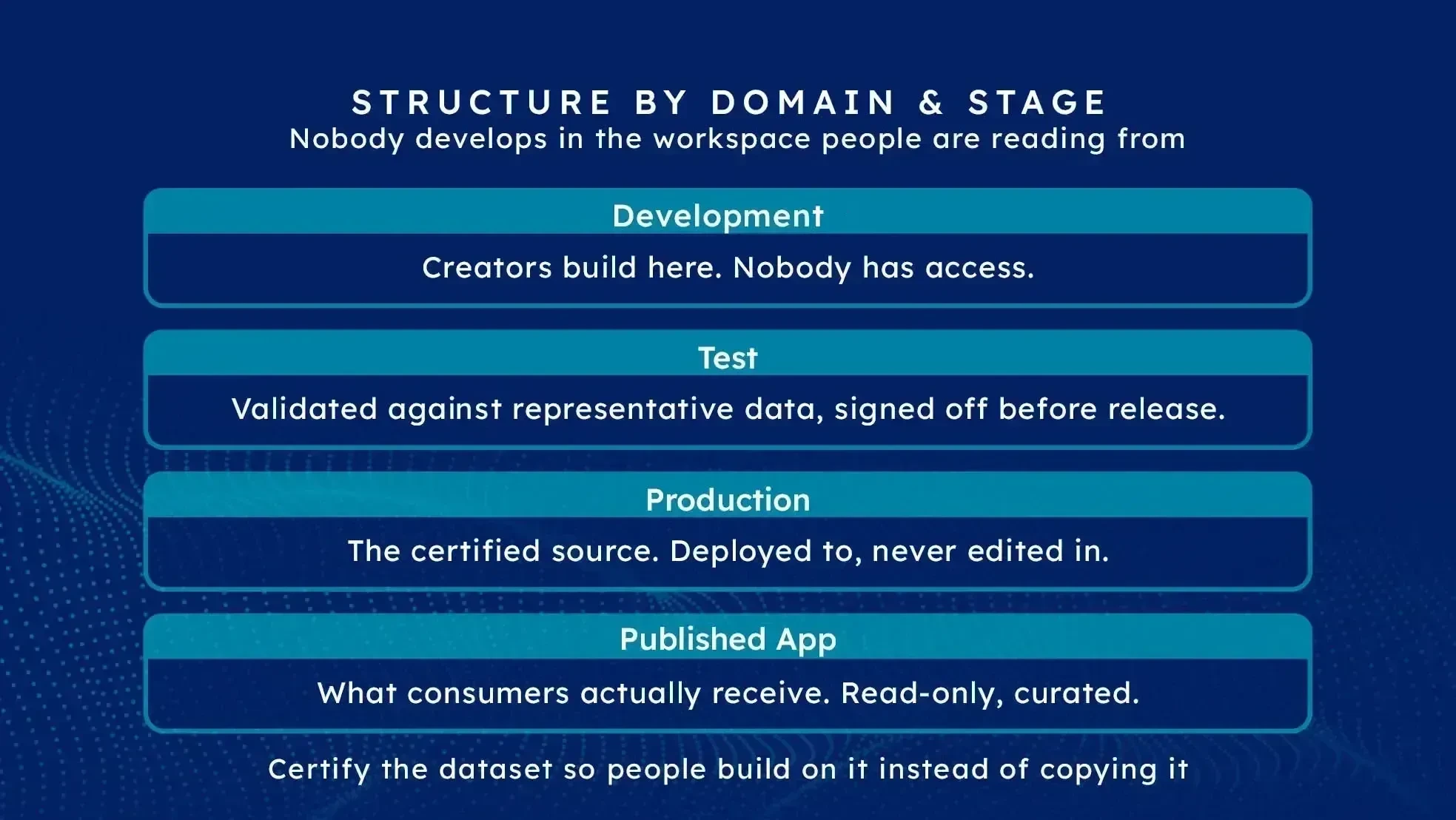
Stage - development, test, production. Content is built in development, validated in test, and consumed from production. Without this separation, someone is always editing a report that people are reading.
In practice that produces workspaces like "Finance [Dev]", "Finance [Test]", "Finance [Prod]". It looks bureaucratic at three workspaces and pays for itself at thirty. In Fabric, deployment pipelines move content between the stages properly rather than by republishing.
Apps Are the Front Door
A workspace is a workbench; an app is the finished product published from it.
Consumers should receive apps, not workspace access. Three reasons: permissions stay simple, works-in-progress cannot be mistaken for finished reports, and you can restructure the workspace without disturbing anyone.
A reasonable rule: if someone does not build content, they should never see a workspace.
Certification Is the Highest-Value Control
Endorsement lets you mark a dataset as certified - the organisation's approved source - or promoted as a lighter recommendation.
This matters more than it appears because it addresses the root cause of duplication. Analysts create competing datasets mostly because they cannot tell which existing one to trust. Certification answers that question at the moment they are looking.
Certify sparingly, and mean it. A certified dataset needs an owner, agreed definitions and monitored refresh - the label is a promise, and certifying everything makes it worthless.
Naming, Set Once
Boring and worth doing on day one, because retrofitting names across a live estate is disruptive.
A convention that works: "[Domain] [Subject] [Stage]" for workspaces, and report names describing the decision rather than the data - "Monthly Sales Review" rather than "SalesData_v3_FINAL". Avoid initials, version numbers and dates in names; that information belongs in the platform, not the title.
Ownership and Lifecycle
Every workspace needs a named business owner - a person, not a distribution list - responsible for what it contains and who can see it. Platform administration stays central; content ownership sits in the business.
Content needs an end. Reports built for a project should be archived when the project ends. Without a lifecycle, an estate only ever grows, and everything accumulated becomes something nobody dares remove.
A light quarterly review is enough: what has not been opened in ninety days, what has no owner, what duplicates something certified.
Recovering a Sprawling Estate
If you are already past the point of comfort, resist the urge to design the perfect structure and migrate everything into it. Work from evidence instead.
1. Read the usage data. Power BI records what is actually opened. Most estates discover a substantial share of content has not been viewed in months - that is your archive list, and it is uncontroversial because nobody is using it.
2. Find the duplicates. Several reports on near-identical data indicate a missing certified dataset. Build that, repoint what matters, retire the rest.
3. Impose structure on what survives. Once the estate is smaller, restructuring is a manageable exercise rather than a programme.
4. Close the tap. Whatever you clean up will return within a year unless workspace creation is governed and the certified alternative is easier to find than building a new one.
This pairs closely with adoption: findability and trust are governance features, and they are also the two things that most determine whether people use the platform at all.
Where Solv Systems Comes In
We design workspace governance for organisations standing up Power BI properly, and we untangle estates that grew faster than their structure - which is the more common engagement.
The approach is deliberately evidence-led: start from usage data rather than an ideal model, archive what nobody opens, consolidate onto certified datasets, then impose structure on what remains. It is less satisfying than a clean design and it is far more likely to stick. Governed workspaces are how a single source of truth for reporting survives contact with a growing estate. Workspace access decides who reaches a report; row-level security decides what they see inside it.
Sources and Further Reading
Frequently asked
By business domain and lifecycle stage rather than by person or by report. A workable default is one workspace per domain per stage - development, test and production - with content published to an app for consumers. Workspaces named after individuals are the clearest early warning sign of sprawl.
A workspace is where content is built and where creators collaborate. An app is the packaged, read-only view published from it for consumers. Consumers should generally receive apps rather than workspace access, which keeps permissions simple and stops works-in-progress being mistaken for finished reports.
It marks the dataset as the organisation's endorsed source, making it visible and preferred when someone looks for data to build on. It is a governance signal rather than a technical control, but it is the most effective single thing you can do to stop people creating competing copies of the truth.
There is no fixed number - the symptom is what matters. When people cannot find the right content, when the same report exists in three places, or when nobody knows who owns a workspace, you have too many for your governance model, whatever the count.
A named business owner per domain, with platform administration handled centrally. Ownership that sits only with IT fails because IT cannot arbitrate what a business term means; ownership with no named individual fails because nobody is accountable when something breaks.
Start from usage data rather than opinion. Power BI tells you what is actually opened; most estates find a large share of content has not been viewed in months. Archive the unused, consolidate duplicates onto certified datasets, then impose structure on what remains - in that order.