In Short: How Do You Break Down Data Silos?
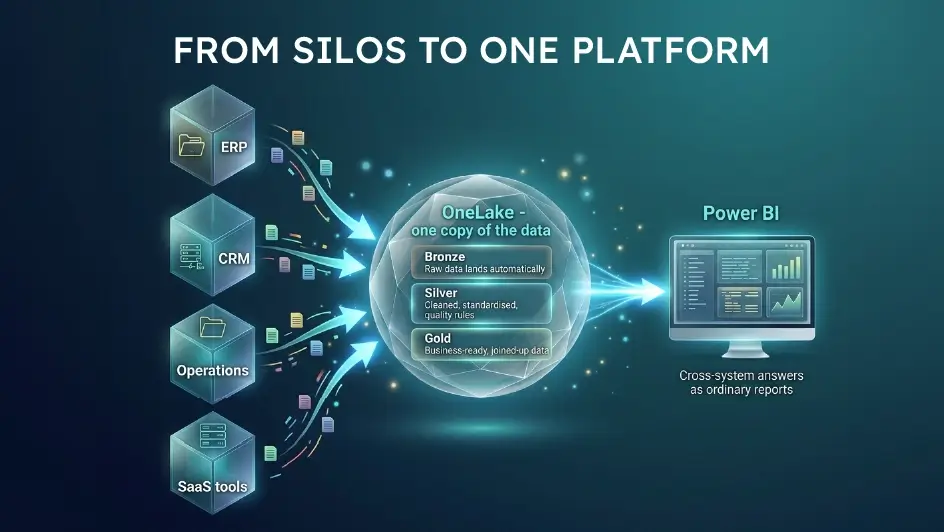
You stop trying to wire systems to each other point-to-point, and instead land all of them in one governed platform. Microsoft Fabric does this with OneLake - a single logical data lake where pipelines consolidate your ERP, CRM, and operational systems - and a medallion architecture that cleans and joins the data until "the CRM customer" and "the ERP customer" are finally the same customer. Power BI sits on top, so cross-system questions become ordinary reports instead of research projects.
The Question Nobody Can Answer
Ask a simple question in most businesses - "which customers are profitable?" - and watch what happens.
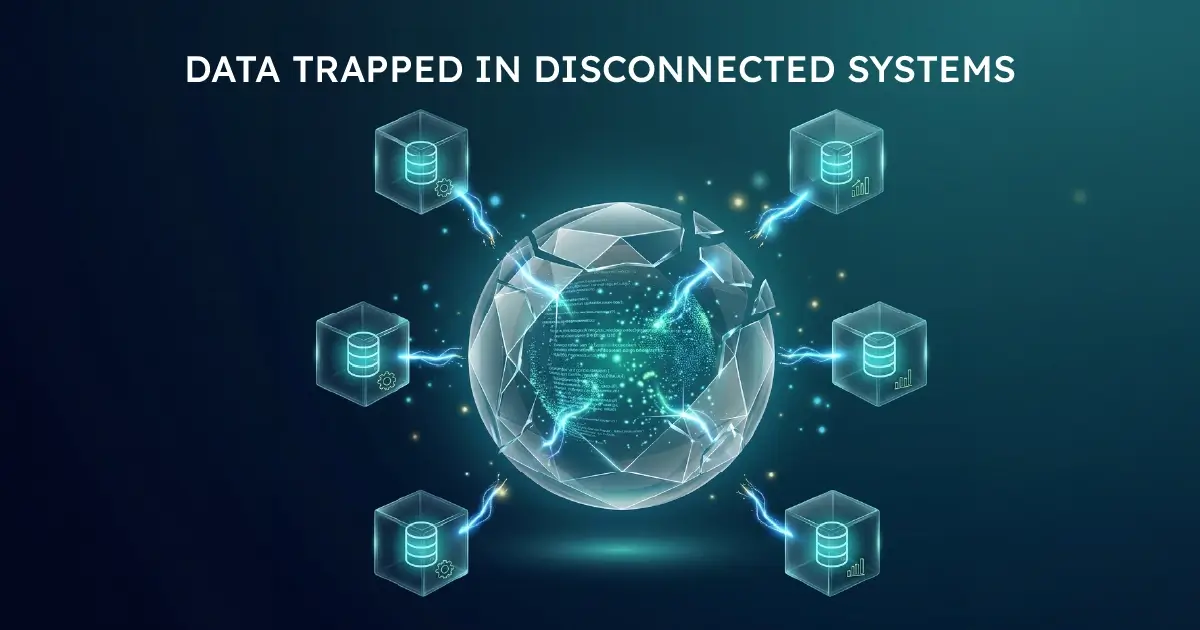
Sales knows what each customer buys; that's in the CRM. Finance knows what each customer costs to serve; that's in the ERP. Operations knows the delivery exceptions and support load; that's in a third system, or a shared drive, or someone's head. The answer to the question exists. It's just distributed across systems that have never been introduced to each other.
So the question gets answered the usual way: someone spends two weeks exporting, matching, and stitching spreadsheets - and produces an answer that's out of date by the time it's read, and impossible to reproduce next quarter.
This is the data silo problem, and it quietly caps what your organisation can know about itself.
How Silos Happen (Hint: Nobody Chose Them)
No one designs a siloed business. Silos accumulate. Each system was bought to solve a real departmental problem - the CRM for sales, the ERP for finance, the scheduling tool for operations. Each purchase made sense. But every system stores its data in its own shape, with its own customer IDs, its own product codes, its own idea of what a "date" is.
Integration was always "phase two." Phase two rarely arrives on its own, because connecting systems properly is genuinely hard - and doing it badly (point-to-point exports, scheduled CSV drops, heroic spreadsheets) creates a maintenance burden that grows with every new connection.
The result: the more successful and systemised your business becomes, the more fragmented its view of itself gets.
What Silos Actually Cost You
Cross-functional questions go unanswered. Customer profitability, true cost-to-serve, marketing ROI, end-to-end order lifecycle - the most valuable questions in any business are precisely the ones that span systems. Silos make them research projects instead of dashboard views.
Every department optimises its own corner. Sales optimises bookings, operations optimises utilisation, finance optimises working capital - each using its own data. Without a shared view, these local optimisations regularly work against each other, and nobody can see it happening.
Duplication and drift. The same customer exists in four systems with three spellings and two addresses. Which is right? Every silo answers differently, and every downstream report inherits the disagreement.
AI becomes impossible before it begins. Every AI initiative - from Copilot to custom agents - depends on unified, well-governed data. Organisations that skip this step don't get AI; they get a chatbot that confidently reads from one silo and misses the rest. If AI is anywhere on your roadmap, the silo problem is already on your critical path.
What Good Looks Like: One Platform, One Copy of the Data
The old answer to silos was a data warehouse project: long, expensive, and often obsolete before launch. The modern answer - and the one Microsoft has bet its entire data strategy on - is Microsoft Fabric.
Fabric is a unified data platform that brings integration, storage, engineering, and analytics into one service, built around OneLake - a single logical lake where all your organisation's data lives once, in an open format, available to every workload.
For a business drowning in silos, the practical architecture looks like this:
- Pipelines connect your source systems - ERP, CRM, operational tools, SaaS platforms - and land their data in OneLake automatically. We've built production Fabric integrations for everything from Salesforce and Shopify to Odoo and monday.com.
- A medallion architecture cleans and conforms it. Raw data lands in a Bronze layer, gets cleaned and standardised in Silver, and becomes business-ready, joined-up data in Gold. This is where "the CRM customer" and "the ERP customer" finally become the same customer.
- Power BI sits on top. Dashboards and self-service analytics draw from the unified Gold layer - so cross-system questions become ordinary reports, not research projects.
- Governance is built in. Security, access control, and data quality rules apply across the platform, not per-silo.
The key shift: instead of many systems each holding a fragment of the truth, you have one governed platform holding the whole picture - while your operational systems keep doing their jobs undisturbed.
How to Get There
1. Start from questions, not systems. List the five cross-functional questions your leadership most wants answered. They define which systems to connect first - and give the project a business outcome instead of a technical scope.
2. Connect incrementally. You don't integrate everything at once. Two or three systems, connected properly through a metadata-driven pipeline design, deliver the first unified views within weeks - and the same architecture absorbs each additional system cheaply.
3. Invest in the conforming layer. Matching customers, products, and hierarchies across systems is the unglamorous work that makes everything else possible. It's also where experience shows: this is design judgement, not configuration.
4. Put reporting on top early. Nothing builds momentum like the first dashboard that answers a question no one could answer before. And once the platform exists, matching data freshness to decision speed becomes a design choice rather than a dream.
Where Solv Systems Comes In
Unifying siloed data is the core of what Solv Systems does. As a Microsoft Fabric implementation partner with 100+ projects and 50+ system integrations delivered, we design and build exactly this architecture - pipelines, OneLake, medallion layers, governance, and the Power BI reporting on top.
We work metadata-driven rather than hand-crafting brittle one-off pipelines, which means the platform we leave you with absorbs new systems and schema changes without breaking. And we deliver iteratively: first unified views in weeks, expanding system by system, with your team trained as we go.
One client's technology manager summarised the outcome well in a verified review: the work "saved the client time and improved data accuracy," delivered "on time" with efficient project management. That's the goal - not a platform for its own sake, but a business that can finally see itself whole.
See Your Whole Business in One Place
If answering cross-system questions in your organisation still requires a fortnight and a heroic spreadsheet, the constraint is architectural - and it's fixable in months, not years.
Our Microsoft Fabric consulting team will map where your data sits today, what it takes to unify it in Fabric, and which connections would pay off first.
Sources and Further Reading
- OneLake overview
- Fabric lakehouse and medallion architecture tutorial
- Microsoft Fabric documentation
- Fabric Data Factory documentation
Frequently asked
A system that holds its data in isolation - its own customer IDs, product codes, and formats - disconnected from the rest of the business. Silos accumulate innocently as departments buy tools for real needs, but collectively they mean no one can see the whole business without weeks of manual stitching.
The single logical data lake at the heart of Microsoft Fabric. All your organisation's data lives there once, in an open format, available to every Fabric workload - integration, engineering, warehousing, real-time analytics, and Power BI - without copies proliferating across systems.
A layered approach to organising data in a lakehouse: raw data lands in Bronze, gets cleaned and standardised in Silver, and becomes business-ready, joined-up data in Gold. The Silver-to-Gold conforming work is where records from different systems - like the CRM customer and ERP customer - finally become one entity.
No. Your ERP, CRM, and operational tools keep doing their jobs exactly as they do today. Fabric pipelines consolidate their data downstream into one governed platform - the unification happens in the analytics layer, not by ripping out systems.
First unified views typically land within weeks: two or three systems connected through a metadata-driven pipeline design, with reporting on top early. The same architecture then absorbs each additional system incrementally - months for a broad estate, not years.
Every AI initiative - Copilot, custom agents, forecasting - answers questions using your data. If that data is fragmented across silos, the AI confidently reads from one fragment and misses the rest. A unified, governed foundation is on the critical path for any serious AI roadmap.