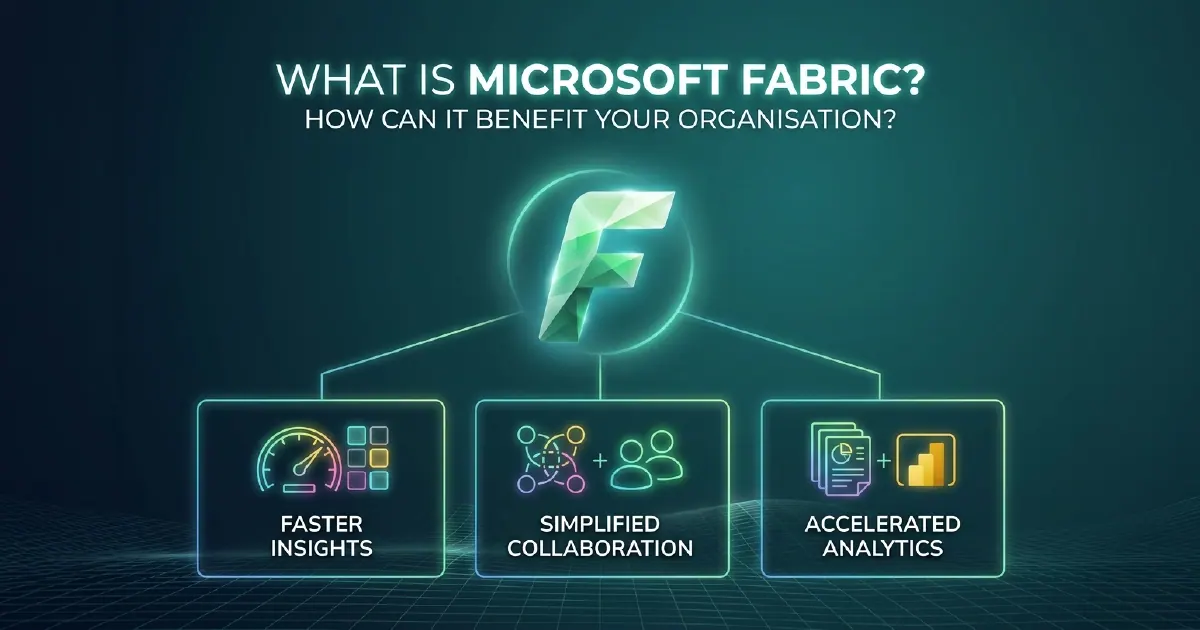
In Short: What Is Microsoft Fabric?
Microsoft Fabric is Microsoft's unified, end-to-end data and analytics platform. It brings data integration, data engineering, data warehousing, real-time analytics, data science, and business intelligence together into a single SaaS environment built on a shared data foundation called OneLake.
If your organisation is running separate tools for data ingestion, transformation, warehousing, and reporting - each managed by different teams with different access controls, different cost centres, and different maintenance burdens - Fabric is the platform designed to collapse that complexity into one governed, integrated experience.
This guide covers what Fabric is, how its architecture works, and specifically how it can benefit your organisation.
Why Microsoft Fabric Exists
Data platform sprawl is the dominant pain point for analytics teams in 2026. Most organisations have accumulated a collection of point solutions over the past decade: a pipeline tool here, a warehouse there, a separate BI platform, a real-time streaming layer, a machine learning environment. Each works individually. Together, they create friction, duplication, and brittle dependencies that slow down every analytics initiative.
Microsoft's answer to this is to converge the entire analytics stack into a single platform experience, rather than trying to integrate many separate products. That is what Fabric is: not a new product alongside Azure Data Factory, Azure Synapse, and Power BI, but a convergence of those capabilities under a unified governance model, a shared storage layer, and a single capacity-based commercial model.
The result is a platform where a data engineer, a data scientist, a BI developer, and a business analyst can all work on the same data, in the same environment, without copying data between systems or managing cross-service access controls.
The Architecture: OneLake at the Centre
The foundation of Microsoft Fabric is OneLake - a single, logical data lake for your entire organisation, analogous to how OneDrive provides a single file storage layer for Microsoft 365.
OneLake has three properties that matter architecturally:
- One copy of the data. All Fabric workloads read from and write to OneLake. There is no data copying between services. A table in your Lakehouse is the same table your Power BI semantic model reads from through Direct Lake mode.
- Delta format by default. All tables in OneLake are stored as Delta tables, which means they support time travel, schema evolution, and ACID transactions out of the box.
- Shortcuts for external data. OneLake can reference data stored in Azure Data Lake Storage, Amazon S3, or Google Cloud Storage without copying it. The data stays where it is; Fabric treats it as if it were local.
On top of OneLake, Fabric provides six workloads - purpose-built analytics experiences for different personas and use cases.
The Six Fabric Workloads
Data Factory
The ingestion and orchestration layer. Pipelines and Dataflow Gen2 move data from hundreds of source systems into OneLake. This replaces Azure Data Factory for most Fabric-native implementations.
Data Engineering
Spark-based notebooks and Lakehouse environments for data transformation at scale. Data engineers write PySpark, Scala, or SparkSQL to build the medallion layers - Bronze, Silver, Gold - that structure raw data into analytics-ready assets.
Data Warehouse
A fully managed, serverless SQL warehouse for structured analytics. For teams that prefer SQL over Spark, or that need high-concurrency reporting workloads, the Fabric Warehouse provides T-SQL authoring and familiar database semantics.
Real-Time Intelligence
Eventhouse (KQL databases), Eventstreams (real-time ingestion), and Activator (event-triggered actions) form the real-time layer. For organisations that need analytics on streaming data - operational telemetry, IoT sensors, transactional events - this workload provides sub-second latency at scale.
Data Science
Notebooks, machine learning experiments, and model management for data scientists building predictive and AI-augmented analytics on the same data the rest of the organisation uses.
Power BI
The BI and visualisation layer, now natively embedded in Fabric. Semantic models built on top of Gold-layer Lakehouse tables using Direct Lake mode deliver high-performance, governed reporting without data import or DirectQuery overhead.
How Microsoft Fabric Benefits Your Organisation
1. One Platform, One Governance Model
Instead of managing access controls, compliance settings, and audit logs across five or six different Azure services, Fabric uses Microsoft Entra ID and Microsoft Purview for unified governance across every workload. Your security team configures it once; it applies everywhere.
2. Faster Time-to-Insight
Because all workloads share OneLake, there is no data movement between the ingestion layer and the reporting layer. A pipeline that lands data in Bronze at 8am can have a governed Power BI report refreshed by 8:15am. In a traditional multi-tool stack, that same workflow might involve three scheduled jobs, two API calls, and a manual verification step.
3. Lower Total Cost of Ownership
Fabric's capacity-based pricing (F-SKUs) covers all workloads under a single meter. You are not paying for Azure Data Factory compute, Azure Synapse Analytics pools, Power BI Premium, and Azure Storage separately. For organisations running significant data workloads, the consolidation typically reduces total cost while increasing capability.
4. AI Readiness
Fabric's Data Agents, Copilot integration, and connection to Microsoft Foundry mean that organisations with a well-governed Fabric estate can deploy AI tools - conversational data querying, automated insight generation, agentic workflows - without building a separate AI data layer. Your data foundation and your AI foundation become the same thing.
5. Reduced Engineering Complexity
A metadata-driven Fabric implementation replaces dozens of brittle, point-to-point pipelines with parameterised, reusable patterns. The reduction in maintenance overhead is material - teams that previously spent 60% of their time keeping pipelines alive shift to spending that time building new capability.
Which Organisations Benefit Most?
Fabric is not the right choice for every organisation at every stage. It delivers the most value when:
- You are already in the Microsoft ecosystem. If your organisation uses Microsoft 365, Azure, and Power BI, Fabric is a natural consolidation. The governance model, identity layer, and commercial relationship are already in place.
- You have multiple source systems to integrate. The medallion architecture pattern Fabric enables is most valuable when you have three or more source systems that need to be joined for analytics.
- Your current analytics stack is fragmented. If your data engineers, BI developers, and data scientists are working in separate tools with separate access controls, Fabric is the convergence platform.
- You want to enable AI over your data. Fabric's Data Agents and Foundry integration make it the logical foundation for organisations planning to add AI-augmented analytics in the next one to three years.
For sector-specific builds, we have dedicated guides for financial services, manufacturing, professional services and logistics and supply chain.
What Does Getting Started Look Like?
Most organisations approach Fabric adoption in one of three ways.
Foundation first. Start with OneLake, Data Engineering, and one source system. Establish the medallion architecture pattern, governance baseline, and semantic model conventions before expanding. This is the approach we recommend for organisations with no existing Fabric footprint.
Migration from Synapse or Azure Data Lake. Organisations already running Azure Synapse Analytics or Azure Data Lake Storage can migrate into Fabric incrementally, using OneLake shortcuts to reference existing ADLS data without copying it.
Power BI-first. Organisations with an existing Power BI estate can adopt Fabric by upgrading to Fabric capacity, gaining access to Lakehouse and Data Engineering workloads without disrupting existing reports and workspaces.
The right starting point depends on your current state. The organisations that try to do everything at once - migrate all sources, rebuild all pipelines, retrain all teams simultaneously - take three times as long and deliver a third of the value compared to organisations that sequence the work deliberately.
How Solv Systems Approaches Fabric Implementations
We are a specialist Microsoft Fabric, Power BI, and AI consultancy. Every Fabric engagement we run follows the same structural principles: metadata-driven pipelines, medallion architecture, governed semantic models, and a defined operating model before the first pipeline goes to production.
We deliver Fabric implementations across South Africa, the United Kingdom, the United States, and globally. If you are evaluating Fabric or planning your first implementation, we are happy to give you a realistic view of what the work involves and what outcomes you can expect. When you need to take the decision to a board, our guide to building the business case for Microsoft Fabric covers how to frame it.
Sources and Further Reading
- Microsoft Fabric documentation
- OneLake overview
- Fabric lakehouse and medallion architecture tutorial
- Azure pricing for Microsoft Fabric
Frequently asked
Microsoft Fabric is an all-in-one data and analytics platform from Microsoft. It combines data ingestion, transformation, storage, real-time analytics, and Power BI reporting into a single environment built on a shared data lake called OneLake. Instead of running separate tools for each part of your data workflow, Fabric brings them together under one governance model and one pricing structure.
No, but Fabric evolved from Synapse. Microsoft Fabric converges Azure Synapse Analytics, Azure Data Factory, and Power BI Premium into a single unified platform. Synapse Analytics still exists, but Microsoft's strategic investment is in Fabric. Organisations on Synapse can migrate to Fabric incrementally using OneLake shortcuts to avoid data-copying migrations.
OneLake is the shared data storage foundation of Microsoft Fabric - a single, logical data lake that all Fabric workloads read from and write to. It stores data in Delta Parquet format by default, supports time travel and ACID transactions, and can reference data in external storage (Azure Data Lake Storage, Amazon S3, Google Cloud Storage) via shortcuts without copying it.
Microsoft Fabric uses capacity-based pricing through F-SKUs (F2 through F8192). F-SKUs start at approximately $0.18 per Capacity Unit per hour and cover all Fabric workloads under a single meter. You can also use existing Power BI Premium P-SKU capacity for Fabric workloads. The right capacity depends on your workload mix - we have published detailed cost guides for US, UK, and South African markets.
No. Power BI is one of the six workloads inside Microsoft Fabric. If you already have Power BI, Fabric adds capabilities around it - particularly the Lakehouse, Data Engineering, and Real-Time Intelligence workloads. Your existing Power BI reports and semantic models continue to work, and upgrading to Fabric capacity unlocks Direct Lake mode, which significantly improves performance for large datasets.
A medallion architecture organises data in OneLake into three layers: Bronze (raw, unmodified source data), Silver (cleaned, standardised, joined data), and Gold (business-ready, aggregated data designed for consumption by Power BI and Data Agents). This pattern separates raw ingestion from transformation from consumption, making the platform easier to govern, test, and maintain over time.
A focused Fabric Foundation implementation - establishing OneLake, one or two source system pipelines, Bronze through Gold medallion layers, and a governed Power BI semantic model - typically takes six to eight weeks. Larger enterprise implementations covering multiple business domains and source systems typically run three to six months. We offer a fixed-price six-week Fabric Accelerator for organisations that want a defined scope and known cost.
Fabric delivers the most value for organisations already in the Microsoft ecosystem that are dealing with fragmented analytics tooling, multiple source systems, or growing pressure to enable AI over business data. If your analytics stack is working well and your teams are productive, there is no urgency to migrate. If you are experiencing delays, data quality issues, or rising platform costs, Fabric is worth a serious evaluation.