In Short: Why Is Your Reporting Always Out of Date?
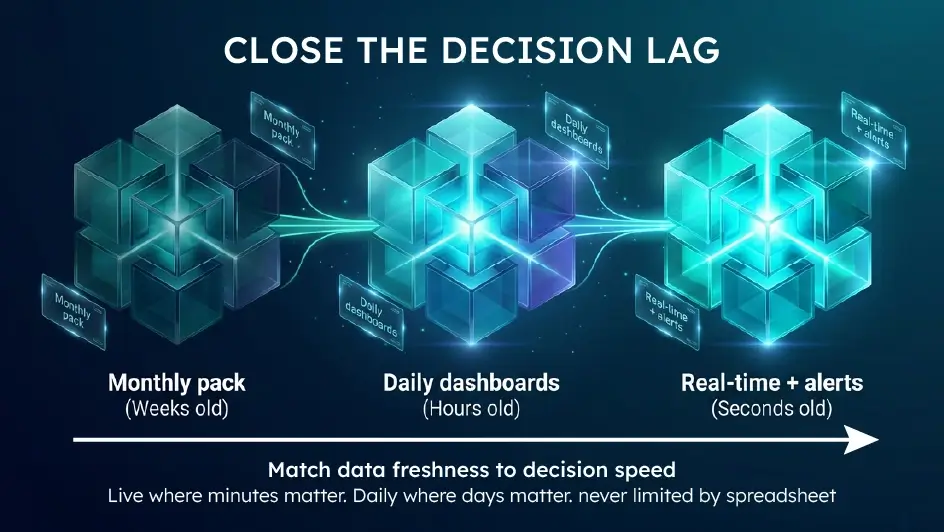
Because it moves at the speed of the people who assemble it, over plumbing designed for a batch era. The fix is not "real-time everything" - it's matching data freshness to decision speed. On Microsoft Fabric, that spectrum is a design choice: automated pipelines refresh management dashboards several times a day, Real-Time Intelligence streams operational events within seconds, and alerts flag problems the moment a metric goes out of range instead of in next month's pack.
An Uncomfortable Question
When your leadership team met this week, how old was the data on the table?
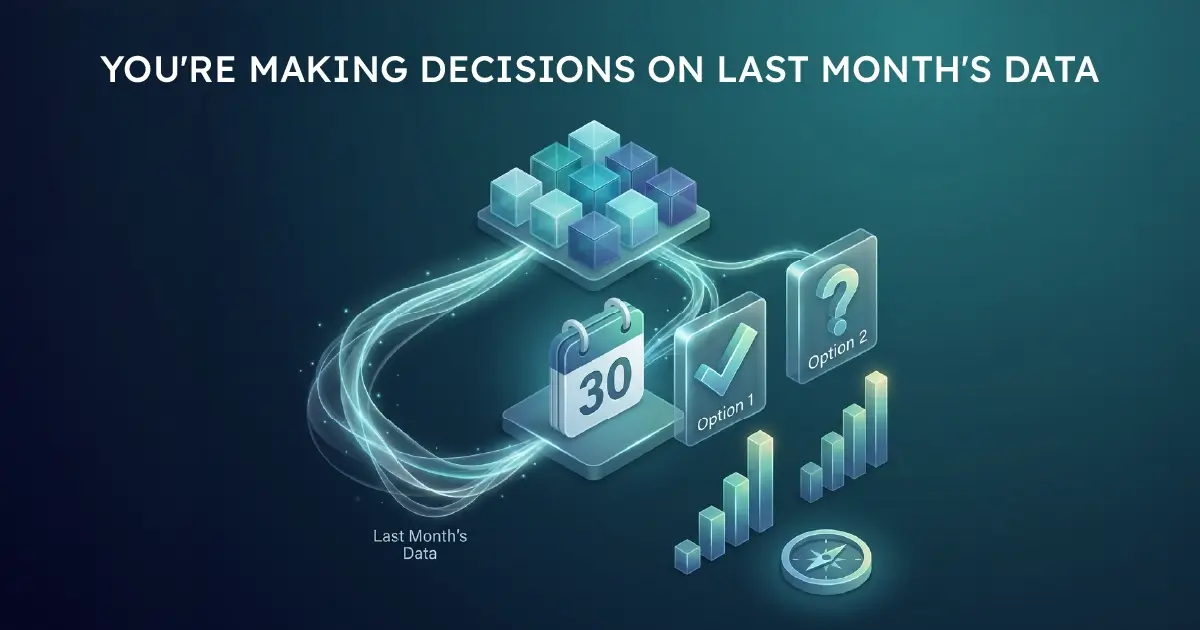
For most organisations the honest answer is somewhere between two weeks and six. The monthly pack describes the previous month; it lands mid-month; decisions taken on it play out the month after. By the time the business responds to a problem, the problem has had six to ten weeks to grow.
Nobody experiences this as a crisis, because it's how it has always worked. But "how it has always worked" was set by the limits of manual reporting - not by how fast your business actually moves.
The Decision Lag, Itemised
Stale data doesn't fail loudly. It taxes you quietly, decision by decision.
Problems run longer than they should. A margin leak, a quality issue, a churn spike - each one exists for weeks before the report that reveals it is even assembled. The cost of a problem is roughly proportional to how long it runs undetected. Slow reporting is a subsidy you pay to your own problems.
Opportunities expire before you see them. A product suddenly moving, a region outperforming, a competitor stumbling - opportunity windows are often measured in days. A monthly cadence guarantees you learn about most of them after they've closed.
Forecasting becomes guessing. When the freshest data is weeks old, forecasts start from a stale baseline, and every downstream plan - stock, staffing, cash - inherits the error.
Your operational teams disconnect from the numbers. When frontline managers can only see performance long after the fact, the numbers stop being a tool they use and become a judgement they receive. The feedback loop that drives improvement never forms.
Why Your Reporting Is Slow (It's Not Your People)
Reporting lag is almost never a motivation problem. It's an architecture problem, with three usual suspects:
Manual assembly. If people build the report, the report moves at the speed of people. Exports, spreadsheets, checks, formatting - each step adds days. (Automating the assembly is usually the first fix.)
Batch-era plumbing. Many data setups still revolve around overnight jobs, weekly extracts, or month-end processing - designs inherited from when compute was expensive and "real-time" was exotic.
No shared platform. When data must be gathered from disconnected systems each time, every report starts from zero. The gathering is the delay. If this is your situation, the silo problem and the staleness problem are the same problem.
What Good Looks Like: Data at the Speed of the Business
Modern data platforms have quietly removed the technical excuses for stale reporting. On Microsoft Fabric, the spectrum of freshness is a design choice, not a limitation:
- Scheduled refresh, many times a day. For most management reporting, moving from monthly packs to dashboards refreshed every few hours is transformative on its own - and straightforward once data flows through automated pipelines into OneLake.
- Near-real-time operational dashboards. For operations, sales floors, logistics, and service teams, Fabric's Real-Time Intelligence capabilities can stream events into dashboards within seconds - stock positions, order flow, sensor readings, call volumes.
- Alerts instead of discoveries. Rather than someone noticing a bad number in next month's pack, thresholds trigger alerts the day - or the minute - a metric goes out of range. Data Activator in Fabric makes "the system tells you" the default.
- One platform, every cadence. The same governed data serves the monthly board pack, the daily management view, and the live operational screen - consistent definitions across all three, so faster never means "different numbers."
The right target isn't "everything real-time" - that's expensive and mostly unnecessary. The right target is matching data freshness to decision speed: live where minutes matter, daily where days matter, and never again limited by how long the spreadsheet takes to build.
How to Get There
1. Audit your decision cadences. For each recurring decision - pricing, staffing, stock, campaign spend - ask: how fresh is the data it uses, and how fresh could it usefully be? The gaps form your business case.
2. Automate the pipeline first. Real-time dashboards on manually assembled data are impossible by definition. Automated ingestion into a governed platform is the prerequisite - and delivers most of the value by itself.
3. Pick one high-frequency use case as the proof. A live operations dashboard or daily sales view, shipped in weeks, does more to change an organisation's expectations than any strategy document.
4. Add alerting deliberately. Define the thresholds that matter and let the platform watch them. This is where reporting stops being a rear-view mirror and starts being an instrument panel.
Where Solv Systems Comes In
Solv Systems builds exactly this progression - from static monthly reporting to governed, automated, real-time-where-it-matters analytics on Microsoft Fabric and Power BI. With 100+ projects delivered globally, we've done it for energy businesses, logistics operations, financial services, and more.
Our approach is pragmatic: we don't sell "real-time everything." We start with your decisions, match the architecture to the cadence each one needs, and deliver in stages - automated pipelines and refreshed dashboards first, streaming and alerting where the business case is real. Clients describe the effect in verified reviews as "clear improvements in reporting efficiency, data accuracy, and visibility into operational metrics."
The end state: your teams stop asking "what happened last month?" and start asking "what's happening now, and what do we do about it?"
Close the Gap Between Events and Action
Every week of reporting lag is a week your problems run free and your opportunities age. The technology to close that gap is mature, and the path is well-trodden.
Our Microsoft Fabric consulting team will look at where your data sits, how fresh your key decisions actually need it to be, and what a staged path to real-time looks like.
Sources and Further Reading
- Fabric Data Factory documentation
- OneLake overview
- Microsoft Fabric documentation
- Fabric Real-Time Intelligence
Frequently asked
The gap between something happening in your business and your response to it. With monthly reporting, a problem typically runs six to ten weeks before a decision addresses it: weeks until the reporting period closes, more until the pack is assembled, more until the decision plays out.
No - 'real-time everything' is expensive and mostly unnecessary. The right target is matching data freshness to decision speed: live dashboards where minutes matter (operations, logistics, service), daily views for management, and scheduled refresh for board reporting - all from one governed platform so the numbers stay consistent.
Fabric's set of capabilities for streaming data: events flow into dashboards within seconds of happening - stock positions, order flow, sensor readings, call volumes. It runs on the same platform and governed data foundation as your scheduled reporting.
Fabric's alerting engine. You define thresholds that matter - a margin floor, a stock level, an error rate - and the platform watches them continuously, triggering alerts the moment a metric goes out of range. Problems get announced by the system instead of discovered in next month's pack.
Automate the pipeline. Real-time dashboards on manually assembled data are impossible by definition, so automated ingestion into a governed platform is the prerequisite - and moving from monthly manual packs to dashboards refreshed several times a day delivers most of the value by itself.
Audit your decision cadences: for each recurring decision - pricing, staffing, stock, campaign spend - ask how fresh the data it uses is, and how fresh it could usefully be. Most management decisions benefit from daily data; few need minutes; almost none are served well by six-week-old numbers.