In Short: Is Microsoft Fabric Free?
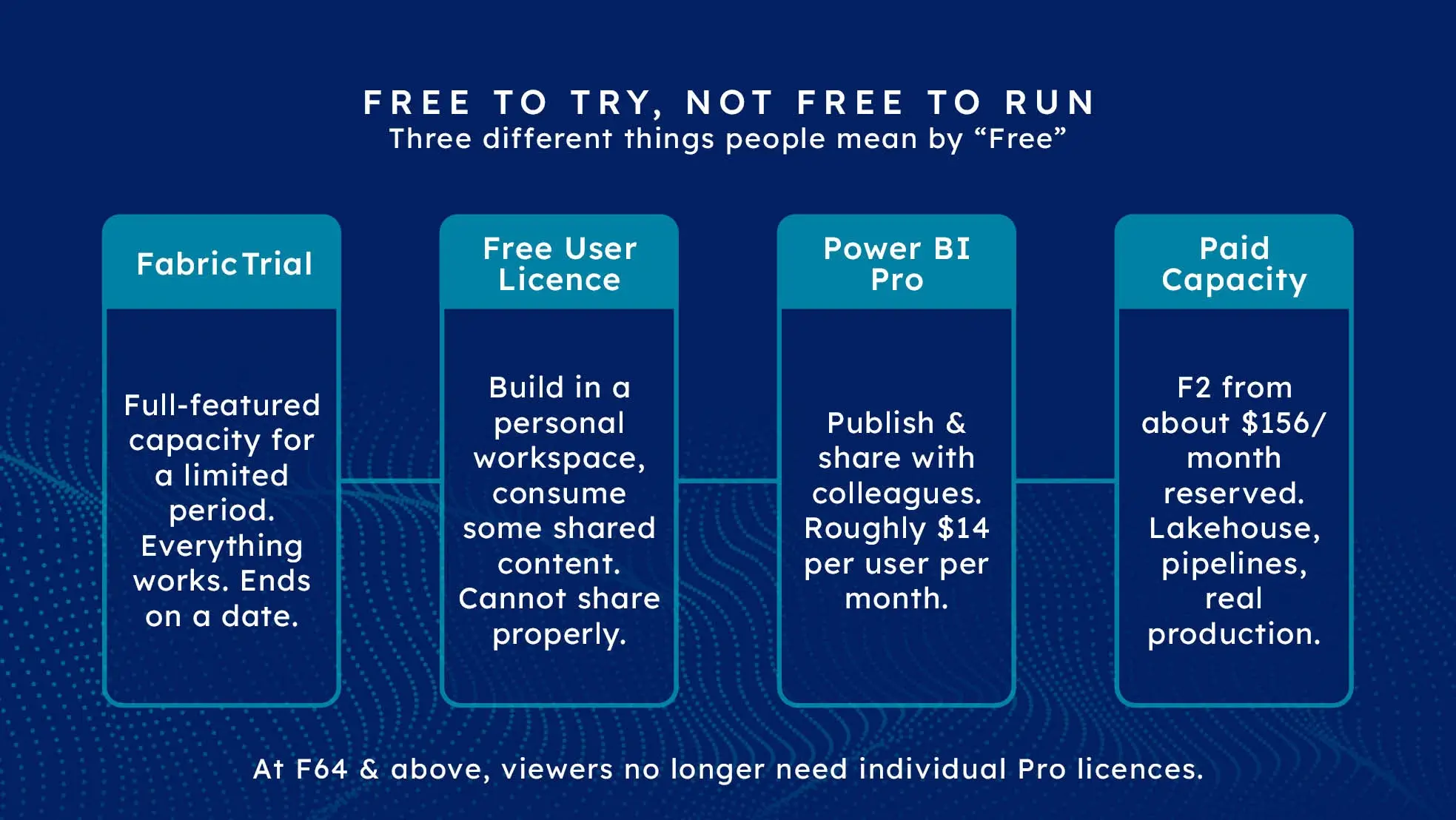
Free to try, not free to run. A time-limited trial gives you a full-featured Fabric capacity for evaluation. Power BI's free licence lets an individual build in a personal workspace and consume some shared content, but not share their own work in the way organisations need. Anything that looks like production - scheduled refreshes, shared reports, lakehouses and pipelines used by a team - requires a paid capacity.
Two Different Things Called Free
Most of the confusion around this question comes from conflating two separate mechanisms.
The trial is about the capacity - the compute that runs Fabric workloads. Microsoft offers a time-limited full-featured trial capacity so you can evaluate the platform before buying an F SKU. Trial terms have changed more than once, so confirm the current position on Microsoft Learn rather than trusting a number in an article, including this one.
The free licence is about the user. Power BI has long offered a free per-user licence alongside Pro. It is not a trial and it does not expire - but what it permits is narrower than most people assume.
You can be in either state independently. A free-licence user on a paid F64 capacity is a perfectly normal and fully supported arrangement.
What the Free Power BI Licence Actually Allows
A free licence lets someone build reports in their own personal workspace and consume content that has been shared with them under certain conditions.
What it does not allow is the thing that makes BI useful in an organisation: publishing to a shared workspace and distributing to colleagues. That requires Power BI Pro, at roughly $14 per user per month.
There is one important exception, and it is the most consequential line in Fabric's pricing model. On an F64 capacity or above, viewers do not need Pro licences. (To see what that capacity costs in your currency, run it through our Fabric pricing calculator.) Content creators still do; consumers do not. For organisations with wide report audiences this often decides the capacity tier on its own - see our pricing guide for the arithmetic.
What You Get During the Trial
A trial capacity is genuinely full-featured. Lakehouses, pipelines, notebooks, warehousing, real-time intelligence and Power BI all work. It is not a crippled demo, which is what makes it worth taking seriously.
The mistake most organisations make is spending it on exploration. A trial spent clicking through features tells you the product exists. A trial spent building one real workload end to end - a genuine source system, landed and conformed, with a report someone actually wanted - tells you whether the platform solves your problem, and leaves you with something to keep.
That distinction is worth planning before the clock starts.
What Happens When the Trial Ends
Trial capacity stops. Items created in trial workspaces become inaccessible until those workspaces are assigned to a paid capacity. The data is not immediately destroyed, but nothing runs.
Two practical implications:
- Decide before the end date, not on it. Assigning a workspace to a purchased capacity is straightforward; doing it under pressure while reporting is down is avoidable stress.
- Do not let the trial become production. It happens more often than you would expect: a trial workload proves useful, people start relying on it, and nobody has budgeted for the capacity. If the trial worked, that is the signal to buy.
The Cheapest Real Production Setup
For an organisation that wants Fabric properly, the floor is lower than most expect: an F2 reserved capacity at roughly $156 per month in US regions, plus Power BI Pro for whoever publishes.
That is enough for a lakehouse, scheduled pipelines and a handful of governed reports for a small team. It is not enough for heavy concurrency or frequent large refreshes - but it is a real production platform, not a toy. Sizing beyond that is covered in our capacity sizing guide.
Update, 29 September 2026: Microsoft announced a new, lower entry point at FabCon Europe 2026: Fabric zero-provisioned (F0), a capacity SKU with no upfront compute-capacity charge, on which supported workloads use on-demand billing by default. It is not free - you pay for the compute you consume, and storage is charged separately - and it is coming soon, in preview in the coming weeks, with pricing not yet published. See Fabric F0 and on-demand billing explained and our FabCon Europe 2026 recap.
When Free Is Genuinely Enough
It is worth saying plainly, because the honest answer is sometimes no purchase.
If your requirement is a few reports over a couple of sources for a small team, Power BI Pro without any Fabric capacity may be all you need. You forgo lakehouse, pipelines, warehousing and Direct Lake - but if none of those solve a problem you currently have, paying for them is not a strategy.
The point at which that stops working is usually recognisable: refreshes taking too long, too many sources to manage in individual datasets, or the same data being rebuilt in several reports. That is when the platform earns its cost, and not particularly before.
Where Solv Systems Comes In
Our Microsoft Fabric consultants help organisations get something real out of a Fabric trial rather than a tour of the features - picking the workload that will actually prove or disprove the case, building it properly, and being straight about what the ongoing cost would be.
Sometimes that conversation ends with a recommendation to stay on Power BI Pro for another year, with our Power BI consultants getting more out of the reports you already have. That is a legitimate outcome and we would rather say it than sell a capacity you cannot yet use. For what an F64 capacity costs and unlocks, see Microsoft Fabric F64 explained.
Sources and Further Reading
Frequently asked
Fabric is free to try and not free to run. A time-limited trial gives you a full-featured capacity for evaluation, and Power BI has a free user licence with real limits on sharing. Anything resembling production - scheduled refreshes, shared reports, lakehouses and pipelines used by a team - requires a paid capacity.
Microsoft has changed trial terms more than once, so check the current position on Microsoft Learn rather than relying on a figure in an article. What matters more than the exact length is what you do with it: a trial spent proving one real workload is worth far more than one spent exploring features.
Consume content in certain circumstances and build in your own personal workspace. What it does not allow is the thing most organisations actually need - sharing content with colleagues through workspaces and apps. That requires Power BI Pro, or an F64 capacity or above, where viewers no longer need individual licences.
Trial capacity stops, and items in trial workspaces become inaccessible until they are attached to a paid capacity. The data is not deleted immediately, but the workspaces stop functioning. Plan the transition before the end date rather than discovering it on the day.
An F2 reserved capacity, at roughly $156 per month in US regions, plus Power BI Pro for anyone publishing content. That is enough for a lakehouse, pipelines and a handful of governed reports for a small team. Our pricing guide sets out the full range.
Sometimes, and it is a legitimate answer. If all you need is reporting on a handful of sources and Pro licences for a small team, Power BI Pro without Fabric capacity can be sufficient. You give up lakehouse, pipelines, warehousing and Direct Lake - so it works until data volume or integration complexity grows.