In Short: Why Did Your AI Initiative Stall?
Almost certainly not because of the technology. Stalled AI initiatives share four causes: the data foundation wasn't ready, there was no specific problem to solve, nobody planned the path to production, and users never learned to trust the answers. All four are fixable - and none of them comes in the licence box. The organisations getting real value from AI run the sequence in the right order: readiness assessment first, data foundation second, narrow measurable use cases third, production guardrails last.
The Pilot That Never Landed
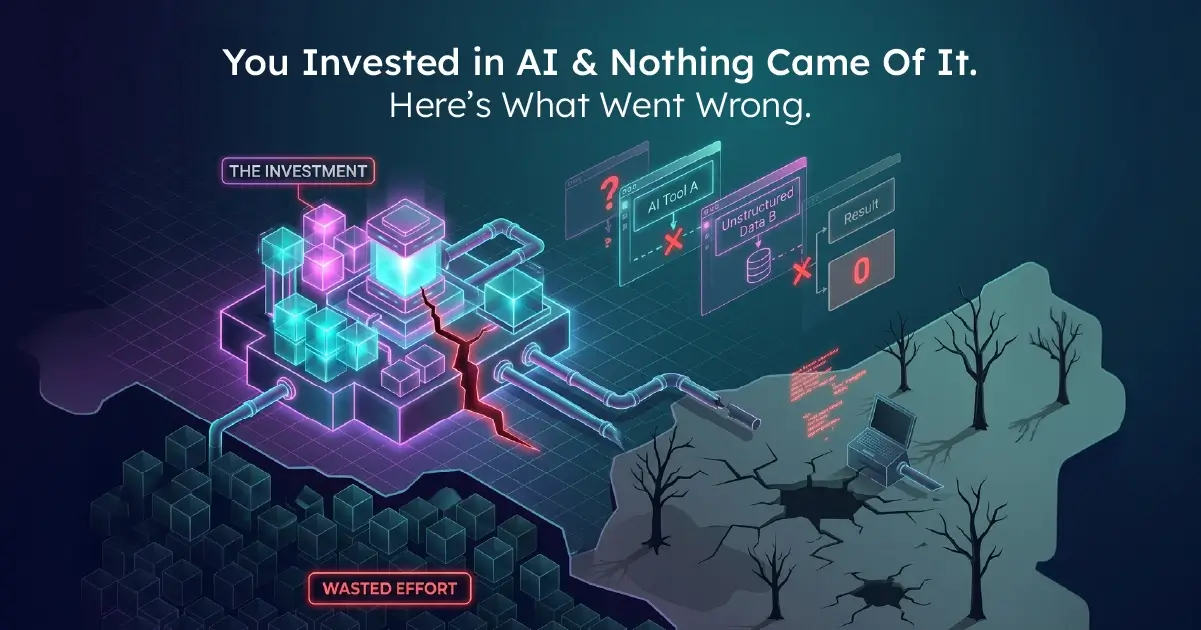
Somewhere in the last two years, your organisation probably ran an AI initiative. Perhaps it was Copilot licences rolled out to enthusiastic indifference. Perhaps a chatbot pilot that demoed beautifully and then quietly never reached production. Perhaps a workshop that produced a slide titled "AI Opportunities" and nothing else.
You are in large company. Across the industry, the pattern repeats: real budget goes in, a promising demo comes out, and then... nothing operational. The pilot doesn't fail loudly - it just never becomes part of how the business runs.
The comforting explanation is that the technology isn't ready. The accurate explanation is usually less comfortable: the technology was fine. The foundation underneath it wasn't.
The Four Ways AI Initiatives Quietly Die
1. The data wasn't ready. This is the big one. AI systems answer questions using your data - and if that data is scattered across silos, inconsistently defined, and quietly wrong, the AI inherits every one of those flaws and presents them fluently. A Copilot that can't see the systems where the real answers live, or an agent trained on data with three versions of every customer, produces confident nonsense. Users try it twice, get burned once, and never come back. No amount of prompt engineering fixes a foundation problem.
2. There was no specific problem. "We need to do something with AI" is a mandate, not a use case. Initiatives launched from FOMO select their technology first and go looking for a problem afterwards - which is why so many pilots demo well (demos are chosen to demo well) and deploy never (no operational problem was ever defined, so there's nothing to deploy into).
3. Nobody planned for production. A pilot is a controlled environment. Production means security review, data privacy, access control, monitoring, error handling, a plan for when the AI is wrong, and an owner. Pilots that were never designed with that path in mind hit the governance wall at full speed - and stall there permanently.
4. Trust was never established. If users can't tell where an answer came from, and the answer is sometimes wrong, they rationally stop asking. Reliability and verifiability aren't nice-to-haves in enterprise AI; they're the adoption mechanism.
Notice what's absent from this list: model quality. The models are the most commoditised part of the stack. The differentiators are data, use-case selection, governance, and trust - all of which are within your control, and none of which come in the licence box.
What Good Looks Like: Readiness Before Rollout
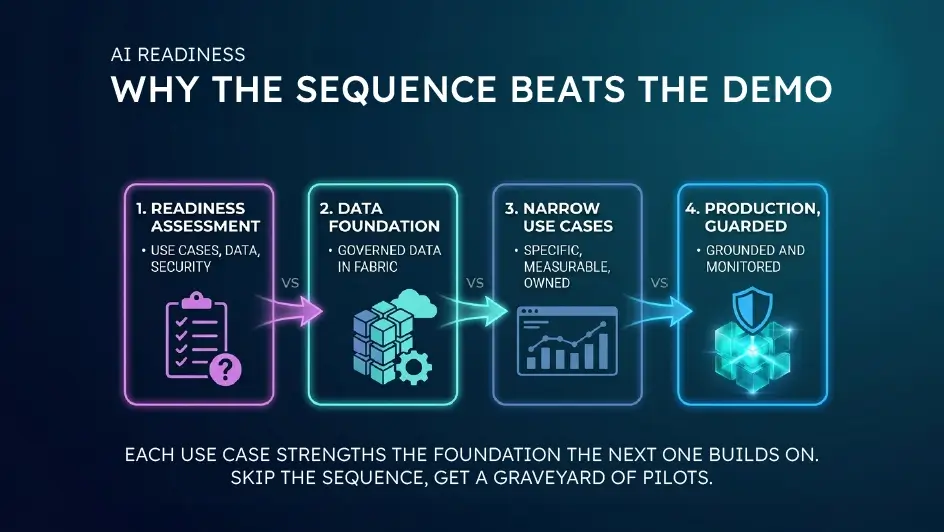
Organisations that get real value from AI do the unglamorous things first. The sequence matters more than the tools:
Start with a readiness assessment, not a purchase. Our AI-readiness checklist is the version of this we run with clients. Before building anything, establish honestly: which use cases would actually pay off here? Is the data those use cases depend on unified, governed, and trustworthy? Are the security and privacy foundations in place to let AI touch it? A structured AI readiness assessment answers these in weeks, and routinely saves the six-figure lesson of learning them in production.
Fix the data foundation the use cases depend on. Not all of it - the parts your first use cases need. In the Microsoft ecosystem this typically means consolidating the relevant systems into Microsoft Fabric, with governed, well-defined data as the substrate. This is why Microsoft's own AI strategy puts the data foundation underneath everything else: agents and Copilots are only as good as what they can reliably see.
Choose narrow, measurable first use cases. The successful pattern is consistently boring: a Copilot Studio agent that answers policy and process questions from your actual documents; an agent that guides staff through a complex workflow; an intelligent automation that reads inbound documents and files them correctly; a Fabric data agent that lets managers ask questions of governed data in plain English. Each has a defined user, a measurable saving, and a clear answer to "how do we know it's working?"
Build with guardrails and ship to production deliberately. Grounded answers with sources, private-data boundaries, responsible-AI controls, monitoring, and an iteration loop based on real usage. Treat AI output as experimental until proven - then expand what's proven.
Organisations that follow this sequence get compounding returns: each use case strengthens the foundation the next one builds on. Organisations that skip to the demo get a graveyard of pilots. To place your organisation on that curve, see the six-layer agent stack.
Where Solv Systems Comes In
This sequence is precisely how Solv Systems delivers AI. Our Automation & AI practice is deliberately discovery-first: we start with an AI readiness assessment that identifies your high-value use cases and tests whether your data, security, and governance foundations can support them - and tells you plainly if they can't yet, and what it takes to fix.
Because we're also a Microsoft Fabric and data platform partner, we build the missing foundation rather than just diagnosing it - the unified, governed data layer that separates AI that works from AI theatre. On top of it, we design and deliver Copilot Studio agents and custom automations to production standard: grounded in your data, wrapped in responsible-AI guardrails, monitored, and measured against the outcome they were built for.
And we're honest about the experimental nature of AI - we validate in controlled stages and track outcomes, so you invest where value is demonstrated instead of over-committing early. That honesty is, in our experience, exactly what separates the second AI initiative that works from the first one that didn't.
Make the Second Attempt the One That Works
A stalled AI initiative isn't evidence that AI doesn't work for your business. It's evidence that the sequence was wrong - and sequences can be rerun.
Our automation and AI team will look at where your data sits today, what it would take to make it AI-ready, and which use cases would pay off first. No hype - a straight assessment.
Sources and Further Reading
Frequently asked
Four recurring causes: the data foundation wasn't ready (silos, inconsistent definitions, quality problems), there was no specific operational problem defined, nobody planned for production requirements like security and monitoring, and users never learned to trust the answers. Model quality is almost never the reason - the models are the most commoditised part of the stack.
A structured evaluation, typically a few weeks long, that answers three questions before you build anything: which AI use cases would actually pay off in your organisation, whether the data those use cases depend on is unified and trustworthy, and whether your security and governance foundations can support AI touching that data.
No - only the data your first use cases depend on. The practical approach is to pick narrow, measurable use cases, consolidate the relevant systems into a governed platform like Microsoft Fabric, and expand the foundation use case by use case. Each one strengthens the foundation the next builds on.
Consistently boring ones: an agent that answers policy and process questions from your actual documents, intelligent automation that reads and files inbound documents, or a data agent that lets managers query governed data in plain English. Each has a defined user, a measurable saving, and a clear answer to 'how do we know it's working?'
A grounded AI answers from specified, governed sources - your documents, your data platform - and can show where each answer came from. Grounding plus verifiability is what builds user trust, and trust is the actual adoption mechanism for enterprise AI.
They solve different problems. Off-the-shelf Copilot adds AI to Microsoft 365 workflows; custom agents built in Copilot Studio target your specific processes and data. Most organisations end up with both - but either way, the value depends on the data foundation underneath, not the licence.