In Short: Is This Even a Choice?
Mostly, no. Salesforce Data Cloud is a customer data platform that unifies customer records and activates them inside Salesforce. Microsoft Fabric is a general-purpose analytics platform for the whole business. They overlap on customer data and diverge everywhere else. Organisations that force one to do the other's job usually end up disappointed with whichever they picked - most that ask this question need both, with a clear boundary between them.
Why the Comparison Keeps Coming Up
Both are pitched as "one place for all your data", and both talk about unification, real-time and AI. If you read only the marketing pages you would reasonably conclude they compete.
They do not, in the way that matters. The distinction is not what data each holds - it is what happens next.
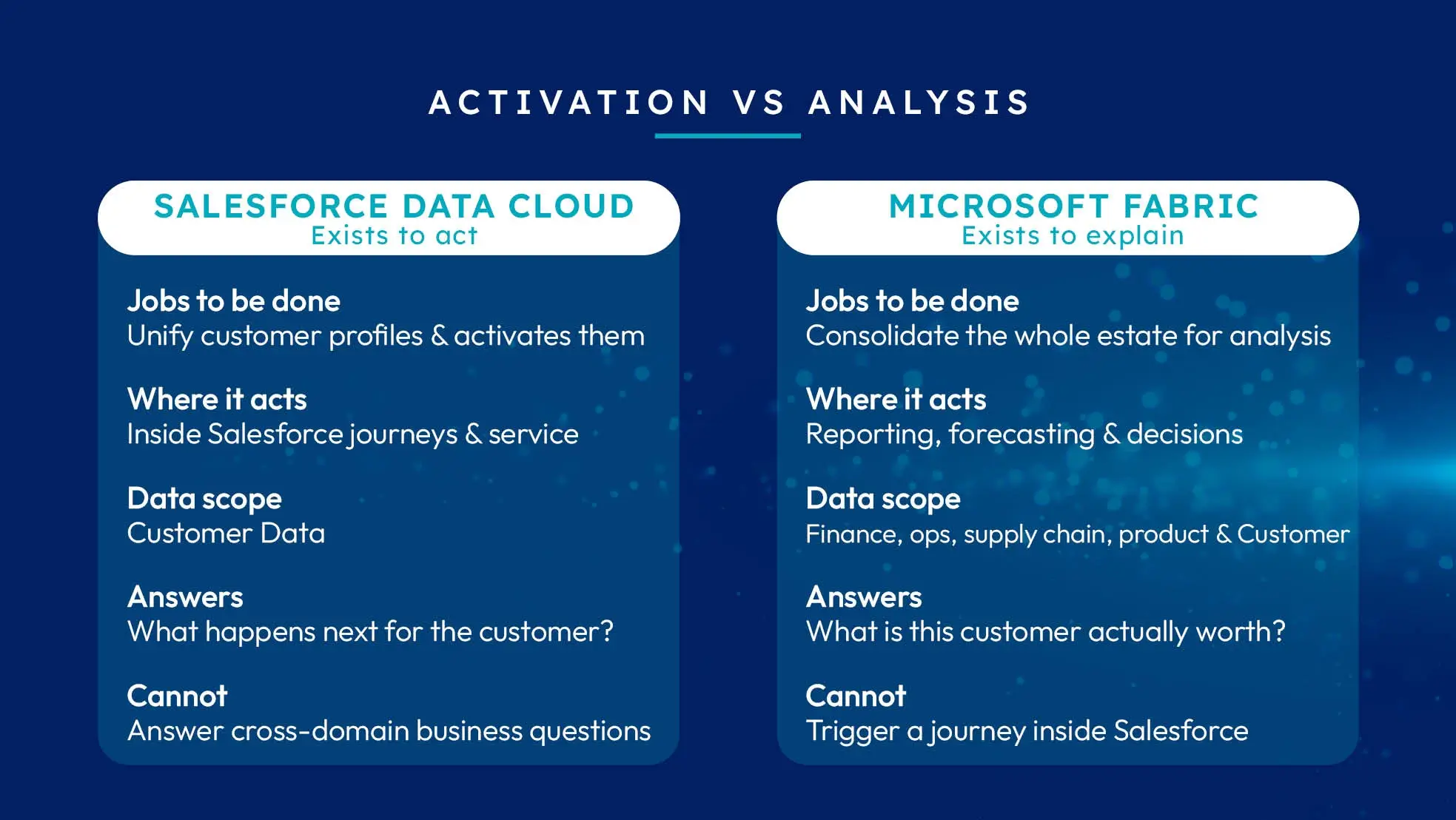
- Salesforce Data Cloud exists to act. It resolves identities into a unified customer profile and pushes segments and signals back into Salesforce so marketing, sales and service can use them in a journey, a campaign or a service interaction.
- Microsoft Fabric exists to explain. It consolidates finance, operations, supply chain, product and customer data into a governed model so the business can answer questions and make decisions.
Activation versus analysis. Once you hold that distinction, most of the confusion resolves.
What Data Cloud Does That Fabric Does Not
Activation inside the Salesforce ecosystem is the whole point, and an analytics platform cannot substitute for it. Building a segment in Fabric and exporting it to Salesforce on a schedule is not the same as a profile that updates in the flow of a service conversation.
If your requirement is real-time personalisation, journey orchestration, or giving an agent the current picture of a customer mid-call, that belongs where the action happens.
What Fabric Does That Data Cloud Does Not
Everything that is not about customers, and the cross-domain questions that are.
Customer profitability is the clearest example. Salesforce knows what a customer bought. It does not know what they cost to serve - that lives in the ERP, the support system, the logistics platform and the finance ledger. Answering it requires a platform that holds all of them, which is what a medallion lakehouse in OneLake is for.
The same applies to supply chain analytics, financial reporting, operational dashboards, workforce analytics and every board-level question that spans systems. Data Cloud is not designed for these and does not pretend to be.
Where They Genuinely Overlap
Two areas, and both are worth planning deliberately:
The customer record itself. Both can hold a unified customer view, and if both do, they will eventually disagree. Left unmanaged this becomes exactly the conflicting-numbers problem that stalls executive meetings.
Ingestion of the same sources. Both can pull from your web analytics, e-commerce platform and marketing tools. Doing this twice is not fatal, but it is duplicated pipeline maintenance and a second place for definitions to drift.
Drawing the Boundary
The rule that holds up in practice: decide by what the data is for, not by where it came from.
- Data that will trigger an action inside Salesforce belongs in Data Cloud.
- Data that will be analysed, reported on, or combined with non-customer systems belongs in Fabric.
- Data doing both needs one system of record and a defined direction of flow - not bidirectional sync, which is how two platforms quietly diverge.
Then agree the definitions once. "Active customer" must mean the same thing in both, and someone must own that definition. This is a data governance question, and it is far cheaper to settle before either platform is configured than after both are live.
Getting Salesforce Data Into Fabric
This is a well-trodden integration and one of the more common ones we build. Fabric pipelines ingest Salesforce objects on a schedule into OneLake, where they land in a governed medallion structure and join finance, operations and product data.
Update, 29 September 2026: Microsoft announced at FabCon Europe 2026 a preview of bidirectional integration with Salesforce Data Cloud 360. Microsoft says Salesforce data becomes part of the unified data estate "without moving or duplicating it", available across Fabric for analytics and AI, including as business context for Fabric data agents. While it is in preview, scheduled pipelines remain the production pattern, and the integration does not change the boundary rule above: each dataset still needs one system of record and a defined direction of flow.
The engineering considerations that matter: API limits, incremental loading against modified timestamps rather than full extracts, and conforming the Salesforce account to whatever the ERP calls the same customer. That last one is the unglamorous work that makes cross-system reporting possible, and it is where these projects succeed or fail. Our guide to breaking down data silos covers the pattern in more depth.
So Which Should You Buy?
If you run Salesforce seriously and need marketing or service activation, and you also need enterprise analytics, budget for both and draw the boundary deliberately.
If you need one and are choosing: buy Data Cloud if the problem is acting on customer data inside Salesforce. Buy Fabric if the problem is understanding the business. Consolidating onto either to save licence cost tends to be a false economy once you price the workarounds.
Where Solv Systems Comes In
We are a Microsoft Partner and we build Fabric platforms, including Salesforce integrations into Fabric. We are not a Salesforce implementation partner, and we will say so rather than talk you out of Data Cloud where activation is the genuine requirement.
Where we help is the boundary: mapping which workloads belong where, agreeing the definitions that must hold across both, and building the Fabric side so cross-system questions finally have an answer.
Sources and Further Reading
- Salesforce Data Cloud documentation
- Microsoft Fabric documentation
- Fabric lakehouse and medallion architecture tutorial
- FabCon and SQLCon 2026 in Barcelona: Building the data foundation for Microsoft Copilot and agents
Frequently asked
Only at the edges. Data Cloud is a customer data platform - it unifies customer records and activates them inside Salesforce for marketing, sales and service. Fabric is a general-purpose analytics platform covering finance, operations, supply chain and every other domain. They overlap on customer data and diverge everywhere else.
Often yes, if you run Salesforce seriously and need enterprise analytics. Data Cloud earns its place by activating segments and profiles inside Salesforce workflows, which an analytics platform cannot do. Fabric earns its place by answering questions that span systems Salesforce never sees. Organisations that force one to do both jobs usually end up disappointed with whichever they chose.
Yes. Fabric pipelines can ingest Salesforce objects on a schedule into OneLake, where they join finance, operations and product data in a governed model. This is one of the more common integrations we build, because customer profitability and cost-to-serve questions need data Salesforce does not hold.
It depends what the view is for. If the purpose is real-time activation - triggering a journey, personalising a service interaction - it belongs where the action happens, in Data Cloud. If the purpose is analysis, reporting and cross-domain questions, it belongs in the analytics platform. Many organisations reasonably maintain both, with agreed definitions shared between them.
Rarely, once the work is honest. Consolidating onto Data Cloud means rebuilding non-customer analytics in a platform not designed for it; consolidating onto Fabric means losing native activation inside Salesforce and rebuilding it. The saving on licences tends to be smaller than the cost of the workarounds.
The same way you stop any two systems disagreeing: one governed definition, defined once, with a clear owner - and a single direction of flow for each attribute rather than bidirectional sync everywhere. This is a data governance problem rather than a product problem, and it is worth settling before either platform is configured.