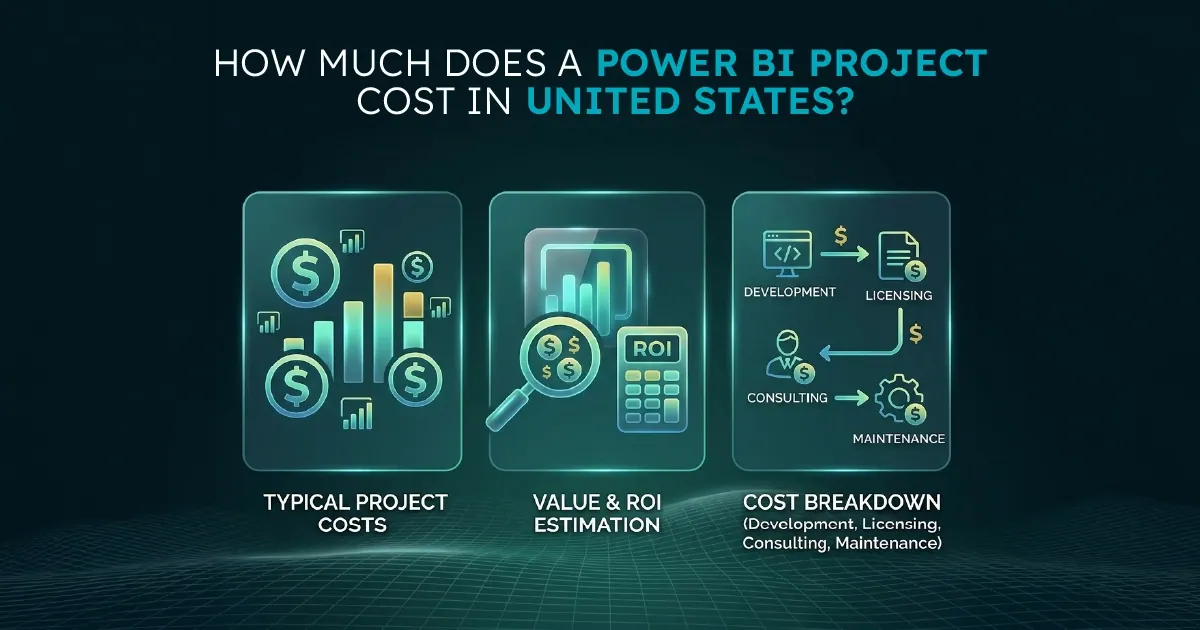
In Short: How Much Does a Power BI Project Cost in the US?
A Power BI project in the US typically costs between $3,000 and $300,000, depending entirely on what you actually need. The variation is wide because "a Power BI project" can mean anything from a single dashboard for an executive team to a full enterprise BI rollout replacing a legacy reporting platform.
This guide breaks the range into five real project profiles, with cost ranges in USD, what drives the variation, and the Microsoft licensing costs that sit alongside consulting fees. The numbers reflect typical US consultancy market rates and engagements we have scoped and delivered for US clients.
The intent is to help US buyers self-categorise their project in fifteen minutes so the conversation with any consultancy starts from a position of informed expectation rather than vendor opacity. Budget is half the picture; for elapsed time per profile, see how long a Power BI project takes.
A note on rates. The cost ranges below are based on Solv Systems' standard US rates. US-headquartered consultancies, global SIs, and specialist boutiques with premium positioning can all sit materially above these figures. Use these ranges as a floor, not a market average.
The Two Costs You Actually Pay
A Power BI project has two cost components.
The first is consulting cost: the people building the reports, models, and pipelines. This is the variable cost driven by scope and complexity, and it is what most of this guide covers.
The second is Microsoft licensing: the per-user or capacity-based fees you pay Microsoft for Power BI itself. Licensing is mostly predictable once you know your user count and tier choice. It is paid monthly and continues after the project ends.
All consulting fees in this article are quoted pre-tax. B2B consulting services are generally not subject to sales tax in most US states, but confirm with your finance team for your specific state situation.
Power BI Licensing in 2026 (US Context)
Microsoft restructured Power BI licensing in 2025, and the position in 2026 is now more settled. The four practical options:
Power BI Free. Personal use only. Cannot share content with other users. Useful for individual exploration or evaluation. Not viable for any organisational deployment.
Power BI Pro. $14 per user per month. The standard licence for organisational use, required to publish, share, and consume Power BI content in shared workspaces. Included in Microsoft 365 E5 at no additional cost - many US organisations are already paying for it without realising.
Power BI Premium Per User (PPU). $24 per user per month. Adds larger dataset sizes (100 GB), 48 daily refreshes, paginated reports, deployment pipelines, and advanced AI features. Every PPU user needs their own PPU licence, unless the content is hosted on a Fabric F64+ capacity.
Fabric F-SKU capacity. The successor to Power BI Premium per capacity (P-SKUs, retired for new customers in 2024). F2 starts at approximately $262 per month. F64 (approximately $8,388 per month) is the threshold where viewer users can consume Power BI content without per-user Pro licences - the right model for organisations distributing reports broadly to large viewer populations.
Four practical implications for US buyers:
- USD-native pricing. Microsoft prices Fabric capacity in USD globally. Power BI Pro and PPU are priced in USD for US customers, which means no currency fluctuation risk unlike some international markets.
- Enterprise Agreement pricing. Most large US organisations purchase through an EA or MCA. Check which model your organisation uses and when your agreement renews.
- The Pro vs F64 decision. The break-even between per-user Pro ($14 per month) and F64 capacity ($8,388 per month) sits at approximately 600 active Pro users at current pricing. Above that, F64 is materially cheaper. Most US enterprises with 1,000+ Power BI viewers have already moved to F64 or are actively planning to.
- Microsoft 365 E5 inclusion. A meaningful portion of US enterprises have Power BI Pro included via M365 E5 and have never claimed it. Audit your existing M365 licensing before purchasing additional Pro licences.
Five Project Profiles, Five Cost Ranges
Most US Power BI projects fall into one of five profiles. Pick the one that fits your context.
Profile 1: The Single Dashboard or Report
When this applies. You need one well-built, production-quality dashboard or report - usually for an executive team, a board pack, a compliance submission, or a single business function. Clear scope, defined audience, clean source data.
Team and timeline. One senior BI developer. One to two weeks. Five to fifteen consulting days.
What gets delivered. A production-ready Power BI report or dashboard, including data connections, semantic model, RLS if needed, visual design, and basic documentation. Typically one round of stakeholder review before sign-off.
Cost range: $3,000 to $10,000.
Who this fits. US mid-market organisations with a contained, defined reporting need. Often the right starting point before committing to larger work.
Profile 2: The Departmental BI Build
When this applies. Building a Power BI solution for a single department or business unit. Five to twenty reports, two to five source systems, a defined user group of 10 to 50 people.
Team and timeline. One to two BI developers, with a part-time architect on more complex projects. Four to eight weeks. Twenty to fifty consulting days.
What gets delivered. A complete departmental BI solution: data pipeline, shared semantic model, the in-scope reports, RLS where required, deployment to a shared workspace, user training, and documentation.
Cost range: $12,000 to $30,000.
Who this fits. The "we need proper reporting for Finance" or "Sales needs a dashboard suite" project. The most common Power BI project profile we see, both in the US and internationally.
Profile 3: The Mid-Sized BI Rollout
When this applies. Multiple departments in scope. Twenty to sixty reports. Five to ten source systems. A larger user base (50 to 500 users). Some governance requirements including consistent semantic model standards, naming conventions, and workspace structures.
Team and timeline. Two to three mixed consultants (architect, BI developers, part-time data engineer). Three to four months. Eighty to two hundred consulting days.
What gets delivered. A coordinated Power BI rollout across multiple business units. Centralised data layer (often a small Fabric Lakehouse or Warehouse), shared semantic models with governance baseline, the report estate, RLS and CLS patterns, workspace and app structure, training programmes, and adoption support.
Cost range: $50,000 to $125,000.
Who this fits. US organisations professionalising their BI practice for the first time. Common in mid-market businesses and the larger end of the SME segment with an existing Power BI footprint that has become inconsistent.
Profile 4: The Enterprise BI Build or Refresh
When this applies. Large-scale Power BI deployment, often replacing legacy reporting infrastructure. Sixty-plus reports. Multiple business units. Regulated environment (SOX, HIPAA, SEC, CCPA). Hundreds to thousands of users. Meaningful governance, security, and change management overhead.
Team and timeline. Three to five consultants: lead architect, BI developers, data engineer, part-time project manager, occasional governance lead. Four to eight months. Two hundred to five hundred consulting days.
What gets delivered. A production-grade enterprise Power BI estate. Modernised semantic models, full report estate, governance framework (Purview labels, RLS, CLS, DLP), capacity strategy at scale, deployment pipelines, training and enablement programmes, change management support, and transition to operational steady state.
Cost range: $125,000 to $300,000.
Who this fits. US enterprises modernising their BI estate - replacing Power BI Report Server, migrating from another BI tool, rebuilding a sprawled Power BI estate into something governed and supportable, or undertaking a regulated reporting modernisation.
Profile 5: Managed Power BI Service (Ongoing)
When this applies. You have a working Power BI estate that needs ongoing build, support, optimisation, and growth, but not a full-time internal BI team. Particularly relevant for US businesses wanting flexible senior capacity under a predictable monthly cost.
Three commercial shapes are typical:
- Light support (2–4 days per month): Bug fixes, small report additions, minor enhancements - $1,500 to $3,000 per month
- Embedded part-time (50% FTE): Active development on a rolling backlog, regular new reports, ongoing user support - $5,500 to $7,500 per month
- Full embedded resource (100% FTE): Equivalent of an in-house senior Power BI developer, managed by the consulting firm - $11,000 to $14,000 per month
Who this fits. US organisations that have completed a Power BI build and want continuous improvement, or where the workload is steady but not large enough to justify a full-time hire.
What Drives Cost Variation Within Each Profile
Five factors push a project up or down within its range.
- Complexity of business logic. A sales report on clean ERP data is fast. A profitability report reconciling allocations, intercompany eliminations, and cost roll-ups is much slower. The number of reports matters less than the complexity of the calculations behind them.
- State of the underlying data. Clean, documented source data is fast to work with. Excel exports, undocumented databases, and broken pipelines are slow. The same scope on clean versus messy data can vary by 30 to 50 percent.
- DAX complexity and performance requirements. Standard time intelligence and basic measures are quick. Complex DAX (parent-child hierarchies, advanced filter context, custom aggregations) is slower to build and validate. Sub-second performance requirements on large semantic models add real engineering effort.
- Visual design and stakeholder iteration. A pragmatic dashboard built once and signed off is fast. A heavily designed, multi-iteration dashboard with multiple senior stakeholders is slower. We have seen 10-report projects take longer than 30-report projects because of design iteration overhead.
- Internal team capacity. If your team can validate, sign off, and conduct UAT on time, projects move fast. If we are waiting on the client for two days every week, projects slip and cost rises.
What Is Typically Not Included in the Headline Number
A few items US buyers often miss when budgeting.
- Microsoft licensing. A separate Microsoft cost paid monthly, not part of consulting fees.
- Power BI capacity (F-SKU) if needed. For enterprises moving to F64+ for viewer access, capacity cost runs $8,400+ per month.
- Internal team time. Most projects require 10 to 30 percent of one to two internal team members for the duration - stakeholder sessions, requirements validation, sign-offs, UAT.
- Training beyond the basics. Comprehensive Power BI training programmes for hundreds of staff is a separate engagement from what is included in delivery.
- Custom visuals. Most projects use standard or AppSource visuals. Custom-developed visuals are bespoke engineering work and priced separately.
- Embedded analytics. Customer-facing applications with embedded Power BI use different licensing (Embedded A-SKUs or F-SKUs) and a different consulting profile. Worth scoping separately.
- Compliance documentation. For HIPAA-covered entities or SOX-regulated organisations, audit evidence packages and compliance documentation are real deliverables that sit outside a standard BI project scope.
How to Ballpark Your Power BI Project in Ten Minutes
Four questions get you most of the way.
How many reports are in scope? One to five suggests Profile 1 or 2. Five to twenty suggests Profile 2 or 3. Twenty-plus suggests Profile 3 or 4.
How many business units or departments are involved? One suggests Profile 1 or 2. Two to five suggests Profile 2 or 3. Five-plus suggests Profile 3 or 4.
How many active users will consume the reports? Under 50 suggests Profile 1 or 2. 50 to 500 suggests Profile 2 or 3. 500-plus suggests Profile 3 or 4, and likely an F-SKU capacity rather than per-user licensing.
Is the source data clean and well-modelled? Yes: stay in your profile. No: budget the higher end of your profile, or shift up one profile if the data work will be substantial.
This is not a quote. It is a sanity check before any consultancy conversation. A real proposal will be more specific.
Where Solv Sits
At Solv Systems we deliver Power BI projects across all five profiles to US clients from our headquarters in South Africa. We work with clients across all US time zones, with four to five hours of daily overlap with East Coast clients - enough for daily standups, regular stakeholder reviews, and same-day responsiveness on delivery questions.
We invoice US clients in USD under US-friendly contract terms. We engage as a consulting firm under a Corp-to-Corp service structure, not as individual contractors, which keeps contractor classification concerns out of the engagement for both sides.
The cost ranges above reflect what you would pay working with us. US-headquartered firms, global SIs, or boutiques with specialist positioning may charge considerably more for equivalent scope. Treat these ranges as a useful reference point, not an industry-wide ceiling.
Our team holds current Microsoft certifications across Fabric (DP-600, DP-700), Power BI (PL-300), and Azure data services (DP-203). You can read more about our US practice on our Microsoft Fabric and Power BI consultants US page. For the licence costs that sit on top of the project, see our guide to Power BI licensing in 2026.
Sources and Further Reading
Frequently asked
Because 'simple' varies enormously. A single executive dashboard on clean SAP data is a five-day job. The same dashboard on data spread across three Excel files, four database tables, and a PowerPoint deck is a fifteen-day job. The ranges honestly reflect what we see, rather than averaging it away.
Yes, for clearly scoped projects. Profile 1 and Profile 2 work is almost always fixed-bid. Profile 3 and Profile 4 are typically time and materials inside a not-to-exceed envelope. Profile 5 (managed service) is a monthly retainer.
We deliver under a Corp-to-Corp service agreement - your organisation is contracting with Solv Systems as a consulting firm, not with individual contractors. This avoids contractor classification complexity (employee vs. independent contractor under IRS and state rules) that arises with direct 1099 relationships on ongoing work.
No. We are headquartered in Gqeberha, South Africa, with consultants delivering globally. We invoice US clients in USD under US contract terms. We attend in person in the US for discovery, key stakeholder sessions, and the moments that genuinely need it.
South Africa is on GMT+2. With US East Coast clients, we share four to five hours of daily working-hours overlap - enough for standups, stakeholder reviews, and same-day resolution of issues. For West Coast clients, we adjust our schedule to cover the overlap window.
Depends on your viewer count. At current US pricing ($14 per month Pro vs $8,388 per month F64), the break-even is approximately 600 active Pro users. Below that, Pro per user is cheaper. Above that, F64 is cheaper. We model this for clients during scoping using actual user counts and a realistic three-year projection.
Microsoft Fabric and Power BI services are available across multiple US Azure regions (East US, West US, Central US, and others). For clients with data residency requirements - including HIPAA-covered entities, SOX-regulated firms, and state-level privacy laws like CCPA - we design solutions to keep data within US Azure regions.
A pure Power BI project is much narrower than a Fabric migration. Fabric migrations include data platform work - Lakehouses, Warehouses, pipelines - that Power BI projects often skip. If the project is 'we need better reporting', it is usually a Power BI project. If it is 'we need to modernise our data platform end-to-end', it is a Fabric migration.