In Short: Four Layers, Three Bills, One Dependency
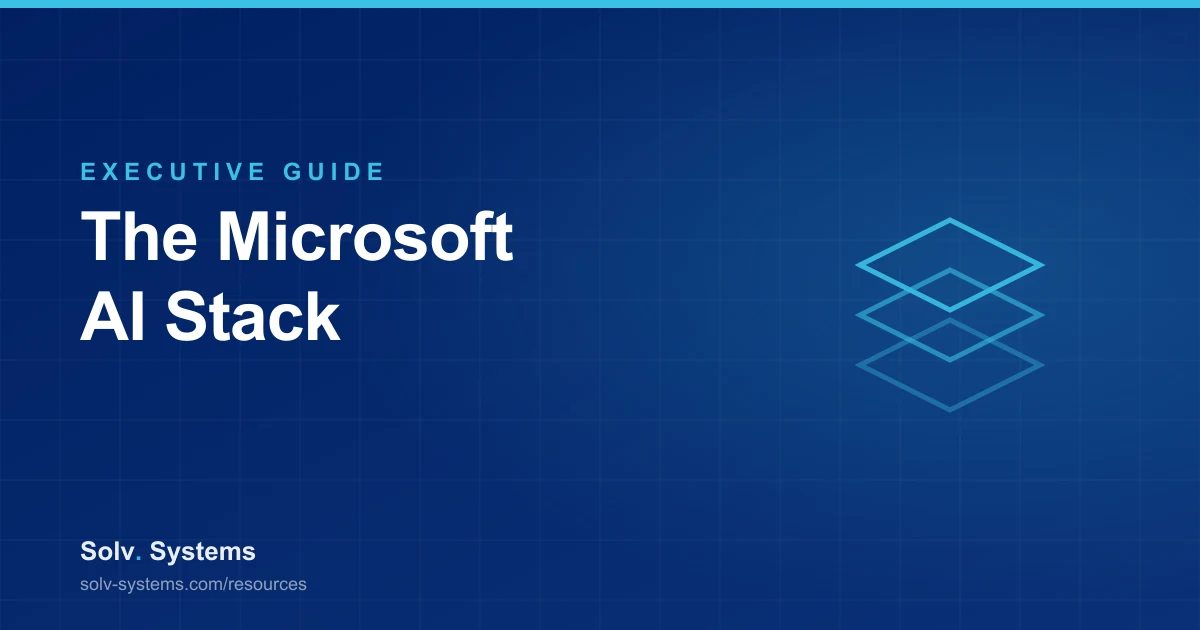
Strip the branding and Microsoft's AI portfolio resolves into four layers: assistants your people use, platforms your teams build agents on, a context layer that grounds all of it in your organisation's knowledge, and the data platform underneath. Three charging models run through it - per-user licences, Fabric capacity consumption, and metered usage - and one dependency runs under everything: the quality and governance of your data estate, which no licence purchase can compensate for.
That is the whole map. The rest of this guide walks it layer by layer, with the funding view attached, because the executive question is rarely "what is it" and usually "what does it commit us to".
Layer 1: Assistants People Use
Microsoft 365 Copilot is the per-user flagship: the assistant in Teams, Word, Excel and Outlook, grounded in your Microsoft 365 estate. Copilot Cowork, generally available since 16 June 2026, extends it from assistance to delegation: agentic workspaces where work is handed over rather than co-written, a shift we unpack in our Cowork analysis. Copilot in Fabric and Power BI brings the same assistance to the data estate, billed against capacity rather than per user, per our capacity consumption guide.
The funding view: per-user licences for the roles that measurably benefit, the included Copilot Chat tier for everyone else, and capacity headroom for the BI side. The full licensing map is in our Copilot licensing guide.
Layer 2: Platforms That Build Agents
Three build paths, matched to three builders. Copilot Studio for makers assembling conversational agents from connectors and topics. Microsoft Foundry for engineers building custom agents with full model choice and evaluation - the Studio versus Foundry decision is one of the first architectural forks. Fabric data agents for the analytics-specific case: curated question-answering over governed data, the build-versus-enable choice every data leader now faces.
The funding view: consumption, in credits or tokens, which scales with success. The discipline that keeps it sane is piloting one agent, measuring, and building the cost model from evidence, as we detail in what AI agents cost.
Layer 3: The Context Layer
Microsoft IQ, announced at Build 2026, is the strategic centre of the portfolio: four pillars that ground AI in knowledge with permissions enforced. Work IQ over workplace data, whose APIs reached GA on 16 June 2026; Fabric IQ, the semantic foundation over structured business data; Foundry IQ for retrieval across enterprise knowledge; Web IQ for live web grounding.
Why an executive should care about what sounds like plumbing: grounding is the difference between an assistant that answers from your governed numbers and one that improvises fluently. It is also where your existing investments compound - every well-built semantic model becomes agent infrastructure the day IQ touches it.
Layer 4: The Data Platform, and the Dependency That Rules Them All
Underneath everything sits Fabric and OneLake: the governed data foundation the assistants query, the agents ground in, and the context layer reads. This is where the uncomfortable truth lives: every layer above amplifies the state of the data below. Wrong data becomes fluent wrong answers; loose permissions become searchable exposure; ambiguous definitions become inconsistent AI behaviour.
Which is why our standing advice inverts the usual buying order: fund the readiness work - quality, semantic models, security - for a handful of domains first, then switch on the assistants, then build the first agent, then scale on evidence. The organisations that bought the stack top-down are the ones writing the cautionary case studies; the ones that built bottom-up are the ones renewing the licences. For the strategy behind the portfolio, see our analysis of Microsoft's AI strategy for 2026.
Sources and Further Reading
Frequently asked
Four, in practice: assistants people use (Microsoft 365 Copilot, Copilot Cowork, Copilot in Fabric and Power BI); platforms for building agents (Copilot Studio for makers, Microsoft Foundry for engineers, Fabric data agents for analytics); the context layer that grounds AI in your knowledge (Microsoft IQ, spanning Work IQ, Fabric IQ, Foundry IQ and Web IQ); and the data platform underneath it all (Fabric and OneLake).
The context layer, announced at Build 2026, that grounds AI in your organisation's knowledge with permissions enforced: Work IQ over workplace data, Fabric IQ over structured business data, Foundry IQ for retrieval, Web IQ for the live web. It matters because grounding is what separates an assistant that knows your business from one that improvises about it.
Three cost models: per-user licences (Microsoft 365 Copilot, GitHub Copilot), capacity consumption (Copilot and AI features in Fabric, billed in capacity units), and metered consumption (Copilot Studio credits, Foundry tokens and hosting). Most estates end up with all three, which is why AI cost governance is its own discipline.
The boring answer with the best track record: fix the data foundations for two or three domains, roll Copilot to the roles with obvious productivity cases, build one scoped data agent on your strongest domain, and only then invest in custom agents. Each step funds confidence in the next.
Cowork, generally available since 16 June 2026, is Microsoft's agentic workspace: instead of chatting with an assistant, users delegate tasks that agents carry out across files, mail and meetings. Strategically it signals where the licence value is heading - from assistance to delegation - and it raises the stakes on the same foundations: permissions, labels and data quality.