In Short: GPT-6 in Microsoft Foundry Is Now a Family of Four
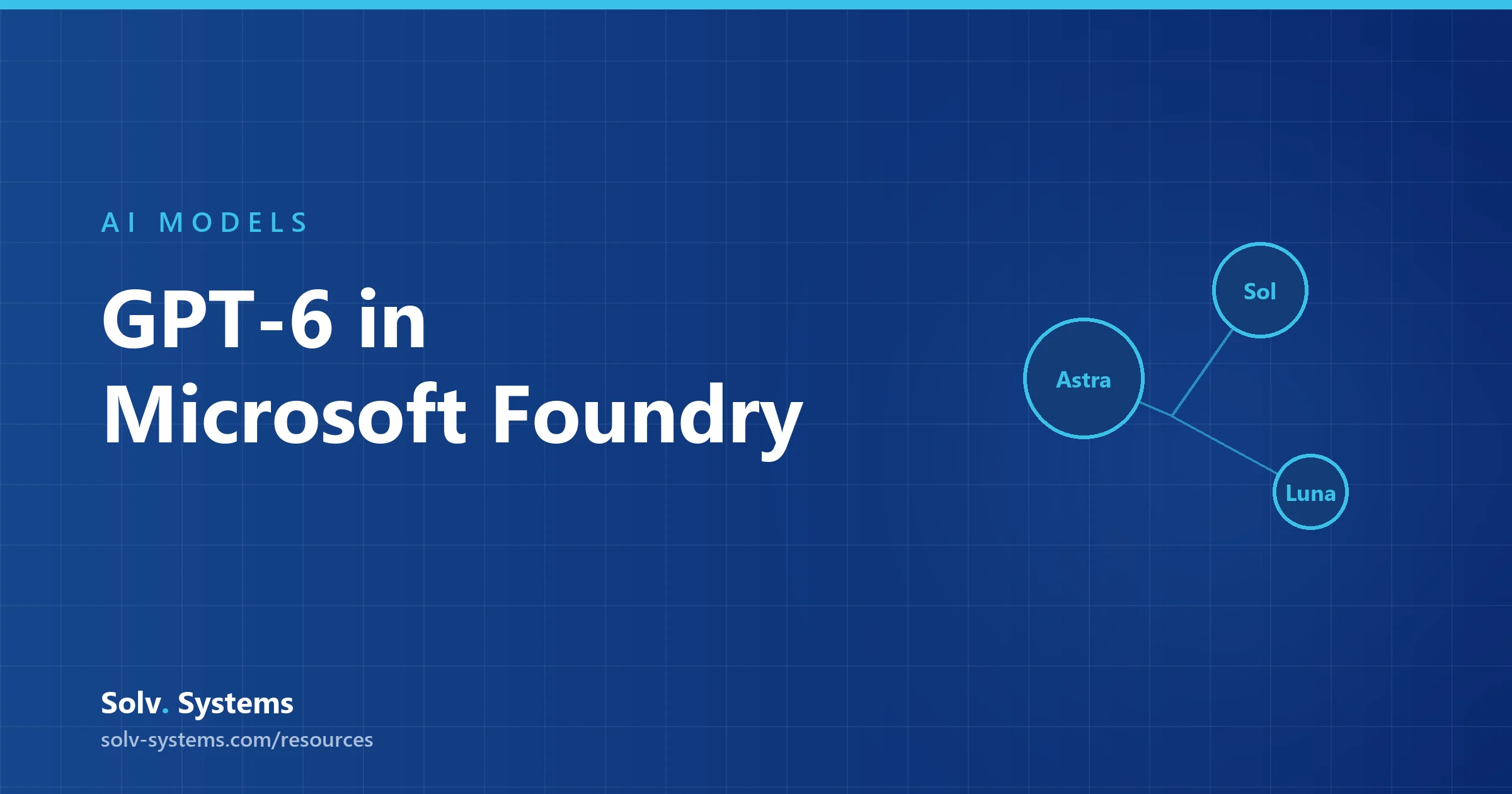
OpenAI's GPT-6 series is now complete in Microsoft Foundry, and the newest member is already the one most teams should test first. GPT-6 Astra became generally available on 3 September 2026, GPT-6 Sol and GPT-6 Luna joined it on 22 September, and on 30 September Microsoft announced that GPT-6.1 Sol is generally available as an upgrade to GPT-6 Sol.
Microsoft's guidance in the GPT-6.1 Sol post is short: "start with GPT-6 Astra for the most demanding reasoning, use GPT-6.1 Sol as the new default for production agents and complex workflows, and scale high-volume data and preparatory tasks with Luna." This post covers what each model is for, what GPT-6.1 Sol costs by deployment type, and how to decide on evidence rather than launch notes.
Astra vs Sol vs Luna: What Each Model Is For
In Microsoft's own wording:
- GPT-6 Astra brings "advanced reasoning, software engineering and computer use to demanding work that requires both judgment and action." Microsoft recommends customers "start with GPT-6 Astra for demanding work."
- GPT-6 Sol is "excellent for general-purpose use". It supports "enterprise agents, coding and complex knowledge work, including reasoning across multiple steps, long-context analysis, and workflows that use tools."
- GPT-6 Luna is "Sol's smaller, faster sibling, built for high-volume work. Use it for extraction, summarization, request routing, and routine customer interactions."
- GPT-6.1 Sol delivers "substantial improvements in agentic coding, computer use, and professional work, with performance approaching GPT-6 Astra across these evaluations."
Microsoft Learn lists the same shape for all four: a 1,050,000-token context window, up to 922,000 input tokens and 128,000 output tokens, reasoning effort and verbosity controls, computer use, and text and image input with text output. Training data runs to April 2026 for Astra and both Sol models, and May 2026 for Luna. Learn also notes that some quota tiers must request quota for the GPT-6 family, while Tier 5 and Tier 6 subscriptions have it by default.
What GPT-6.1 Sol Costs
These are Standard (pay-as-you-go) prices from Microsoft's GPT-6.1 Sol launch post, in USD per million tokens (input / cached input / cached writes / output):
- Global Standard, short context: $2.00 / $0.10 / $2.50 / $10.00
- Global Standard, long context: $4.00 / $0.20 / $5.00 / $15.00
- Data Zone Standard (US): $2.20 / $0.11 / $2.75 / $11.00 short; $4.40 / $0.22 / $5.50 / $16.50 long
- Data Zone Standard (EU and APAC): $2.40 / $0.12 / $3.00 / $12.00 short; $4.80 / $0.24 / $6.00 / $18.00 long
Microsoft states that "the US Data Zone is priced at a 10% premium to Global, and the EU and APAC Data Zones are priced at a 20% premium to Global." Learn explains that short and long context refer to the number of input tokens in an individual request, not the model's maximum window. We could not find the GPT-6 threshold stated on the pricing page at the time of writing, so confirm it before modelling long-context workloads.
For comparison, the 22 September post prices GPT-6 Sol identically except for cached input, which is $0.20 short context and $0.40 long context. GPT-6.1 Sol halves that rate, which matters for agents that resend a long, stable system prompt on every turn. The same post lists GPT-6 Astra at $10.00 input and $50.00 output (short context, Global) and GPT-6 Luna at $0.10 and $0.50.
On 1 October the Azure OpenAI pricing page listed Astra, Sol and Luna but not yet GPT-6.1 Sol, so the launch post is the only Microsoft source for its prices today.
Provisioned Throughput and Data Residency
For GPT-6.1 Sol, "Provisioned Throughput is available at launch through Global and US Data Zone deployments", and Microsoft says "additional regions and deployment options will follow soon." It has not published GPT-6.1 Sol PTU prices; the post says only that "Provisioned Throughput pricing varies by deployment type." The pricing page does list GPT-6 Astra PTUs: a minimum of 15, at $1 per PTU hour Global and $1.10 in the Data Zone.
The residency choice is the governance decision. Learn describes Global deployments as ones that "might be processed in any Azure region where the model is deployed", while for Data Zone deployments "Microsoft processes prompts and responses anywhere within the specified data zone" - the US, the EU or Asia Pacific. For UK and EU personal data, that distinction belongs in your GDPR assessment of the data platform.
Check the Learn region table rather than the launch posts alone. On 1 October it did not show GPT-6 Astra under EU Data Zone Standard, or any GPT-6 model under EU Data Zone Provisioned, although the 22 September post lists both. Astra's GA post also states that "prompts and outputs are not used to train the models."
Where GPT-6 Sits in the Foundry Catalogue
GPT-6 is not the only new frontier option this month. Claude Opus 5.5 reached Foundry on 22 September at $4 input and $20 output per million tokens (Global Standard and US DataZone, hosted on Azure), and Claude Sonnet 5.5 followed on 28 September at $2 and $10. Sonnet 5.5 matches GPT-6.1 Sol's short-context headline price, which makes the comparison a question of quality per task rather than list price. Our framework for choosing models in Microsoft Foundry still applies: route each task to the cheapest model that clears your quality bar.
One caution on automation: the model router can pick models per prompt, but the Learn page listing its supported models did not yet include any GPT-6 model when we checked. If you want GPT-6 in production now, you have to choose and deploy it yourself.
For older OpenAI deployments, Microsoft's advice is to evaluate "an upgrade to GPT-5.6 Sol and above". The pricing page lists GPT-5.6 Sol at $4 input and $20 output (short context, Global), twice the GPT-6 Sol rate.
What GPT-6 Means for the Cost of Agents
Microsoft says it plainly: "look beyond price per token to cost per task." Agents multiply tokens across turns, tool calls and retries, so the unit price is only one input - our breakdown of what AI agents cost to run covers the rest.
As an illustration (our arithmetic on Microsoft's Global short-context prices, excluding cache writes), take an agent turn with 30,000 cached input tokens, 10,000 fresh input tokens and 3,000 output tokens:
- GPT-6 Astra: about $0.28 per turn
- GPT-6.1 Sol: about $0.053 per turn
- GPT-6 Luna: about $0.003 per turn
The gap between tiers is roughly five to twenty times, so the routing decision matters more than which point release you choose. Flexible reasoning effort is the second lever: Microsoft says it lets teams reserve "deeper reasoning for the work that needs it."
What to Do Now
- Build an evaluation set first. Fifty to a hundred real cases per task type, scored on Astra, GPT-6.1 Sol, Luna and the Claude 5.5 models. Microsoft's own line is that "the right model for a job should be determined through evaluations."
- Test GPT-6.1 Sol where you run GPT-6 Sol or GPT-5.x today. Same headline price as GPT-6 Sol, cheaper cached input, and Microsoft's stated improvements in agentic coding and computer use.
- Push routine steps down to Luna - extraction, summarisation and routing - and measure what you lose, if anything.
- Choose the deployment type deliberately. Global, Data Zone or Provisioned, checked against the Learn region table.
- Keep identity and data controls in place. Agents with computer use need scoped access; see our guide to governing AI agents with Entra Agent ID.
- Do not plan on tuning GPT-6 yet. Learn's reinforcement fine-tuning list is still o4-mini and invitation-only GPT-5; our comparison of RFT services covers the options.
For how this release changes our earlier comparison, see MAI-Thinking-1 vs Claude vs GPT-5.
Where Solv Systems Comes In
We build production agents on Microsoft Foundry and spend most of our model time on evaluation, not selection. If you want Astra, GPT-6.1 Sol, Luna and the Claude models tested on your own tasks, with a cost per task for each, our AI automation consultants can run that evaluation and leave the harness with your team.
Sources and Further Reading
- GPT-6 Astra, Sol, and Luna: For production agents in Microsoft Foundry (Microsoft Azure Blog, 22 September 2026)
- Introducing GPT-6.1 Sol in Microsoft Foundry (Microsoft Foundry Blog, 30 September 2026)
- GPT-6 Astra: Frontier intelligence for work, now generally available in Microsoft Foundry (Microsoft Azure Blog)
- Foundry Models sold by Azure (Microsoft Learn)
- Region availability for Foundry Models sold by Azure (Microsoft Learn)
- Azure OpenAI pricing
- Claude Opus 5.5 comes to Microsoft Foundry (Microsoft Foundry Blog)
- Claude Sonnet 5.5 is now available in Microsoft Foundry (Microsoft Foundry Blog)
- Model router in Foundry Models (Microsoft Learn)
Frequently asked
Microsoft positions Astra for the most demanding reasoning, software engineering and computer use; Sol for general-purpose production agents, coding and complex knowledge work; and Luna, Sol's smaller and faster sibling, for high-volume work such as extraction, summarisation, request routing and routine customer interactions.
Yes. Microsoft announced on 30 September 2026 that GPT-6.1 Sol is generally available in Microsoft Foundry, as an upgrade to GPT-6 Sol. Microsoft now describes it as the new default for production agents and complex workflows.
Microsoft's launch post lists Global Standard at $2.00 input, $0.10 cached input, $2.50 cached writes and $10.00 output per million tokens for short context, and $4.00, $0.20, $5.00 and $15.00 for long context. The US Data Zone is a 10% premium and the EU and APAC Data Zones a 20% premium. Check the Azure OpenAI pricing page for current rates.
Microsoft Learn lists a 1,050,000-token context window for GPT-6 Astra, Sol, Luna and GPT-6.1 Sol, with up to 922,000 input tokens and 128,000 output tokens. Input, output and reasoning tokens share that budget.
Microsoft's posts list EU Data Zone Standard deployments for the GPT-6 series and for GPT-6.1 Sol, where prompts and responses are processed within the EU. Provisioned Throughput for GPT-6.1 Sol launched in Global and the US Data Zone only, and the Learn region tables do not match the launch posts in every case, so check the region availability page for the exact model and deployment type.
Not without evaluation. Microsoft's own guidance is that the right model should be determined through evaluations and that cost per task matters more than price per token. Run your own tasks on Astra, GPT-6.1 Sol, Luna and the Claude models before switching production traffic.