In Short: What actually is the Microsoft Fabric Remote MCP Server ?
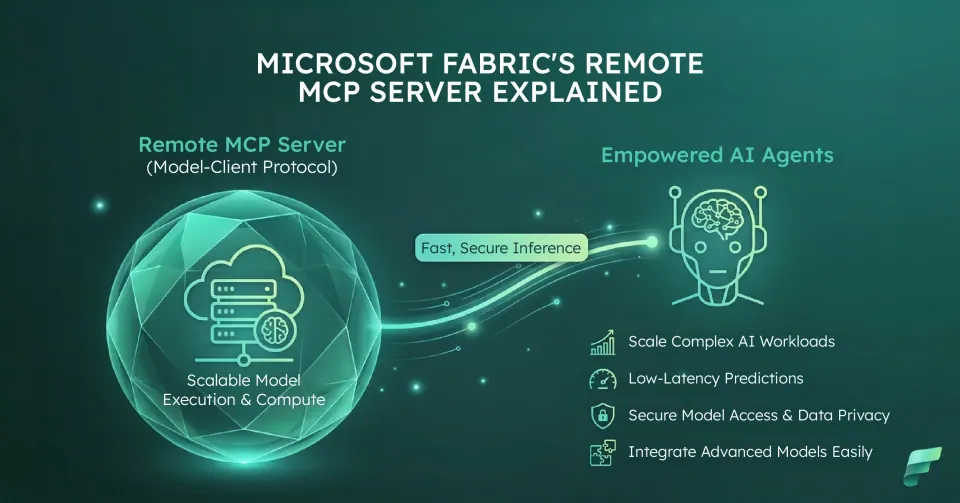
Microsoft Fabric's Remote MCP Server is a cloud-hosted interface that allows AI agents to connect directly to your Fabric data environment. Rather than building custom connectors, teams can expose Fabric capabilities to AI agents through a standardised protocol to control exactly what those agents can see and do.
If you are weighing up what this means for your own estate, our Microsoft Fabric consulting services and implementation cost guides for the UK, US and South Africa are a practical starting point.
Why Does AI Agent Integration Matter Now?
Organisations are moving quickly from experimenting with AI assistants to deploying AI agents. These are systems that take sequences of actions autonomously, rather than just answering individual questions.
The challenge is data access. An AI agent is only as useful as the data it can reach. And connecting agents reliably and securely to enterprise data environments has, until recently, required significant custom engineering work for each integration.
Model Context Protocol (MCP) is an emerging standard that changes this. It provides a common interface between AI agents and the data sources or tools they need to interact with, reducing the integration burden substantially.
Microsoft Fabric's Remote MCP Server implements this standard at the platform level.
What Is the Remote MCP Server?
The Remote MCP Server is a cloud-hosted MCP implementation built into Microsoft Fabric. It was released in preview as part of the March 2026 feature update.
In practical terms, it means:
- AI agents can connect to Fabric through a standardised interface
- The connection is cloud-hosted: agents do not need to run locally or within a specific environment to access Fabric
- Access controls, governance policies, and security configurations set in Fabric apply to agent interactions automatically
A local MCP option was already generally available. The Remote MCP Server extends this to cloud-hosted agent deployments, which is the more common scenario for enterprise AI workloads.
What Can AI Agents Actually Do Through the MCP Server?
Through the Remote MCP Server, agents can interact with Fabric capabilities including:
- Querying data from lakehouses, warehouses, and KQL databases
- Running notebooks and pipelines on demand
- Accessing OneLake metadata and catalogued assets
- Triggering Data Factory pipelines based on external events or conditions
- Reading from Fabric Data Agents as virtual analysts
The key distinction is that these interactions happen through Fabric's security and governance layer, not around it. Access is scoped to what the agent's identity is permitted to see, enforced by the same mechanisms that govern human users.
How Does This Relate to Fabric Data Agents?
Fabric Data Agents reached general availability in March 2026. They are virtual analysts: natural language interfaces that can query multiple data sources across a Fabric environment and return synthesised answers.
The Remote MCP Server and Fabric Data Agents are complementary, not alternatives:
- Fabric Data Agents are the intelligence layer that understands questions and produces answers from data
- Remote MCP Server is the connectivity layer that allows external agents and AI systems to interact with Fabric programmatically
An organisation might use Fabric Data Agents for business users asking natural language questions, while using the Remote MCP Server to connect an autonomous operations agent that monitors pipelines and alerts on anomalies.
What Business Problems Does This Solve?
1. It Removes the Custom Integration Tax Every AI agent deployment that previously required a bespoke Fabric connector now has a standardised path, reducing build time and ongoing maintenance.
2. It Brings Agent Interactions Under Governance Agents connecting through the Remote MCP Server operate within Fabric's existing access control and audit framework. Security teams do not need to build separate governance mechanisms for AI workloads.
3. It Enables Multi-Agent Architectures on Fabric Data Multiple agents, such as monitoring agents, analysis agents, and reporting agents, can connect to the same Fabric environment through a common interface, without creating conflicting or redundant data access patterns.
4. It Accelerates AI-Ready Data Estate Maturity Teams that have invested in structuring their data in Fabric can now expose that investment to AI workloads without rebuilding the data layer for each new use case.
What Is the Strategic Point Most Organisations Miss?
The Remote MCP Server is infrastructure, not a product. Its value is in what it enables, rather than in what it does on its own.
Organisations that see it as a technical feature to evaluate in isolation will underestimate its significance. Organisations that treat it as the connectivity foundation for their broader AI agent strategy will find it significantly reduces the friction between their data investments and their AI ambitions.
Why work with Solv Systems on AI Agent Integration?
At Solv Systems, we integrate AI agents with Fabric to drive autonomous action, not just individual answers.
Strategy Before Build
We define clear use cases for AI agents within your workflows before selecting the connectivity layer.
Patterns That Scale
We use standardized protocols like MCP to ensure your AI agents are modular, maintainable, and secure.
Proactive Engineering
We manage the complex integration between language models and enterprise data environments so you don't hit engineering bottlenecks.
Governance and Adoption
We ensure every agent interaction is governed by the same security policies that protect your core data estate.
This article is part of our Fabric MCP series. For how the servers fit together - and why you likely need more than one - start with The Fabric MCP Stack: What Each Server Does.
Sources and Further Reading
Frequently asked
It was released in preview in March 2026. A GA timeline has not been confirmed.
MCP is an open standard for connecting AI agents and language models to external tools and data sources. It was introduced by Anthropic and is gaining broad adoption across the AI ecosystem.
Yes. The local MCP Server reached general availability earlier. The Remote MCP Server extends the same capability to cloud-hosted deployments.
No. Direct API integrations remain available. The Remote MCP Server provides an alternative path better suited to AI agent frameworks that support the MCP standard.
No. The Remote MCP Server is independent of Fabric Data Agents, though the two are designed to work well together.