In Short: What Is the Fabric Pro-Dev MCP Server?
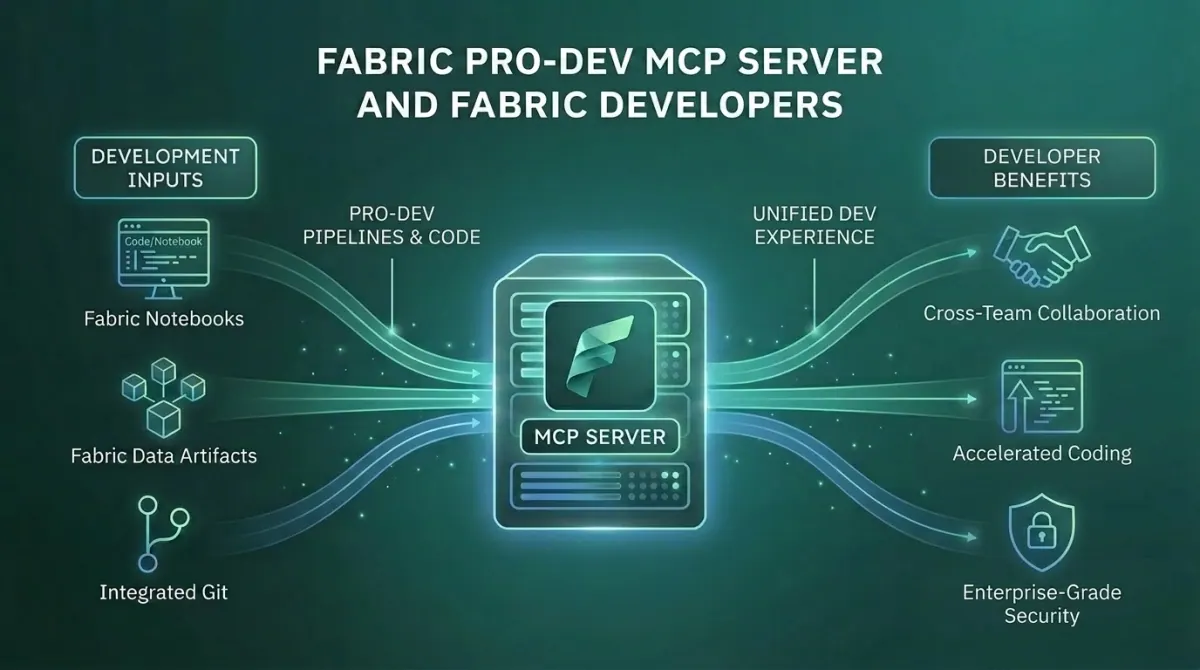
The Fabric Pro-Dev MCP Server is a local Model Context Protocol server that gives AI coding assistants comprehensive, accurate knowledge of Microsoft Fabric. It packages the full Fabric REST API specification, JSON schemas for every item type, OneLake data operations, and Microsoft's own best practice guidance into a single context layer the agent can read from at code generation time.
It runs as a subprocess on the developer's machine. It is open source. It is generally available, which puts it ahead of the cloud-hosted Core server, which is still in preview.
For Fabric developers writing notebooks, pipelines, deployment scripts, and custom items, this is the tool that makes the difference between AI-generated code that compiles and AI-generated code that actually works against the current Fabric API surface.
If you are weighing up what this means for your own estate, our Microsoft Fabric consulting services and implementation cost guides for the UK, US and South Africa are a practical starting point.
What Problem Was Microsoft Trying to Solve?
The honest version of "AI assists with Fabric development" looks like this. A developer asks GitHub Copilot to write a Python script that creates a Lakehouse and uploads a CSV file. The model generates code that looks correct, references plausible API endpoints, uses reasonable parameter names, and runs without syntax errors. It then fails at runtime because the API surface changed, the parameter names are slightly different, the authentication pattern is wrong, or the item definition schema does not match what Fabric actually expects.
This is not a model intelligence problem. It is a context problem. Frontier coding models are trained on snapshots of the public internet, and Fabric's API surface evolves faster than any training run. Without grounded context, the model produces plausible-looking code that drifts from reality in subtle ways. The developer spends as much time correcting the AI as they would have spent writing the script themselves.
The Fabric Pro-Dev MCP Server addresses this directly. The server ships with the live OpenAPI specifications, current JSON schemas, and Microsoft's recommended patterns embedded as MCP resources the agent reads at the moment of code generation. The model is no longer guessing. It is consulting the actual reference, packaged as MCP tools.
The downstream effect is that AI-generated Fabric code stops being a starting point that needs heavy correction and starts being something close to production-ready on first generation.
What Is the Fabric Pro-Dev MCP Server, Exactly?
Pro-Dev is one of two Fabric MCP servers. The split is straightforward.
- Fabric Pro-Dev MCP Server - Local subprocess. Open source. Optimised for development workflows. Provides API documentation, item schemas, best practice guidance, OneLake data operations, and core item creation. Has access to the local file system. Generally available.
- Fabric Core MCP Server - Cloud-hosted by Microsoft. Performs real operations against your live Fabric tenant. No local install. Public preview.
Pro-Dev is for building. Core is for operating. Most teams will use both, often in the same workflow.
The Pro-Dev server exposes several categories of capability:
API specifications and best practices
Full OpenAPI specs for Fabric's public APIs. The agent looks up the correct endpoint, parameter names, request shapes, and response handling at code generation time. Pagination, long-running operations, and error handling guidance are surfaced as standalone tools the agent can consult.
Item definition knowledge
JSON schemas for every Fabric item type - Lakehouses, pipelines, semantic models, notebooks, real-time intelligence workloads, and the rest of the catalogue. When an agent generates code that creates or modifies a Fabric item, it reads from the actual current schema rather than a stale memory.
OneLake operations
Tools that connect the developer's local file system to OneLake. Uploads, downloads, table namespace discovery, table configuration, and DFS-level item listing. The pattern is "I have this CSV locally, get it into the Bronze Lakehouse in this workspace as a Delta table" - and the agent can complete the full round trip.
Fabric CLI wrapping
Pro-Dev can wrap the Fabric CLI as MCP tools, which is how CI/CD scenarios actually work. A deployment pipeline invokes the agent, the agent invokes the CLI through MCP, and changes deploy without a human in the loop.
Local file system access
This is the differentiator from Core. Pro-Dev can read configuration files, write generated code, manipulate Power BI Project files, and operate on local folders. The developer's working directory becomes part of the agent's context.
The recommended install is the VS Code extension, which handles configuration and authentication automatically. The server also works with GitHub Copilot, Claude Desktop, Cursor, Claude Code, and any MCP-compatible client.
What Changes for Fabric Developers?
The day-to-day shift is meaningful, and most of the value comes from changes that look small in isolation but compound across a working week.
- Code generation gets a lot more reliable - The single largest change is that AI-generated Fabric code now has access to the current API spec at generation time. The "looks right but does not work" problem largely goes away. The agent reads the spec, generates the code, and the code works on the first run. This changes the developer's relationship with AI assistance from "useful starting point" to "actually faster than writing by hand".
- Local-to-cloud data operations become conversational - Uploading a file to OneLake, registering a Delta table, configuring partitioning, inspecting schemas. With Pro-Dev, the developer describes the outcome and the agent walks the steps, prompting for clarification only when something is ambiguous.
- Item creation follows the right schema by default - When an agent creates a notebook, a pipeline, or a semantic model definition, it reads from the current JSON schema. Items get created correctly the first time, including the parts that are easy to forget - like default lakehouse references in notebooks or trigger definitions in pipelines.
- CI/CD becomes more accessible - The Fabric CLI wrapped through Pro-Dev means deployment automation no longer requires deep CLI knowledge. A developer can describe a deployment and the agent assembles the right CLI calls. This does not replace proper CI/CD pipelines. It lowers the barrier to setting them up.
- Documentation generation becomes routine - Pro-Dev includes tools for inspecting items and producing structured documentation. Generating a Markdown reference for a workspace - with item descriptions, schema details, and dependency relationships - becomes a single prompt.
Where Does It Fit in the Broader Fabric MCP Story?
Microsoft's MCP strategy across Fabric and Power BI is more coordinated than it might appear at first. The cleanest way to see it:
- Fabric Pro-Dev MCP Server - Local development companion. Generally available. Knows everything about Fabric's API surface and item schemas. Used during the build.
- Fabric Core MCP Server - Cloud operations layer. Public preview. Cloud-hosted. Performs real operations against your live tenant. Used during the operate.
- Fabric RTI MCP Server - Real-Time Intelligence layer. Public preview. Exposes Eventhouse, Eventstream, and KQL operations as tools.
- Power BI Modeling MCP Server (now listed as the Power BI Authoring MCP server) - Semantic model development. Generally available as a local server, with a hosted remote version in preview. Builds and modifies models through natural language.
- Power BI Remote MCP Server - Data query layer. Public preview. Cloud-hosted. Queries published semantic models.
A developer working in VS Code with Pro-Dev, Core, and the Power BI Modeling server has the full Fabric and Power BI surface available in one conversation. This is the composition pattern Microsoft is building toward, and Pro-Dev being generally available first signals where the priority sits.
The Strategic Point Most Organisations Miss
Pro-Dev is not really about productivity. It is about raising the floor on what every Fabric developer can produce.
The first reaction most teams have is "this saves time on the boring parts of Fabric development". That is true and it is the lowest-value framing of what the tool actually does.
The bigger shift is that the gap between a senior Fabric developer and a junior one narrows on the technical surface. The senior knows the API quirks, the right pagination patterns, the correct item schemas, the conventions for OneLake paths. The junior has to look these things up. With Pro-Dev grounding the agent, the junior's output starts to look much closer to the senior's, because the same reference material is informing both.
This is good and bad at the same time. The good is that team output goes up and onboarding accelerates. The bad is that the differentiator for senior developers shifts from "knows the API surface" to "makes good architectural decisions, designs for the right level of abstraction, anticipates the failure modes". The technical floor rises, which means the value of judgement above the floor rises with it.
For organisations building Fabric capability, the implication is that hiring and team design should weight architectural and analytical judgement more, and rote Fabric knowledge less. The platform is doing the rote part now.
Who Will Get the Most From the Fabric Pro-Dev MCP Server?
Pro-Dev is most relevant for organisations and individuals that:
- Have engineers actively building on Fabric - notebooks, pipelines, custom items, and deployment automation
- Want to standardise on AI-assisted development as a core practice rather than a personal productivity tool
- Need the API and item-schema accuracy that grounded code generation provides, particularly in environments where errors are expensive
- Are comfortable with local subprocess installation and have the IT support to roll it out cleanly
- Want their CI/CD pipelines to leverage the Fabric CLI through agents rather than only through hand-written scripts
Solo data analysts who consume Fabric rather than build on it will find Pro-Dev less compelling. The case scales with the volume of build work happening on the platform.
Why Work With Solv Systems on Fabric Pro-Dev MCP?
At Solv Systems, we use the Fabric Pro-Dev MCP Server as the standard development environment for our Fabric engineering work, and we help client teams adopt it the same way.
Standards Before Tooling
We start with what good Fabric code looks like in your environment - naming conventions, layer separation, error handling patterns, and CI/CD posture. The MCP server amplifies whatever standards you already have, including the gaps. We close the gaps first.
Developer Environments That Hold Up
We help configure Pro-Dev across your team, including authentication, MCP client choice, integration with GitHub Copilot or Claude Desktop, and the right combination of MCP servers for your team's actual work.
CI/CD Patterns That Use the Platform
We design deployment pipelines that use Pro-Dev's Fabric CLI wrapping for automated promotion across environments, with the right approval gates and audit trails for regulated environments.
Team Capability, Not Just Tool Adoption
The biggest value of Pro-Dev compounds when teams adopt it as a shared practice, not when individuals use it in isolation. We work with your engineering leadership on the patterns and review practices that make the value compound.
This article is part of our Fabric MCP series. For how the servers fit together - and why you likely need more than one - start with The Fabric MCP Stack: What Each Server Does. For what AI-assisted engineering means for team design, see why cutting junior data engineers is a mistake.
Sources and Further Reading
Frequently asked
Yes. Pro-Dev went generally available in early 2026 and is supported through Microsoft's standard support policies. The Fabric Core MCP Server is currently in public preview.
The documentation and best practice tools work entirely locally and offline. The OneLake operations and item creation tools do connect to your tenant when invoked, using your authenticated credentials.
Pro-Dev is local, optimised for building, has file system access, and ships with the full API specification embedded. Core is cloud-hosted, performs real operations against your tenant, and exposes the administrative surface - workspaces, items, permissions, capacities. Most teams use both.
Any MCP-compatible client. The recommended setup is VS Code with GitHub Copilot through the official Fabric MCP extension. It also works with Claude Desktop, Cursor, Claude Code, and custom MCP clients.
Yes. The server is published in the public Microsoft MCP repository on GitHub, alongside other Microsoft MCP server implementations. It can be forked, extended, and contributed back to.
Yes. Pro-Dev can wrap the Fabric CLI as MCP tools, which makes it possible for autonomous agents and deployment pipelines to perform Fabric operations without human-in-the-loop interaction.
If the task is generating code, inspecting item schemas, moving data between local and OneLake, or wrapping a CLI command - use Pro-Dev. If the task is creating or modifying workspaces, roles, or capacities in your live tenant - use Core. If the task involves both, run both servers in the same MCP client.