In Short: What is actually driving Microsoft Fabric's enterprise adoption ?
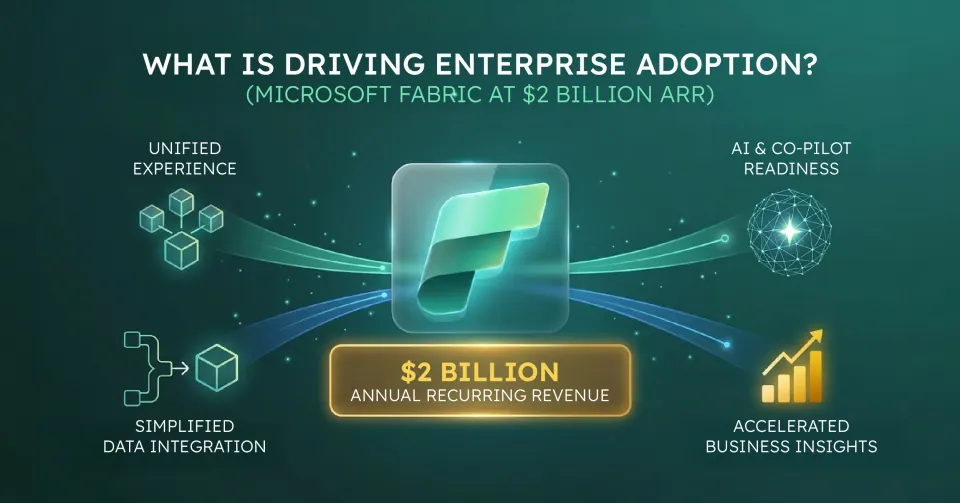
Microsoft Fabric has reached $2 billion in annual recurring revenue with 60% year-on-year growth and 31,000+ customers. This makes it, by Microsoft's own description, the fastest-growing data platform in the company's history. The growth is not accidental. It reflects a specific set of conditions that enterprise data teams are navigating right now.
What Does $2 Billion ARR Actually Signal?
Revenue figures from platform vendors can be difficult to interpret in isolation. The 60% year-on-year growth rate is the more meaningful number.
At $2 billion scale, sustaining 60% growth requires more than early-adopter enthusiasm. It requires that organisations are deploying Fabric, finding value, and expanding. That pattern of initial deployment followed by expansion is the clearest evidence that the platform is delivering on its commercial proposition.
For organisations evaluating or already running Fabric, the growth trajectory also has practical implications: a platform at this scale receives sustained engineering investment, a growing ecosystem of partners and integrations, and a faster path from preview to general availability for new features.
Why Are Enterprises Choosing Fabric?
Three structural factors are driving enterprise adoption at scale.
1. The Cost of Tool Proliferation Has Become Visible
Most organisations running mature data estates have accumulated tools: a data ingestion platform, a separate transformation layer, a warehousing solution, a BI tool, a pipeline orchestrator, and increasingly an AI platform. Each tool has its own licensing, its own governance model, and its own operational overhead.
Fabric's unified licensing model, which is capacity-based and covers the full analytics stack, makes the total cost of that fragmented approach more visible. For many organisations, consolidation onto Fabric reduces both licensing cost and operational overhead, even accounting for migration effort.
2. The AI Readiness Pressure Is Real
Organisations that want to deploy AI agents, run AI-augmented analytics, or connect language models to enterprise data need a structured, governed data foundation. Fabric provides that foundation through OneLake as a single data layer, Fabric Data Agents GA, and the Remote MCP Server in preview, in a way that disconnected tool stacks do not.
The pressure to be AI-ready is accelerating Fabric adoption among organisations that might otherwise have delayed platform consolidation.
3. Microsoft's Enterprise Relationship Is a Distribution Advantage
Fabric is not competing for greenfield data platform decisions alone. In most large enterprises, it is entering an environment where Microsoft already holds a significant position: Azure infrastructure, Microsoft 365, Power BI, and Azure Active Directory for identity. Fabric's integration with that existing estate reduces the switching cost significantly compared to third-party alternatives.
This is not a reason to choose Fabric by default. But it is a real factor in enterprise procurement decisions, and it helps explain why adoption at scale has been faster than comparable platform launches.
How Does This Compare to Competitors?
Microsoft described Fabric as the fastest-growing data platform in its history at FabCon 2026. The competitive context is worth noting.
Databricks and Snowflake are the platforms most often positioned against Fabric in enterprise evaluations. Both are strong, well-established, and growing. The differentiation is not primarily technical; it is architectural and commercial.
- Databricks is strongest in organisations with significant data science and ML workloads, particularly those running open-source Spark natively
- Snowflake is strongest in organisations prioritising governed, multi-cloud data sharing and a pure SQL-first experience
- Microsoft Fabric is strongest in organisations already deeply invested in the Microsoft ecosystem that want to consolidate analytics, warehousing, and BI onto a single governed platform
The $2B ARR figure, combined with the Database Hub announcement at FabCon, suggests Microsoft is actively working to expand Fabric's footprint beyond analytics into operational data management. This represents a direct competitive move toward both Databricks and Snowflake's respective expansion strategies.
What Is the Strategic Point Most Organisations Miss?
Adoption figures describe what other organisations are doing. They do not determine whether Fabric is the right choice for yours.
The more useful question is not "is Fabric growing?". It clearly is. The more useful question is: "does our organisation's data operating model align with what Fabric is designed to support?"
Organisations with fragmented tool estates, significant Microsoft infrastructure investment, and growing AI deployment ambitions are the ones finding the most consistent value. Organisations adopting Fabric primarily because of growth metrics or Microsoft account pressure, without a clear operating model in mind, tend to see slower returns.
Why work with Solv Systems on Fabric Strategy?
At Solv Systems, we treat Fabric adoption as a strategic transformation, not just a technical migration.
Strategy Before Build
We start by aligning your Fabric roadmap with clear business objectives to ensure the platform delivers measurable ROI.
Patterns That Scale
We implement standardized patterns for ingestion, transformation, and reporting that avoid the fragility of ad-hoc analytics.
Proactive Engineering
We anticipate platform evolution and engineering constraints, ensuring your Fabric estate is resilient to future updates.
Governance and Adoption
We define operating models that balance self-service flexibility with enterprise-grade security and governance.
What Adoption at This Scale Means If You Are Buying
Adoption figures are usually reported as vendor scoreboard news. For an organisation making a platform decision, they carry three more practical signals.
Hiring gets easier. A platform at genuine scale has a labour market. Fabric and Power BI skills are now findable in the UK, US and South African markets in a way that narrower platforms are not, which reduces one of the least discussed risks in a platform choice: being unable to staff it in three years.
The ecosystem matures. Partners, training, community answers and third-party tooling all follow adoption. The practical version of this is that your team's unusual problem has probably already been solved and written up by someone.
Roadmap risk falls. Platforms with this level of commercial commitment behind them do not get quietly deprecated. That matters more than it sounds when you are asking a board to fund a multi-year data programme.
The Counterweight Worth Stating
Adoption is not the same as fit, and a platform being popular is not an argument that it suits your workloads.
Fabric's advantages concentrate in Microsoft-centric organisations doing analytics and reporting. If your estate is genuinely multi-cloud, or your centre of gravity is large-scale data engineering and machine learning rather than analytics, the adoption numbers do not change that calculus - see our comparisons with Databricks and Snowflake for where each fits.
The honest use of an adoption figure is as a risk signal, not as a recommendation.
Sources and Further Reading
Frequently asked
It was announced by Microsoft at FabCon 2026 in March 2026 and is the most current publicly available figure.
Microsoft has not published a detailed breakdown. Fabric capacity licensing is distinct from Power BI Premium, though both share capacity infrastructure.
Direct comparison is complex because of different pricing models. In general, Fabric's capacity pricing covers a broader set of workloads under a single SKU, which can favour organisations running diverse analytics workloads. A detailed comparison should factor in your specific workload mix.
Microsoft attributed growth to enterprise demand for unified data platforms, AI readiness requirements, and the commercial appeal of consolidating multiple existing Microsoft data tools under a single Fabric capacity.
Fabric runs on Azure infrastructure. While it can connect to data in other clouds via mirroring and shortcuts, organisations with primary infrastructure in AWS or Google Cloud face higher integration complexity.