In Short: Do You Need a Data Warehouse?
Quite possibly not yet. Power BI can connect to sources directly, transform in Power Query and serve reporting well. A warehouse or lakehouse becomes justified when refresh times become a constraint, when the same transformation is copied across several datasets, or when more than one team needs definitions that agree. Two or more of those together is the signal. One is usually a fixable problem.
The Honest Version
Most content on this question is written by people who sell data platforms, and it concludes that you need a data platform.
We build data platforms. We also spend a reasonable amount of time telling organisations they do not need one yet, because a platform bought too early produces cost, complexity and a maintenance burden without a corresponding benefit - and it sours the organisation on the idea for years.
So the useful question is not "is a warehouse good?" It is "have you outgrown what you have?"
When Power BI Alone Is Genuinely Enough
A meaningful number of organisations are well served by Power BI with no platform beneath it. The profile:
- A handful of sources, ideally with decent APIs or database access.
- Data volumes that refresh comfortably in the time available.
- One team or a small number who broadly agree what the numbers mean.
- Reporting as the requirement - not data science, not operational analytics, not cross-domain questions.
If that describes you, Power BI Pro with well-built datasets is the right answer, and it will remain so for a while. Buying a lakehouse for two sources and one analyst is buying a solution to a problem you have not got.
The Symptoms That Say Otherwise
Watch for these. Individually most are fixable; together they indicate the architecture is the constraint.
Refresh has become a scheduling problem. Refreshes take hours, fail intermittently, or have to be sequenced around each other. Try incremental refresh and moving transformation upstream first - if you have and it is still a problem, that is signal.
The same logic exists in several datasets. Three datasets each independently join customers to orders and each does it slightly differently. This is the clearest indicator: you need a shared transformation layer, and Power Query cannot be one.
Reports disagree. Different datasets define metrics differently and nobody can say which is authoritative. See conflicting numbers.
Source systems are complaining. DBAs asking about your query load, or an API rate limit being hit regularly. Analytics is stressing systems that have a day job.
You need history the source does not keep. Your CRM shows current state; you need to know what it looked like last quarter. No amount of Power BI fixes that - only a platform capturing history can.
Analysts spend more time preparing than analysing. The clearest business signal, and the one to raise with a finance director.
The Middle Ground People Skip
It is not a binary. Two intermediate steps solve a lot of cases:
Dataflows. A shared transformation layer inside Power BI. Define the customer join once, reuse it across datasets. This addresses the duplicated-logic symptom without a platform, and it is often enough for another year.
A single lakehouse for your worst sources. You do not have to consolidate everything. Landing the two systems that cause the most trouble into OneLake, leaving everything else as it is, is a legitimate and modest step - and the architecture absorbs more sources cheaply later.
Starting small is not a compromise. It is how most successful platforms actually begin.
What a Platform Adds
When you do need one, this is what you are buying:
- One place transformation happens, rather than per dataset.
- History, captured deliberately rather than depending on what sources retain.
- A governed layer where definitions are enforced and lineage is traceable.
- Capacity for volume beyond what a dataset handles comfortably.
- A foundation for more than reporting - data science, real-time, AI that works.
That last point is the one worth weighing if AI is on your roadmap, because every AI initiative depends on unified, governed data and organisations that skip it get confident wrong answers.
An Honest Test
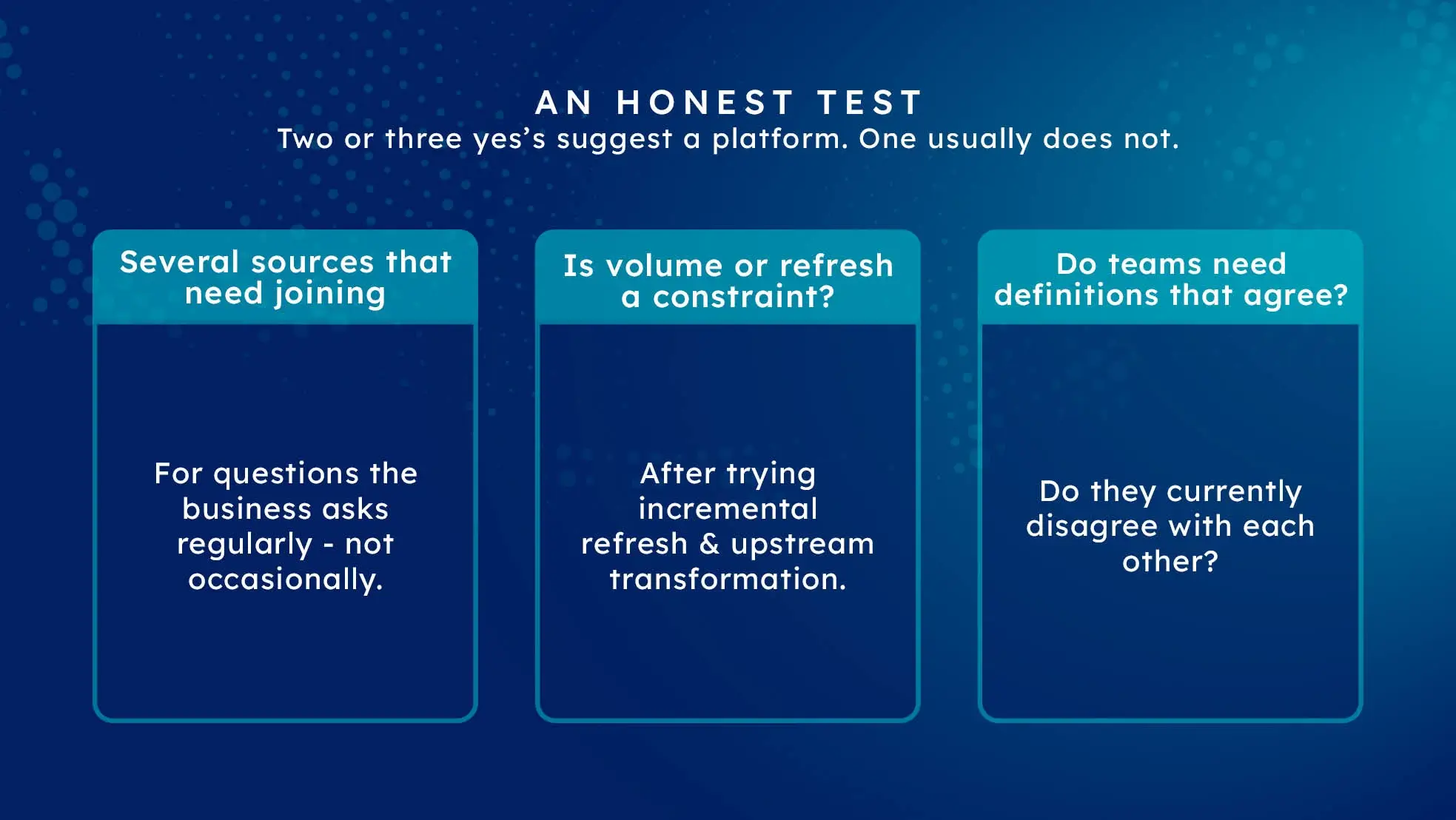
Three questions. Two or three yeses suggest a platform is justified; one usually does not.
1. Do you have several sources that genuinely need joining to answer questions the business asks regularly?
2. Is data volume or refresh duration currently constraining what you can do?
3. Do multiple teams need definitions that agree, and do they currently disagree?
If you answered no to all three and someone is quoting you for a platform, ask them which of those problems it solves.
Where Solv Systems Comes In
We run short assessments that answer this question against your actual sources, volumes and reporting demands - usually in weeks rather than months.
A good assessment is genuinely willing to conclude "not yet", and ours do. When the answer is that dataflows and better modelling will serve you for another year, that is what we will say - it costs you a fraction of a platform and it is the correct answer. When the answer is that you have outgrown it, you will have the evidence to make the case internally.
Sources and Further Reading
Frequently asked
Yes, and for many organisations it should. Power BI can connect directly to source systems, transform in Power Query, and serve reporting perfectly well. A warehouse or lakehouse becomes justified when the number of sources, the volume of data, or the need for shared governed definitions outgrows what datasets alone can hold.
Refreshes taking too long or failing, the same transformation logic copied across several datasets, reports disagreeing because each defines metrics differently, source systems complaining about query load, and analysts spending more time preparing data than analysing it. Two or more of those together is the signal.
It can be. The honest test is whether you have several sources that genuinely need joining, enough volume that refresh is a constraint, and more than one team needing consistent definitions. A business with two sources and one analyst does not need a platform, and buying one produces cost and complexity without a corresponding benefit.
Yes, and it is usually the right sequence. Dataflows give you a shared transformation layer without a full platform. A single Fabric lakehouse for your two most problematic sources is a modest first step. Neither commits you to a programme.
One place where transformation happens rather than per dataset, history that source systems do not keep, a governed layer where definitions are enforced, capacity for volumes larger than a dataset handles comfortably, and a foundation for analytics beyond reporting. Whether those are worth the cost depends entirely on whether you currently need them.
Considerably less than building the wrong thing. A short assessment against your actual sources, volumes and reporting demands will usually give a clear answer in weeks, and a well-run one is as willing to conclude 'not yet' as it is to recommend a platform.