In Short: Snowflake or Microsoft Fabric?
Snowflake sells elastic compute billed by the second; Microsoft Fabric sells a fixed capacity your whole organisation shares. That difference drives most of the decision. Fabric suits Microsoft-centric organisations with steady analytics workloads who value predictable cost and native Power BI. Snowflake suits multi-cloud estates, SQL-heavy workloads, intermittent usage patterns, and organisations that need cross-company data sharing.
What Each One Actually Is
Snowflake began as a cloud data warehouse and grew into a broader data platform. Its defining architectural idea is the separation of storage from compute: data sits once, and independent virtual warehouses spin up against it, sized and billed separately. That is why a reporting workload and a data science workload need not contend with each other.
Microsoft Fabric is a SaaS platform unifying engineering, warehousing, real-time analytics, data science and Power BI on top of OneLake. Its defining idea is that one governed copy of the data serves every workload, with Power BI as a first-class citizen rather than a connected client.
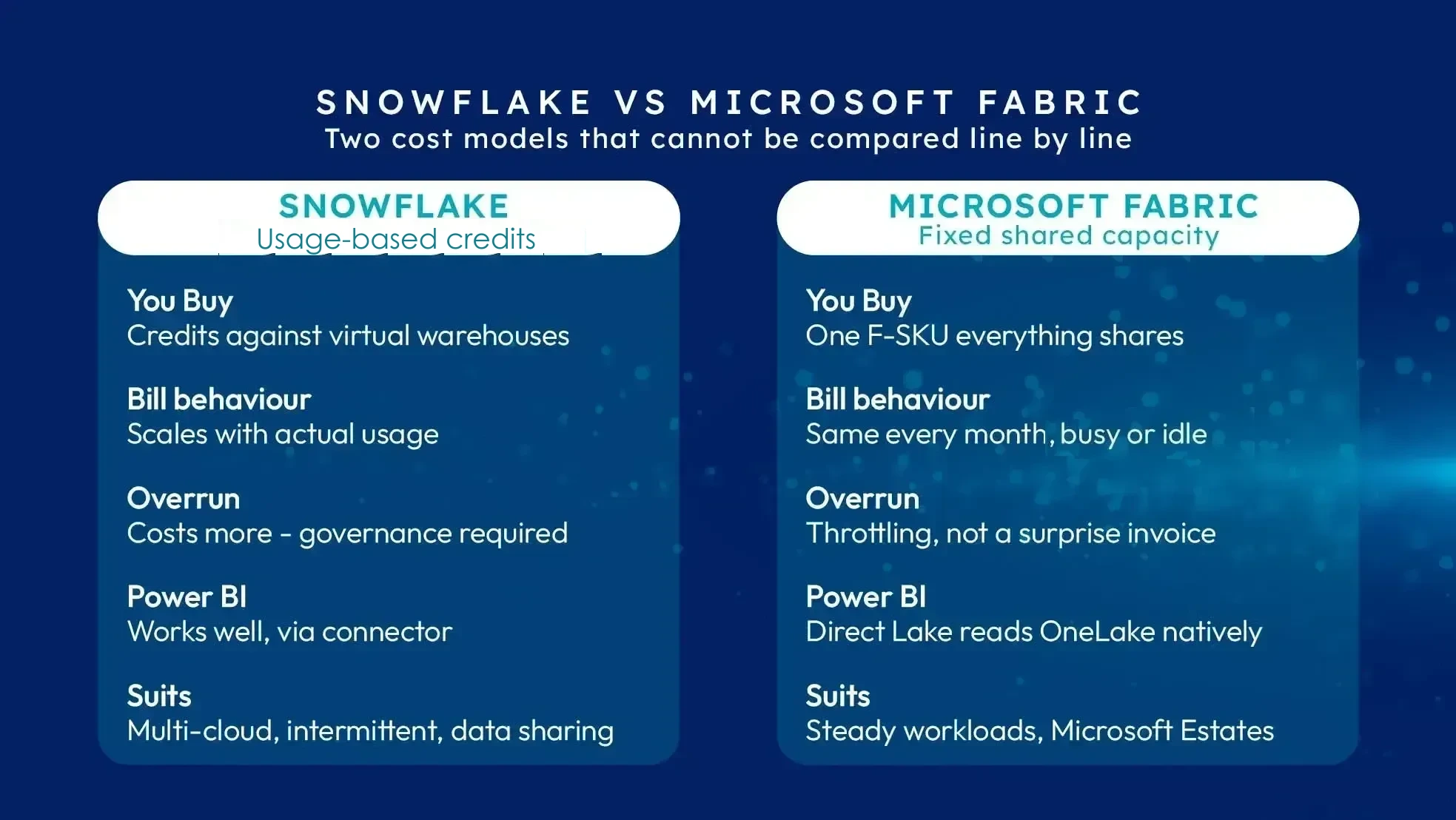
The Cost Models Are Not Comparable Line by Line
This is where most evaluations go wrong. The two platforms do not price the same unit, so a per-hour comparison is meaningless.
- Fabric charges for capacity. One F SKU, shared by everything, billed the same whether busy or idle. Budgeting is trivial. The failure mode is throttling when demand exceeds the capacity, not an unexpected invoice. See our Fabric pricing guide and how capacity units are measured.
- Snowflake charges for consumption. Compute is billed per second against credits while a warehouse runs, and storage separately. Genuinely intermittent workloads can be very cheap; an always-on warehouse nobody is watching can be very expensive.
The honest summary: Snowflake rewards discipline and punishes inattention. Fabric removes that variance entirely, at the cost of paying for headroom you are not always using. Which is better depends on your workload shape and how much cost governance you can realistically sustain.
Reporting: The Difference Most Mid-Market Teams Feel
Power BI connects to Snowflake perfectly well. But there is a meaningful architectural difference between a connector and a shared substrate.
In Fabric, Direct Lake mode reads Delta tables in OneLake directly - no import refresh to schedule, and no query fired at a warehouse for every visual. For large models with wide audiences, that changes both the performance profile and the cost profile, because report traffic is not generating warehouse compute. If most of your value comes out as Power BI reports, this matters more than any feature comparison. Our guide to Direct Lake, Import and DirectQuery covers the trade-offs.
Against that: Snowflake is genuinely BI-tool agnostic. If your organisation runs Tableau, Looker and Power BI across different teams, that neutrality is worth real money.
Governance, Identity and Multi-Cloud
Fabric's governance is inherited rather than configured. Identity is Microsoft Entra, classification and lineage are Purview, and sensitivity labels travel with the data. For an organisation already running Microsoft 365, much of this is done before the data platform project starts.
Snowflake governs well within itself and, crucially, does so identically across AWS, Azure and GCP. It also has genuinely strong cross-organisation data sharing - if you share data with customers, suppliers or partners as part of your business model, that capability has no direct Fabric equivalent.
Can You Run Both?
Yes, and plenty of organisations do. OneLake shortcuts reference external data without copying it, and database mirroring brings an external source into Fabric while it continues to be maintained where it lives.
The common arrangement is Snowflake as the enterprise warehouse, especially where it predates the Microsoft investment, with Fabric serving the analytics and Power BI layer. Before committing to that, be clear about who owns which definitions - two platforms is two places for a metric to drift.
Which Fits a Mid-Market Team?
For a mid-market organisation already on Microsoft, with a small data team and reporting as the main output, Fabric usually wins on total effort rather than on features: fewer moving parts, identity and governance already in place, no warehouse sizing to manage, and analysts able to work in the platform directly.
Snowflake wins when the estate is genuinely multi-cloud, when SQL workloads dominate and need elastic isolation, when BI tooling is heterogeneous, or when data sharing with external parties is part of the business.
What should not decide it: which platform benchmarks faster on a synthetic query. At mid-market volumes both are comfortably fast enough, and the decision will be made on cost predictability, team fit and integration - not milliseconds. If you want the platform-level comparison instead, our Fabric versus Azure Synapse guide covers the Microsoft-internal migration question.
Where Solv Systems Comes In
We implement Microsoft Fabric, so weigh our perspective accordingly. What we try to bring is arithmetic rather than advocacy: modelling your actual refresh schedules, query concurrency and report audience against both cost models, so the comparison is about your workload rather than a vendor's example.
Where Fabric is the right answer, we design and build it end to end - capacity sizing, medallion lakehouse, pipelines, governance and the Power BI layer. Where Snowflake already works and should stay, we integrate rather than replace.
Sources and Further Reading
- Snowflake key concepts
- Microsoft Fabric documentation
- Direct Lake overview
- Microsoft Entra ID
- Microsoft Purview
- learn.microsoft.com
Frequently asked
It can be, for organisations whose workloads are analytics and reporting inside a Microsoft estate. Fabric covers warehousing alongside engineering, real-time and Power BI in one platform. Where Snowflake is doing heavy multi-cloud SQL work, cross-organisation data sharing, or serving many non-Microsoft consumers, replacing it is a bigger question than the feature lists suggest.
Fabric, by design. You buy a capacity and everything runs inside it, so the bill is the same each month regardless of activity unless capacity overage or on-demand billing is in use - and Microsoft documents overage as enabled by default on new capacities, so check the setting - the risk is throttling when you outgrow it, not a surprise invoice. Snowflake bills compute per second against credits, which rewards genuinely intermittent use and punishes unmanaged always-on warehouses.
Power BI connects to Snowflake perfectly well, but the integration is a connector rather than a shared substrate. Fabric's Direct Lake mode reads Delta tables in OneLake without importing or issuing a query per visual, which is a materially different performance and cost profile for large models.
Yes. OneLake shortcuts can reference external data without copying it, and mirroring can bring an external database into Fabric while it continues to be maintained elsewhere. Running Snowflake as the enterprise warehouse with Fabric serving Microsoft-native analytics on top is a workable and reasonably common arrangement.
Usually Fabric, if the estate is already Microsoft. The SaaS model removes a lot of platform administration, identity and governance come from tools the team already runs, and analysts can work in the platform directly. Snowflake is not hard to run, but it expects someone to own warehouse sizing, cost governance and the surrounding tooling.
Both store data in open table formats - Delta Lake in Fabric, with Iceberg support across the industry - so the raw data is portable in principle. The practical lock-in in either platform is everywhere else: pipelines, semantic models, security rules and reports. Judge lock-in by how much logic sits above the storage layer, not by the file format.