In Short: Why Can't the Practice Management System Answer This?
Because it holds roughly half the picture. Time and billing live there; salary cost, overhead and non-billable time live in finance and HR. Utilisation it can produce. Realisation it can mostly produce. True matter profitability spans systems it cannot see, which is precisely why partners can argue about it indefinitely.
Three Numbers, Frequently Confused
Getting the vocabulary agreed prevents most of the arguing.
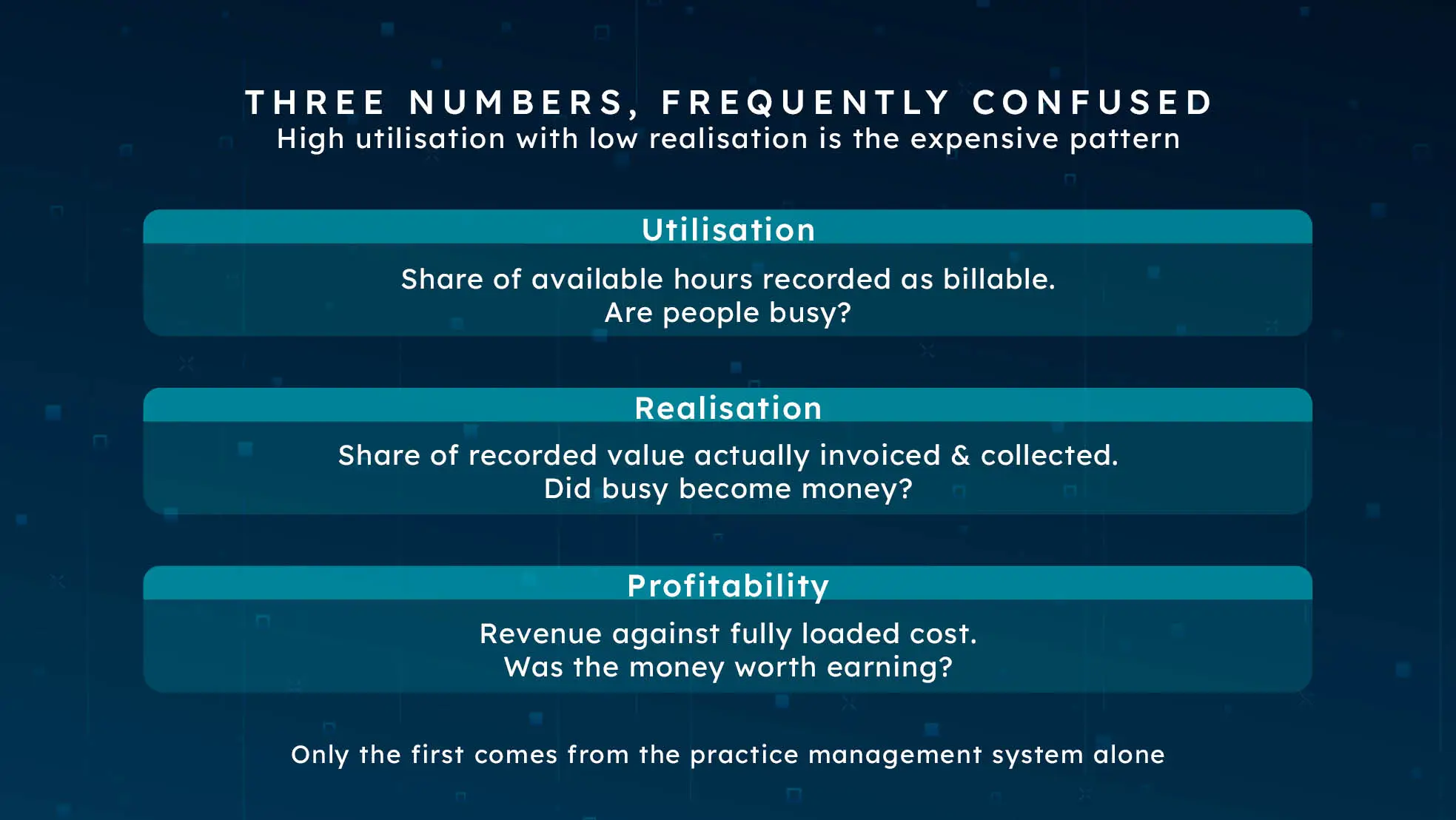
Utilisation - the proportion of available hours recorded as billable. Measures whether people are busy.
Realisation - the proportion of recorded value actually invoiced and collected. Measures whether being busy turned into money.
Profitability - revenue against fully loaded cost for a matter, client or team. Measures whether the money was worth earning.
Most firms report the first, occasionally the second, and rarely the third with any confidence. The most expensive pattern in professional services is high utilisation with low realisation - everyone flat out, margin quietly disappearing in write-offs - and it is invisible if you only look at utilisation.
Matter Profitability Properly
This is where the modelling work is, and where firms need to agree method before anyone builds anything.
Revenue is collected value, not billed value, and not recorded value. Three different numbers, and using the wrong one flatters results.
Cost is fully loaded: salary cost of everyone who touched the matter, at their actual cost rather than a notional rate, plus a defensible overhead allocation.
Overhead allocation is where the argument lives. Per fee-earner, per hour, per revenue pound - each method produces different winners, and every partner will prefer the one that favours their practice. Agree the method once, in writing, with the managing partner's support. The number is only useful if people accept how it was reached.
Write-offs must be attributed to the matter that incurred them, not absorbed centrally, or the unprofitable work stays invisible.
The Model
The data spans at least four systems: practice management for time and billing, finance for cost and collections, HR for salary and availability, and CRM for the client relationship.
Conforming them is the real work - a client in the CRM must be the same client in finance, and a matter must reconcile across all four. That belongs in a governed layer, not in Power Query on one dataset, so every report inherits the same definitions.
Two modelling notes specific to this sector:
Time recorded late will not stop. Design for it. Reports need to show a period both as it looked at close and as it looks now, or every month-on-month comparison shifts under people and trust evaporates. Snapshot at close as well as reporting live.
Availability is not a constant. Leave, training, parental leave and part-time patterns all change the denominator in utilisation. A model that assumes a fixed working year will quietly misreport anyone who is not full-time - which is usually the people most sensitive to being misreported.
Who Sees What
Partners seeing each other's numbers is a cultural decision, and firms land in genuinely different places. Some publish everything internally; some restrict rigorously.
Whatever you choose, implement it with row-level security at the data layer rather than by building separate reports per partner. The rule is then enforced consistently, changeable without a rebuild, and impossible to bypass by opening someone else's copy.
Expect the policy to change once the numbers exist. Build so it can.
What to Build First
Utilisation with realisation next to it. Utilisation is already reported, so trust is easy to establish - people can check it against what they know. Putting realisation alongside it almost always surfaces something nobody had quantified, which is what earns the project its next phase.
Profitability comes second, after the overhead method has been agreed. Attempting it first means the first thing partners see is a number produced by a method they have not signed up to, which is a poor way to build confidence.
Where Solv Systems Comes In
Professional services firms are one of the sectors we work with most, partly because the problem is so consistent: the data exists, it spans four systems, and the arguing is about definitions rather than facts.
We run the definitional conversation - what counts as billable, how overhead allocates, whose numbers are visible to whom - and get it written down before building. Then the Power BI model that joins practice management, finance and HR, with the access rules enforced properly, and reporting partners will actually use because they agreed how it was calculated. The same principle applies well beyond professional services - see our guide to single-source-of-truth reporting.
Sources and Further Reading
Frequently asked
It holds time and billing, which is roughly half the picture. Profitability needs cost - salaries, overhead allocation, non-billable time - which sits in finance and HR. Any question spanning those systems is a question the practice management system structurally cannot answer.
Utilisation is the share of available hours recorded as billable. Realisation is the share of recorded value actually invoiced and collected. High utilisation with low realisation is the most common and most expensive pattern in professional services, and it is invisible if you only report one of them.
Revenue collected against fully loaded cost - salary cost of everyone who touched it, plus a defensible overhead allocation, plus write-offs. The overhead method is where firms argue, so agree it once, in writing, before building anything. The number is only useful if partners accept the method.
A cultural question rather than a technical one, and firms answer it differently. Whatever you decide, implement it with row-level security at the data layer rather than by building separate reports, so the rule is enforced consistently and can be changed without rebuilding.
Design for it, because it will not stop. Reports need to distinguish between a period as it looked at the time and as it looks now, or every month-end comparison will shift under people. Snapshot the position at close as well as reporting live.
Utilisation with a credible realisation view alongside it. It is the number partners already look at, so trust is easy to establish, and putting realisation next to it usually reveals something nobody had quantified.