In Short: What Changed?
At Microsoft Ignite 2026 Microsoft added two things to Foundry IQ, the knowledge layer agents in Microsoft Foundry use to find information:
- Knowledge graphs (public preview): Foundry IQ can map the entities in your content and how they relate, so agents can answer questions that depend on relationships, not just on similar wording
- Microsoft Retriever 1 (public preview): a retrieval model that plans searches, rewrites queries in your organisation's terms and decides when it has enough
Two changes to how Foundry IQ is provided come next month:
- Foundry IQ Serverless: planned to be generally available in December 2026, with usage-based pricing that scales to zero when idle
- Foundry IQ in every new Foundry project: public preview in December 2026
For Fabric customers, the more practical news is that Fabric IQ semantic models, OneLake shortcuts and mirrored items can now be Foundry IQ knowledge sources, in public preview.
Where Foundry IQ Fits
Foundry IQ is one pillar of Microsoft IQ. Microsoft describes the split this way: Fabric IQ for governed business data, and Foundry IQ for unstructured data such as documents, policies and SharePoint content. An agent in Foundry Agent Service uses Foundry IQ to find the passages it needs before it answers.
Until now that retrieval was mostly search: find the chunks of text most like the question. That works for "what is our travel policy" and fails for questions like "which of our suppliers in the delayed orders also had a quality complaint last quarter", where the answer depends on connections across many documents.
Knowledge Graphs: Retrieval That Follows Relationships
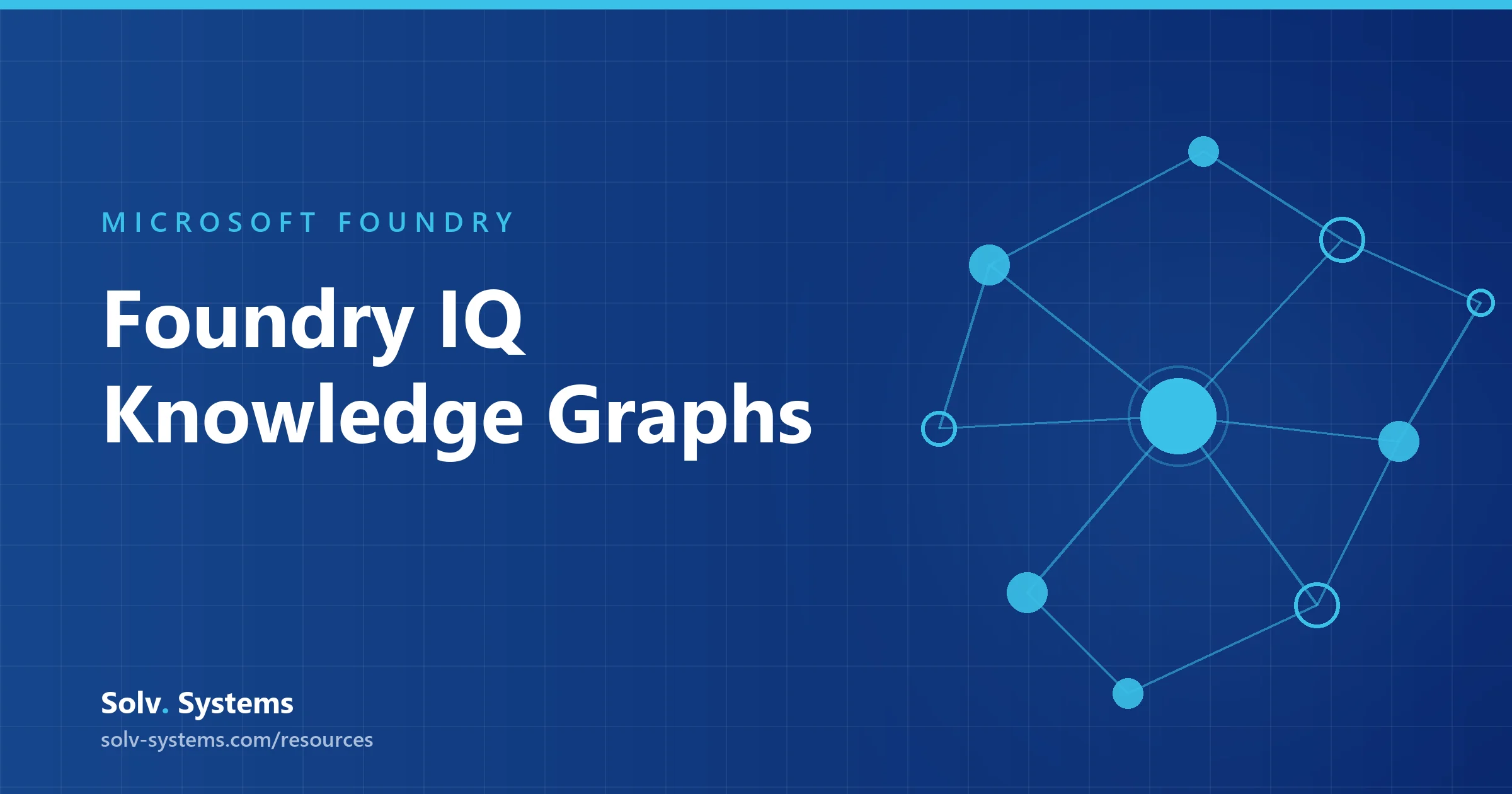
A knowledge graph stores entities and the relationships between them. In Foundry IQ, entities are mapped during indexing, either from your own ontology or from a graph you already have. Agents can then query the connections, and Microsoft says you can do so in natural language or GQL, with citations back to the source.
Where we expect this to help:
- Contracts and suppliers: parties, obligations, renewal dates and the products they cover
- Assets and maintenance: equipment, sites, faults and the engineers who fixed them
- Policies and controls: which policy covers which process, and who owns it
Where it will not: questions answered by a single paragraph. A graph adds indexing work, so use it where the relationships are the point.
Microsoft Retriever 1
Retriever 1 is a model built only for retrieval. Microsoft says it interprets the query, rewrites it using enterprise terminology and decides whether to search again, without needing a frontier model to do that planning. It can be switched on for existing Foundry IQ indexes and knowledge bases without reindexing.
That matters for cost. Agents that use a large model to plan every search pay frontier prices for routine work. A specialised retrieval model is the same idea as routing between model tiers. Microsoft has not published benchmarks or a price for Retriever 1, so measure it on your own questions before switching.
What This Means if You Run Fabric
Fabric data can now ground Foundry agents
The new knowledge sources let a Foundry agent draw on Fabric IQ semantic models and OneLake shortcuts and mirrored items, with OneLake item-level permissions in preview. That gives a governed path from your Fabric estate to Foundry agents, alongside the OneLake Table Read API and delegated shortcuts for direct table access. Foundry Agent Service also lists a Fabric IQ integration in preview.
Watch for two sets of definitions
Fabric IQ already has ontologies: shared definitions of customers, orders and assets bound to your Fabric data. Foundry IQ knowledge graphs can use "your ontology", but Microsoft has not said whether that means a Fabric IQ ontology. Until it does, there is a real risk of defining "customer" once in Fabric and again in Foundry.
Our advice: make Fabric IQ the source of business definitions, and treat a Foundry IQ graph as an index over documents that reuses those names. Write the mapping down.
Permissions still decide what an agent can say
Grounding an agent in more data widens what it can reveal. Check that permissions carry through from SharePoint and OneLake before connecting a source, and see our guide to governing AI agents with Entra Agent ID.
What to Do Now
1. Pick one relationship-heavy use case, such as supplier contracts, and test a knowledge graph against your current retrieval with 50 real questions. 2. Try Retriever 1 on an existing knowledge base. No reindexing is needed, so it is a cheap test of answer quality and cost. 3. Keep both in preview projects. Neither is generally available, so do not put them behind production agents yet. 4. Get your data ready. Clean, well-described data matters more than the retrieval model. Our AI-ready data checklist covers the basics.
Sources and Further Reading
- Foundry IQ: Introducing knowledge graphs, engineered for agents (Microsoft Tech Community)
- What's new in Foundry Agent Service at Ignite 2026 (Microsoft Foundry Blog)
- Microsoft Ignite 2026 Book of News
- Related: What Microsoft Foundry means for Fabric, What is Microsoft IQ?, Fabric IQ ontologies
Frequently asked
It maps the entities in your documents, such as customers, products or contracts, and how they relate, during indexing. You can use your own ontology or bring an existing graph, then agents can follow those relationships instead of relying on text similarity alone. It is in public preview.
A retrieval model for Foundry IQ, in public preview. It interprets a query, rewrites it using your organisation's terminology and decides whether more searches are needed. Microsoft says it can be turned on for existing Foundry IQ indexes and knowledge bases without reindexing.
Microsoft says Foundry IQ Serverless will be generally available in December 2026, with usage-based pricing that scales to zero when idle, a production SLA, higher limits and more regions.
Yes, in preview. Microsoft lists Fabric IQ semantic models, OneLake shortcuts and mirrored items as Foundry IQ knowledge sources in public preview, with OneLake item-level permissions also in public preview.
Both are part of Microsoft IQ. Microsoft describes Fabric IQ as the layer for governed business data, such as semantic models and ontologies, and Foundry IQ as the layer for unstructured data such as documents and SharePoint content.
Not yet. Knowledge graphs and Retriever 1 are in public preview, and Microsoft does not recommend preview features for production. Test them on one document set where relationships matter, and compare answers against your current retrieval.