In Short: How Much Does a Fabric Implementation Cost in South Africa?
A Microsoft Fabric architecture implementation in South Africa typically costs between R240,000 and R8 million, depending on what you are actually building. The variation is wide because "Fabric architecture" can mean anything from a six-week proof of concept on a single workload to a twelve-month enterprise platform replacing a legacy data estate.
This guide breaks the range into four real implementation profiles, with cost ranges in ZAR (and USD equivalents for international finance teams), what drives the variation, the Microsoft Fabric capacity costs that sit alongside consulting fees, and the SA-specific factors (rand-dollar FX exposure, POPIA, Azure South Africa regions) that affect total spend.
The intent is for SA buyers to self-categorise their implementation in fifteen minutes so the conversation with any consultancy starts from informed expectation rather than vendor opacity. We have published the equivalent guide for Power BI projects in South Africa. This article covers the full data platform layer, whether greenfield or migrated from legacy systems.
A note on rates. The cost ranges below are based on Solv Systems' standard South African rates. Other consultancies in the SA market, particularly global SIs and firms with premium positioning, may charge significantly more. Use these ranges as a floor, not a market average.
What "Fabric Architecture Implementation" Actually Means
Before the cost ranges, a definition. "Fabric architecture implementation" is not the same as a Power BI project, and it is broader than a Fabric migration. The terminology gets confused in early conversations, which leads to mispriced expectations on both sides.
A Power BI project delivers reports. A Fabric migration moves an existing data estate onto Fabric. A Fabric architecture implementation delivers the data platform itself, whether greenfield or migrated from existing infrastructure. The deliverables typically include:
- A Lakehouse or Warehouse layer (or both), structured as Bronze, Silver, and Gold in a medallion architecture
- OneLake organisation and shortcut design
- Data engineering pipelines bringing data from source systems into Bronze, then transforming it through Silver to Gold
- Semantic models in Power BI, built against the Gold layer using Direct Lake mode where appropriate
- Workspace and domain structure (often multiple, organised by business unit or data domain)
- Capacity strategy: which F-SKU, how many capacities, how workloads are distributed
- Governance: Microsoft Purview labels, Row-Level Security, Column-Level Security, Data Loss Prevention, POPIA-aligned controls where required
- Security model: Entra ID, role-based access, identity propagation through the layers
- CI/CD pipelines for deployment between environments (typically Dev, UAT, Production)
- Operational tooling: monitoring, alerting, capacity management, audit logging
- Optional: Microsoft Copilot integration, Fabric Data Agents, custom AI tooling on top of the platform
A Power BI project might consume 10 to 50 consulting days. A Fabric architecture implementation typically consumes 100 to 1,000 consulting days, sometimes more. The work category is different. The cost is structurally different.
If you are unsure whether your project is "Fabric architecture" or "Power BI", the simple test: are you primarily delivering reports, or are you delivering the platform underneath the reports? If the answer is the second, this article applies.
The Components of Cost
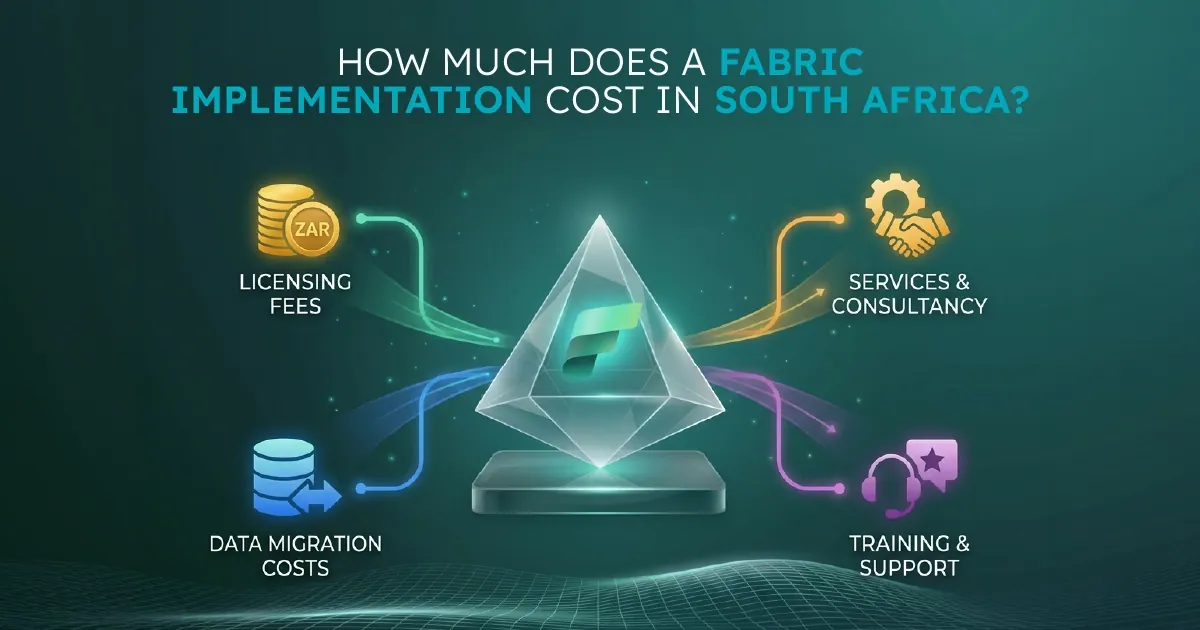
A Fabric architecture implementation has four cost components.
The first is consulting cost: the people designing and building the architecture. This is the variable cost driven by scope and complexity, and it is what most of this guide covers.
The second is Microsoft Fabric capacity cost: the Azure subscription that runs the platform. This is the ongoing operational cost paid monthly to Microsoft, separate from consulting fees.
The third is Microsoft Power BI licensing: per-user Pro licences for content creators, and per-user Pro or Free licences for viewers depending on whether your Fabric capacity is F64 or higher.
The fourth is VAT. SA VAT at 15 percent applies to consulting fees. Microsoft global services are typically billed without local VAT but with reverse-charge treatment for VAT-registered SA entities. Confirm your specific tax position with your tax advisor.
We quote consulting fees excluding VAT throughout this article and cite Microsoft figures at list price in USD (with ZAR equivalent at recent FX) excluding tax.
Microsoft Fabric Capacity Costs in 2026 (SA Context)
Fabric capacity pricing is straightforward but worth covering explicitly because it is the cost SA buyers most underestimate, particularly when ZAR-denominated budgets meet USD-denominated Azure pricing. F-SKU pricing in 2026, paid monthly to Microsoft under Azure:
- F2 – approximately R4,800 per month (USD 262)
- F4 – approximately R9,600 per month (USD 524)
- F8 – approximately R19,200 per month (USD 1,048)
- F16 – approximately R38,400 per month (USD 2,097)
- F32 – approximately R76,800 per month (USD 4,194)
- F64 – approximately R153,500 per month (USD 8,388)
- F128 – approximately R307,000 per month (USD 16,776)
- F256 – approximately R614,000 per month (USD 33,552)
- Higher SKUs available up to F2048 for enterprise scale
Three notes on this. First, ZAR equivalents move with FX. The numbers above use a reasonable conversion at the time of writing but are not pinned. SA buyers should budget with a meaningful FX buffer because rand weakness over a twelve-month implementation can materially affect total cost. Second, the figures above are pay-as-you-go list prices; a one-year reservation (paid annually) reduces them by roughly 41%. Third, capacities run in Azure South Africa North (Johannesburg) and Azure South Africa West (Cape Town) for data residency requirements.
The most strategically important number is F64. At F64 and above, viewer users can consume Power BI content without per-user Pro licences. For an organisation with hundreds or thousands of viewers, this is where the maths shifts decisively in favour of capacity-based licensing. The break-even point sits around 600 active Pro users at current pricing.
Most SA mid-market Fabric implementations land on F8 to F32 capacity for general workloads. Larger enterprises with broad viewer populations move to F64 or above, often combining multiple capacities for workload isolation between development, production, and specific workloads like Real-Time Intelligence or AI.
Four Implementation Profiles, Four Cost Ranges
Most SA Fabric architecture implementations fall into one of four profiles. Pick the one that fits your context. All figures exclude VAT.
Profile 1: The Fabric Foundation / Proof of Concept (4 to 6 Weeks)
When this applies. You want to validate Fabric as a platform for your organisation before committing to a larger investment. Typically a single business workload, two to three source systems, a defined success criterion, and a clear go/no-go decision at the end.
Team and timeline. Two to three senior consultants. Lead architect (part-time), data engineer (full-time), Power BI specialist (part-time toward the end). Four to six weeks. Thirty to sixty consulting days.
What gets delivered. A working Fabric foundation. Lakehouse with Bronze and Silver layers for the in-scope data sources. A small Gold layer designed for the proof-of-concept reports. Two to five Power BI reports demonstrating end-to-end value. Capacity sizing recommendation for production. Architecture documentation and a recommendation on whether to proceed with a larger implementation.
What does not get delivered. Production-grade governance beyond what is needed to demonstrate the concept. Multi-domain structure. CI/CD pipelines. Custom AI work. Comprehensive training programme.
Cost range: R240,000 to R480,000 (approximately USD 14,000 to USD 27,000, excluding VAT).
Fabric capacity during the engagement. F2 to F4. Typically R5,000 to R10,000 per month, billed direct to your Azure subscription.
Who this fits. SA mid-market organisations evaluating Fabric for the first time, or larger enterprises wanting a contained validation before committing to a multi-quarter programme. Often the right starting point if "should we use Fabric" is a real, open question.
Profile 2: The Departmental Fabric Implementation (2 to 3 Months)
When this applies. You are committed to Fabric and want to build a production data platform for a single business domain (Finance, Operations, Sales, etc.). Three to seven source systems, a defined user group of 50 to 200 people, and the intention to expand the platform later to other domains.
Team and timeline. Three to four consultants. Lead architect (full-time first month, part-time after), data engineer (full-time), Power BI specialist (full-time staggered), part-time project manager. Two to three months. Eighty to 150 consulting days.
What gets delivered. A production-ready Fabric platform for the in-scope domain. Full medallion architecture (Bronze, Silver, Gold). Data pipelines for the source systems including incremental refresh. Semantic models in Power BI with Direct Lake mode where appropriate. The report estate for the domain. Workspace and domain structure designed to be extensible. Capacity sizing implemented. Governance baseline (Purview labels, RLS, basic DLP, POPIA-aligned controls). Initial CI/CD between Dev and Production. Internal team enablement and documentation.
What does not get delivered. Multi-domain rollout (would push to Profile 3). Full regulated-industry compliance for FSCA-regulated organisations. Custom AI integration beyond standard Copilot enablement. Comprehensive change management beyond direct user training.
Cost range: R640,000 to R1,200,000 (approximately USD 37,000 to USD 69,000, excluding VAT).
Fabric capacity in production. F4 to F16. Typically R10,000 to R40,000 per month.
Who this fits. SA organisations professionalising one business domain on Fabric, often with the intention of expanding. The most common profile for first serious Fabric implementations in mid-market and larger SME organisations.
Profile 3: The Mid-Sized Fabric Architecture (4 to 6 Months)
When this applies. Multi-domain Fabric platform across several business units. Eight to fifteen source systems. A user base of 200 to 1,000 people. Meaningful governance overhead, often driven by the organisation operating in or adjacent to a regulated sector. The platform is intended to be the primary data infrastructure for the foreseeable future.
Team and timeline. Four to six consultants. Lead architect (full-time), two to three data engineers, two Power BI specialists, full-time project manager, part-time governance and security lead. Four to six months. Two hundred to four hundred consulting days.
What gets delivered. A production-grade Fabric architecture across multiple domains. Full medallion across all in-scope sources, with proper Bronze/Silver/Gold separation and reusable patterns. Multi-workspace, multi-domain structure with clear ownership and access boundaries. CI/CD pipelines for deployment across Dev/UAT/Production. Comprehensive governance: Purview labels and policies, RLS and CLS patterns, DLP, audit trails, sensitivity classification, POPIA-aligned controls. Capacity strategy across multiple capacities where workload isolation matters. Power BI estate with refactored semantic models and adopted standards. Initial Copilot or AI integration where scoped. Comprehensive internal team enablement, runbooks, and handover.
What does not get delivered. Full regulated compliance for FSCA-supervised financial services, banking under SARB regulation, or sensitive healthcare data under POPIA Section 32. Major change management programme (commercial change consultancy work is typically separate). Custom AI tooling beyond what is reasonable within the timeline.
Cost range: R1,600,000 to R3,200,000 (approximately USD 91,000 to USD 183,000, excluding VAT).
Fabric capacity in production. F16 to F64. Typically R40,000 to R155,000 per month, often across two or three capacities for workload isolation.
Who this fits. SA mid-market enterprises and the larger end of mid-market making Fabric their strategic data platform. The most common shape for a serious, multi-domain Fabric build that is intended to scale.
Profile 4: The Enterprise Fabric Architecture (6 to 12 Months)
When this applies. Large-scale Fabric platform replacing meaningful legacy infrastructure (Synapse, on-premises data warehouse, sprawled Power BI estate, third-party BI tool, or some combination). Fifteen-plus source systems. User base of 1,000+. Regulated environment (FSCA, SARB, POPIA Section 32 sensitive data, public sector). Multiple stakeholder groups. The implementation has board visibility and a multi-year investment thesis behind it.
Team and timeline. Six to ten consultants across multiple workstreams. Lead architect (full-time), three to four data engineers, three to four Power BI specialists, full-time project manager, dedicated governance and security lead, change management lead (often part-time), regulatory specialist where applicable. Six to twelve months. Four hundred to 1,000 consulting days.
What gets delivered. A complete production data platform on Fabric, replacing the legacy estate. Full medallion architecture across the full source landscape, with proven scale and performance. Multi-domain, multi-workspace structure with mature governance throughout. CI/CD with proper environment separation and release management. Full regulatory and compliance posture: Purview policies, full RLS and CLS, DLP, sensitivity classification, audit and lineage documentation, evidence packages for relevant regulators (FSCA, SARB, Information Regulator under POPIA). Capacity strategy across multiple capacities and workloads. Power BI estate fully modernised. Copilot, Foundry, and AI integrations where appropriate. Comprehensive training, change management, and transition into operational steady state.
What does not get delivered. Ongoing managed services (separate engagement). Custom application development beyond what supports the platform. M&A or carve-out scenarios (need separate scoping).
Cost range: R3,200,000 to R8,000,000 (approximately USD 183,000 to USD 457,000, excluding VAT).
Fabric capacity in production. F64 to F256+. Typically R155,000 to R700,000+ per month, often across multiple capacities for production, development, and specific workloads such as Real-Time Intelligence or AI.
Who this fits. SA enterprises and large mid-market organisations replacing meaningful legacy investments. Common in financial services, insurance, retail, manufacturing, telecommunications, and public sector. The cost reflects the depth of the work, not the breadth of the headline scope.
What Drives Cost Variation Within Each Profile
Six factors push an implementation up or down within its profile range.
- Number and complexity of source systems. Each system adds connection effort, transformation work, and ongoing operational risk. A clean cloud ERP and a clean cloud CRM are fast. A mainframe with custom file extracts and an undocumented Access database are slow. The variation here is significant.
- Regulatory environment. Regulated organisations (FSCA-supervised financial services, banks under SARB regulation, healthcare under POPIA Section 32, public sector) need substantially more work on Purview, RLS and CLS patterns, audit trails, lineage documentation, and compliance evidence than unregulated mid-market businesses. This is real engineering, not paperwork.
- State of existing data and BI. Clean, documented source data and a well-structured existing BI estate make migration fast. Undocumented legacy reports, semi-broken ETL, and business logic that lives only in someone's head make it slow. We have seen identical-scope projects vary by 40 percent based on data hygiene alone.
- Existing Power BI footprint. A Fabric architecture often involves consolidating or rebuilding an existing Power BI estate. The size and quality of that estate is a strong cost driver. Twenty clean reports is fast. Three hundred reports of mixed quality across uncoordinated workspaces is slow.
- Internal team capacity. If your team can do their part (requirements validation, business logic sign-off, user acceptance testing) on schedule, projects move fast. If we are doing everything because your team is stretched, the effort sits with us and the cost reflects that.
- CI/CD and platform engineering ambition. Some clients want a basic deployable platform. Some want a fully engineered platform with automated testing, environment promotion, monitoring, and operational maturity. Both are valid choices. They are not the same project.
What Is Typically Not Included in the Headline Number
Seven items SA buyers often miss when budgeting.
- Microsoft Fabric capacity costs. A separate ongoing Microsoft cost, paid monthly to Azure. For an enterprise on F64+ capacity, this can run R2 million to R8 million per year. Plan for the ongoing run cost as part of total cost of ownership.
- Microsoft Power BI Pro licences. Required for all content creators, and for viewers if your capacity is below F64. Approximately R3,000 per user per year at current pricing and FX.
- VAT on consulting fees. All consulting fees in this article exclude VAT. Add 15 percent for the total invoice value. VAT-registered organisations recover this; non-VAT-registered organisations carry the full cost.
- FX exposure on Microsoft costs. Microsoft prices in USD globally. ZAR weakness against the dollar over the project lifecycle and ongoing run cost can materially shift the total. We model expected FX exposure as part of capacity strategy work for clients.
- Internal team time. Fabric implementations require meaningful client-side effort: discovery participation, validation of business logic, sign-off on transformations, user acceptance testing. We typically see this consume 25 to 50 percent FTE of two to four internal team members for the duration of the project.
- Ongoing managed service. Most implementations conclude with the platform handed over to the internal team. If you want ongoing support, monitoring, capacity management, and continuous improvement, that is a separate engagement.
- Custom AI work beyond what is scoped. Building Fabric Data Agents, integrating Copilot into business workflows, or developing custom AI solutions on top of the migrated data are real deliverables we offer. They are not usually part of the base implementation.
Managed Fabric Service Options
Most Fabric architectures benefit from ongoing managed service after the initial build. Three commercial shapes are typical for SA clients (also available as our Data Insights as a Service model, structured around monthly outcomes):
Light support (4 to 8 consultancy days per month): Bug fixes, small enhancements, capacity monitoring, governance maintenance. R32,000 to R64,000 per month.
Standard managed service (15 to 20 consultancy days per month, mixed seniority): Active development backlog, regular new reports and pipelines, ongoing user support, governance and security maintenance, capacity optimisation, quarterly reviews. R120,000 to R160,000 per month.
Full managed service (30 to 40 consultancy days per month, often with dedicated named resources): Equivalent of an in-house Fabric team, managed and backed by the consulting firm. Suitable for organisations where the platform is critical but maintaining in-house specialist capability is impractical. R240,000 to R320,000 per month.
How to Ballpark Your Fabric Implementation in Fifteen Minutes
Five questions get you most of the way.
Is this greenfield or replacing existing infrastructure? Greenfield (Profile 1 or 2) is faster and cheaper. Replacing legacy infrastructure (Profile 3 or 4) is more expensive and the existing-estate cleanup work matters.
How many business domains or units in scope? One suggests Profile 1 or 2. Two to five suggests Profile 2 or 3. Five-plus suggests Profile 3 or 4.
How many source systems in scope? Three or fewer suggests Profile 1 or 2. Five to fifteen suggests Profile 2 or 3. Fifteen-plus suggests Profile 3 or 4.
Are you in a regulated sector? Yes (FSCA, SARB, POPIA Section 32, public sector): push toward Profile 3 or 4 regardless of size. Compliance work compounds project effort substantially.
What viewer population are you serving? Under 200: F8 to F16 capacity is sufficient. 200 to 1,000: F16 to F64. 1,000+: F64+ and viewer-free licensing becomes the right choice.
This is not a quote. It is a sanity check before any consultancy conversation. A real proposal will be more specific.
Where Solv Sits
At Solv. Systems we deliver Fabric architecture implementations across all four profiles for South African organisations from our headquarters in Gqeberha, with consultants delivering across Johannesburg, Cape Town, and Durban for on-site discovery, stakeholder sessions, and key delivery moments.
We invoice SA clients in ZAR across three commercial models: fixed-bid for clearly scoped projects, time and materials for evolving scope, and Data Insights as a Service for ongoing platform work after implementation.
We are an SA-based specialist focused on Microsoft Fabric, Power BI, and AI on the Microsoft stack. We are not a generalist IT services firm with a BI practice. The focus shows up in the depth of our certifications (Fabric DP-600, DP-700; Power BI PL-300; Azure DP-203), the productisation of our internal tooling, and the published case studies we point to, including Imperative.
We deliver on POPIA-compliant terms. Capacities and data residency in Azure South Africa North or West are configured where required for SA-specific compliance.
We have delivered production Fabric implementations across all four profiles described above, including in regulated environments. The same team that designed our own internal tooling leads the engagements we deliver to clients. Senior-led delivery is built into how we work.
Sources and Further Reading
- Azure pricing for Microsoft Fabric
- Microsoft Fabric licences
- Fabric capacity planning guidance
- Microsoft Fabric documentation
Frequently asked
Because real projects vary. A clean greenfield implementation with cooperative source system owners and good internal team capacity lands at the low end of Profile 2. A migration of a messy estate where we are doing most of the work lands at the high end. The range honestly reflects what we see.
Yes, for clearly scoped projects. Profile 1 (proof of concept) is almost always fixed-bid. Profile 2 is usually fixed-bid with a defined change request process. Profile 3 and Profile 4 are typically time and materials inside a not-to-exceed envelope, because some discovery happens during the project and pretending otherwise produces bad outcomes for both sides.
POPIA applies to most processing of personal information by SA organisations. Our implementations include POPIA-aligned controls (data classification, access controls, audit logging, retention policies) as standard. For organisations processing POPIA Section 32 sensitive information (health, biometric, religious belief), we design additional controls including operator agreements and Information Regulator-aligned governance documentation.
Microsoft Fabric is available in Azure South Africa North (Johannesburg) and Azure South Africa West (Cape Town) for SA-resident data. For organisations with international parents or multi-country operations, we design implementations using the appropriate Azure region. Data residency requirements are part of the design conversation from the start.
A Fabric architecture implementation is the broader category that includes migrations. If your project is mostly migration of existing systems onto Fabric, our migration-specific cost guide is the more targeted reference. If you are building a new platform or combining greenfield with migration, this article applies.
A Power BI project delivers reports on top of an existing data foundation. A Fabric architecture implementation delivers the data foundation itself, with Power BI as one consumption layer on top. If you primarily need reports, you want a Power BI project. If you need the platform underneath the reports, you want a Fabric implementation. The cost difference reflects that.
Microsoft prices globally in USD. ZAR equivalents are derived from USD pricing and move with FX. Practical effect: budgeting Microsoft costs in ZAR over a multi-year run cost requires modelling FX exposure. We do this for clients during capacity strategy work.
Yes, and we often recommend it. Many Profile 3 projects start as a Profile 1 or Profile 2 implementation of the most important domain, with subsequent phases priced separately. This reduces upfront commitment and gives you operational visibility on the platform before the larger investment.
Inadequate discovery. Implementations that compress or skip the discovery phase to 'save time' almost always discover the work later, when it is more expensive to do. Proposals without a meaningful discovery component priced into them are a warning sign.
Yes. Custom AI integrations, Microsoft Foundry agentic workflows, Fabric Data Agents exposed as MCP servers, and Copilot Studio agents are part of the work we deliver. These are typically priced separately from the base Fabric architecture engagement.
The ZAR ranges apply when the contracting entity is SA-based and the delivery is to a SA business. For multinational organisations where the contracting entity is in the UK, US, EU, or Australia, our international rate cards apply and the equivalent figures will differ. We are happy to quote against either commercial structure.