In Short: How Do You Clear the IT Backlog?
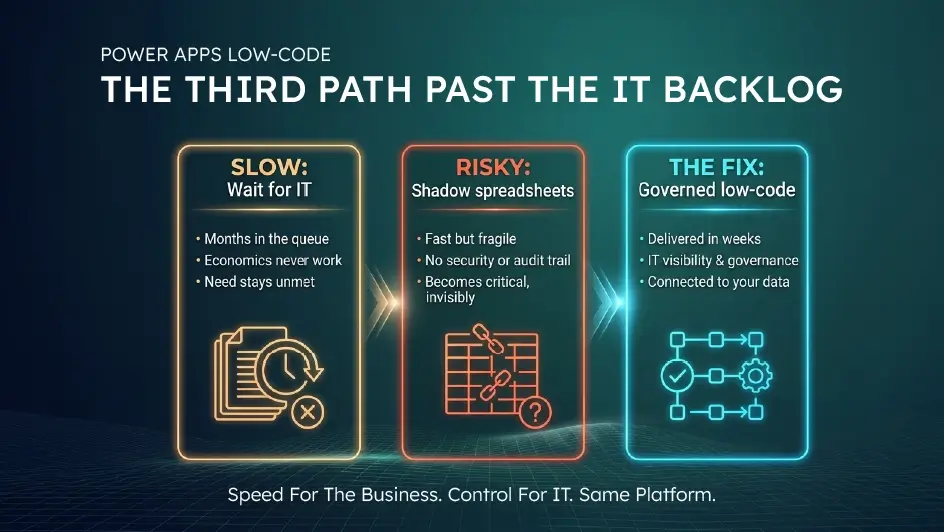
By giving the business a faster official route than waiting for IT - and a safer one than going rogue. Microsoft Power Apps delivers real business applications in weeks at a fraction of traditional cost, connected to the data you already have and governed through Microsoft Entra and centrally managed environments. The choice stops being "wait a quarter or build a shadow spreadsheet": the business gets speed, and IT keeps visibility and control.
The Moment Every Operations Lead Knows
A team needs a simple tool - a way to log site inspections, track approvals, capture customer requests, manage a small process. They ask IT. IT agrees it's a good idea, adds it to the backlog, and gives an honest answer: we can look at this next quarter. Maybe.
So the team does what teams do. They build it themselves - in a spreadsheet. Then a second spreadsheet, for the part the first one couldn't do. Then a shared inbox, a Teams channel, and a set of habits that only Karen understands. Six months later the "temporary" spreadsheet is a business-critical system with no access control, no audit trail, no backups anyone has tested, and formulas nobody dares touch.
Multiply that by every team that ever got the "next quarter" answer, and you have the modern shadow IT estate: dozens of fragile, invisible systems running processes that matter.
The Backlog Isn't an IT Failure
It's worth being fair about the cause. Demand for software inside businesses has exploded; IT capacity hasn't. Every department now runs on digital processes, and each has a queue of small, legitimate needs. Traditional development - requirements, procurement or build, testing, deployment - is simply too heavy a tool for a departmental inspection log. The economics don't work: a £40,000 build for a £15,000 problem gets deprioritised forever, correctly.
The backlog, in other words, is what happens when the only official way to get an application is the expensive way. People don't route around IT out of rebellion. They route around it because the official path can't serve them.
The costs, though, are real on both sides: the business loses months waiting or runs on fragile spreadsheets; IT loses control, visibility, and eventually gets handed the wreckage ("Karen's leaving - can you take over her spreadsheet?").
What Good Looks Like: A Middle Path That's Actually Governed
This is exactly the gap Microsoft Power Apps and the Power Platform were built to fill: business applications delivered in weeks at a fraction of traditional cost, running on the Microsoft foundation you already own - and, crucially, inside IT governance rather than around it.
What that looks like in practice:
- Real applications, fast. Forms, workflows, approvals, mobile data capture, dashboards - built low-code, delivered in weeks. An inspection app, a leave-approval flow, a customer-onboarding tracker: these are days-to-weeks projects on Power Apps, not quarters.
- Connected, not siloed. Power Apps plugs natively into the data you already have - SharePoint, Dataverse, SQL, Dynamics, and (via connectors) most anything else. The new app reads and writes governed data instead of spawning another disconnected list.
- Automated end-to-end. Power Automate handles the workflow around the app - notifications, approvals, integrations - so the process is digital from start to finish, not a form bolted onto manual follow-up.
- Governed by design. Access through Microsoft Entra, data policies enforced centrally, environments and deployment managed properly. IT gets visibility and control over the whole estate - the opposite of shadow IT.
- Reported on from day one. Because the data lands in governed storage, Power BI can report on the process immediately. The spreadsheet era's data black holes disappear.
The strategic shift is this: the choice stops being "wait for IT or go rogue." A governed low-code path means the business gets speed and IT keeps control - which is why Power Platform adoption is as much an IT win as a business one. (Wondering how the Power Platform relates to Fabric? We've compared them here.)
How to Get There
1. Surface the shadow estate. Ask each department: which spreadsheets would hurt if they broke tomorrow? That list - usually longer than anyone expects - is your candidate backlog, pre-validated by real use.
2. Pick two or three quick wins. Ideal first apps are high-annoyance, modest-complexity processes: inspections, requests, approvals, registers. Ship them in weeks and let the results advertise.
3. Establish the governance guardrails early. Environments, data-loss policies, naming, deployment practice. Set up well once, this is what makes app fifty as safe as app one.
4. Build internal capability alongside. The long-term win is your own people building and maintaining apps within the guardrails - with specialists handling the complex cases.
Where Solv Systems Comes In
Solv Systems delivers Power Platform solutions end to end: Power Apps development, Power Automate workflows, the Dataverse and integration architecture underneath, and the governance framework that keeps the estate healthy as it grows. As a Microsoft Power Platform Partner with 100+ projects delivered, we've replaced spreadsheet processes in businesses across energy, logistics, IT services, and financial services.
We're also deliberate about skills transfer - workshops, mentorship, and co-build are part of how we work, because the goal isn't to become your permanent app factory. It's to clear the backlog, stand up the governance, and leave your team able to keep pace with the business on their own.
The before-and-after is stark: processes that ran on fragile spreadsheets become governed applications with proper access control, audit trails, and reporting - and the "next quarter, maybe" conversation stops happening, because the middle path exists.
Clear the Queue
If your teams are running critical processes on spreadsheets because the official route takes too long, the fix isn't more patience - it's a faster official route.
Our Power Platform team will look at your worst spreadsheet-that-became-a-system, tell you what replacing it would honestly take, and how to set up low-code properly from the start.
Sources and Further Reading
Frequently asked
Microsoft's low-code application platform. It lets business applications - forms, approvals, mobile data capture, process trackers - be built in days to weeks rather than months, connected natively to data in SharePoint, Dataverse, SQL, Dynamics and hundreds of other systems, and governed through Microsoft Entra and centrally managed environments.
Shadow IT is the estate of spreadsheets, shared inboxes, and improvised tools that teams build when the official route can't serve them. The risk is structural: business-critical processes end up running with no access control, no audit trail, no tested backups, and total dependence on whoever built them.
Typical departmental applications - inspection logs, approval flows, request trackers, registers - are days-to-weeks projects. That speed comes from low-code building blocks, pre-built connectors to your existing data, and the fact that the platform handles security, hosting, and mobile delivery out of the box.
It is when set up deliberately. Power Platform governance includes managed environments, data loss prevention policies, access through Microsoft Entra, and controlled deployment practices. Done right, IT gets more visibility and control than the spreadsheet estate ever offered - low-code inside governance, not around it.
A high-annoyance, modest-complexity process that real people run every week: site inspections, leave approvals, customer onboarding tracking, equipment registers. Ship two or three of these in weeks and let the results advertise the approach to the rest of the business.
Yes - that's the long-term win of low-code. With governance guardrails established and some mentorship, business users and IT staff can build and maintain most departmental apps themselves, with specialists handling the complex integration and architecture cases.