In Short: Managed Service or Permanent Hire?
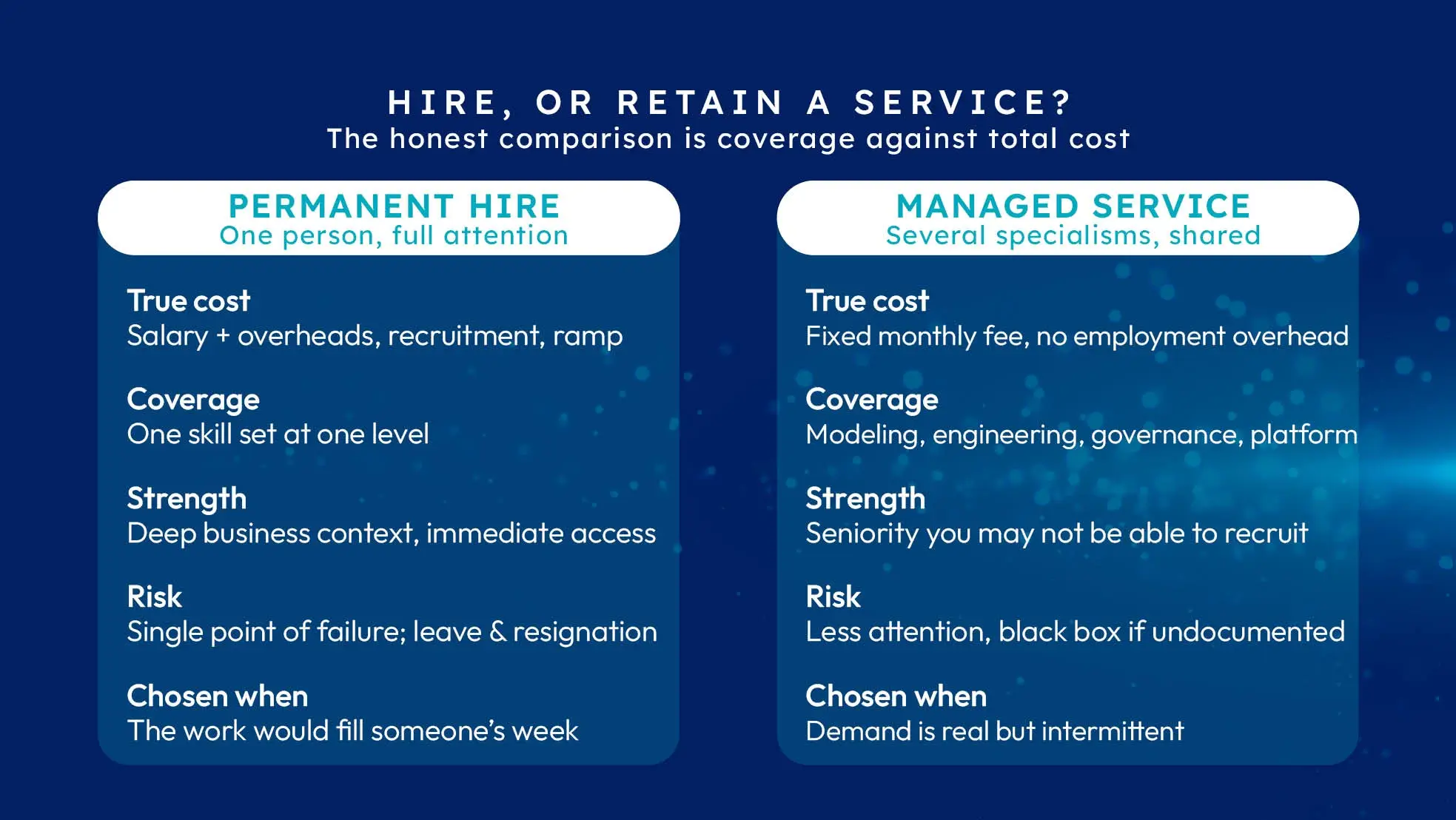
Hire when the work would genuinely fill someone's week and institutional knowledge matters most. Take a managed service when you need several specialisms intermittently, cannot recruit at the level required, or are not yet sure what the permanent role should be. The honest comparison is not salary against monthly fee - it is total cost against coverage, and each wins in different situations.
What a Managed Service Actually Covers
"Data Insights as a Service" and similar labels vary between providers, so the useful question is what is inside the arrangement. A typical retained analytics service covers:
- Refresh monitoring and failure response - somebody notices when the pipeline breaks at 3am, and it is not your finance director at 8am.
- Semantic model maintenance - keeping definitions current as the business changes, which is the work that silently degrades otherwise.
- New report development within an agreed monthly allowance.
- Governance upkeep - access reviews, workspace hygiene, certification of datasets.
- Advisory time - someone to ask before making a decision, rather than after.
What is usually not included, and should be checked: major platform change. A Fabric migration or a significant re-architecture is normally a separate project, not something absorbed into a retainer. Any provider suggesting otherwise is either over-promising or planning to under-deliver on the retainer.
The Real Cost of Hiring
Comparing a monthly service fee against a salary understates the hire, sometimes substantially. The honest total includes:
- Salary, at whatever the market demands for the seniority you actually need.
- Employment overheads - pension, insurance, taxes, equipment, licences.
- Recruitment cost, and the vacancy period before they start.
- Ramp time - three to six months before a new hire is fully productive in your estate.
- Key-person risk - when they take leave, reporting slows; when they resign, the knowledge leaves with them and you restart the cycle.
That last item is the one organisations consistently under-weight. A single in-house BI analyst is a single point of failure for every number the business runs on.
The Real Cost of a Managed Service
In fairness, the other side has costs that do not appear on the invoice:
- Less attention. A retained team is not sitting with you all day. Response times are contractual rather than immediate.
- Less business context. An external team learns your business, but never as deeply as someone living in it.
- Coordination overhead. Requests go through a process rather than a conversation across the desk.
- Knowledge-transfer risk. If the arrangement ends and nothing was documented, you inherit a system nobody internally understands.
That last risk is manageable but only if you manage it - see the questions below.
When Hiring Is Clearly Better
Be honest about this rather than working backwards from a preferred answer.
Hire when the work is continuous. If reporting demand would genuinely occupy someone five days a week, a retainer sized to that is unlikely to be cheaper and definitely less responsive.
Hire when business context dominates. In organisations where the hard part is understanding the business rather than the platform - unusual domain logic, heavy regulation, complex commercial models - proximity beats platform depth.
Hire when you are building a data function. If the strategic intent is an internal capability, start building it. A service can bridge the gap while you recruit, but it should not become the plan by default. When you do recruit, our hiring guide covers what to test for.
When a Managed Service Is Clearly Better
When the demand is real but intermittent. Most mid-market organisations need perhaps two days a week of BI work, spiking at month-end and quarter-end. Hiring for the spike means paying for the trough.
When you need several specialisms. One hire gives you one skill set. A retained team typically spans modelling, engineering, governance and platform administration - and you are unlikely to find all four in one affordable person.
When you cannot recruit at the level required. Senior Microsoft data skills are competitive in every market we work in. A service gives you access to seniority you may not be able to hire.
When you do not yet know what the role should be. This is underrated. A year of a retained service teaches you exactly what your permanent hire should look like - which is far clearer than guessing before you have started.
The Hybrid Most Organisations End Up With
In practice the common arrangement is neither pure option: one internal person who knows the business, backed by a retained team for depth and cover.
The internal person owns relationships, requirements and day-to-day report work. The service covers platform maintenance, the harder engineering, governance and holiday cover. It costs more than either alone and removes the main weakness of both - the single point of failure on one side, the context gap on the other.
If your reporting matters enough to argue about, this is usually the right shape.
Questions to Ask Before Signing
- What exactly is in the monthly allowance, and what is billed separately?
- What are the response times, and what happens when they are missed?
- Who specifically will work on our estate, and will that change?
- What documentation will exist, and what do we inherit if this ends tomorrow?
- How do you avoid becoming a black box?
That last question is the important one. A good provider has a real answer involving documentation standards, legible semantic models and training your people. A provider whose value depends on you not understanding the system is a provider you will struggle to leave.
Where Solv Systems Comes In
We run Data Insights as a Service for organisations that need analytics capability without a permanent hire, and Process Automation as a Service alongside it. Both are structured so your team gains capability rather than dependency - documentation as a deliverable, and training built in rather than sold separately.
We also tell people to hire, when the shape of the work says hire. If reporting demand would fill someone's week and your business context is the hard part, recruiting is the better answer and a retainer would be an expensive way to avoid the decision. A free 30-minute consultation will get you a straight view either way. If you would rather compare against project pricing, our guide to Power BI project costs in the UK sets out typical ranges.
Sources and Further Reading
Frequently asked
A retained arrangement where an external team runs and extends your reporting estate: monitoring refreshes, fixing breakages, building new reports, maintaining the semantic model and keeping governance current. It replaces the operational half of what an in-house BI analyst would do.
Not always, and the honest comparison is not salary against fee. A permanent hire costs salary plus employment overheads plus recruitment, and delivers one person's skill set at their level. A retained service typically costs less than a full-time senior and spreads across several specialisms, but gives you less of any one person's attention.
When reporting demand is continuous and high, when deep institutional knowledge of your business matters more than platform depth, or when you have enough work to keep someone genuinely busy. If your BI person would be occupied five days a week, hire them.
Refresh monitoring and failure response, semantic model maintenance, new report development within an agreed allowance, governance upkeep such as access reviews, and advisory time. What it usually does not cover is deep platform change - a Fabric migration or major re-architecture is normally a separate project.
This is the right question to ask, and the answer depends on the arrangement. A well-run service documents as it goes, keeps the semantic model legible, and trains your people rather than becoming a black box. Ask specifically what you would inherit if the contract ended tomorrow.
Yes, and it is a sensible sequence. A retained service covers the gap while you work out what the permanent role should actually be - which is usually clearer after a year of running than it is before you have started.