In Short: Databricks or Microsoft Fabric?
Both are lakehouse platforms, both store data in Delta Lake format, and both cover engineering, warehousing and analytics. Choose Microsoft Fabric if your estate is already Microsoft and your centre of gravity is analytics and reporting. Choose Databricks if your centre of gravity is large-scale data engineering and machine learning, or you need to run across more than one cloud. The decision is about who uses the platform daily, not which has more features.
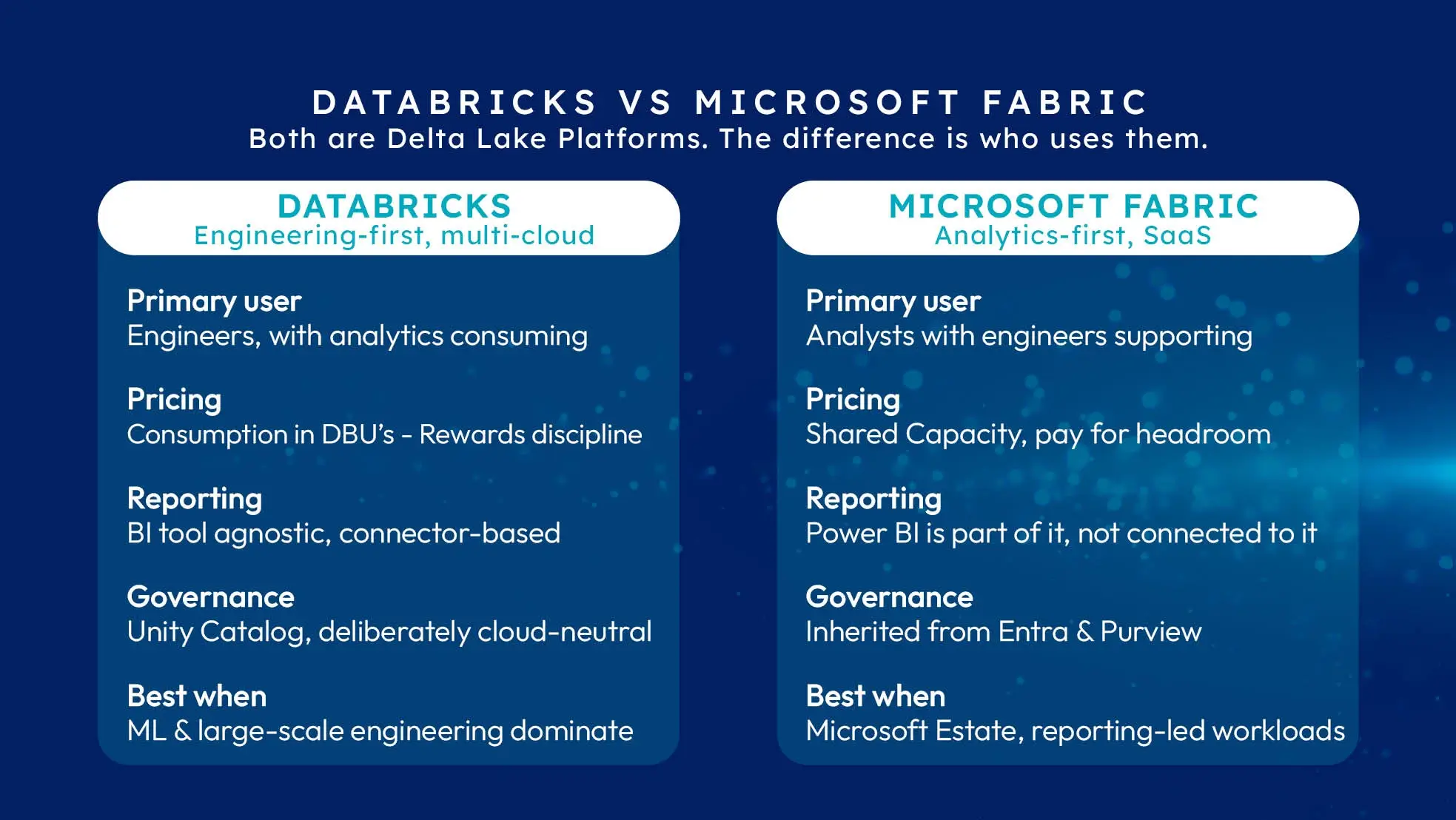
They Are More Similar Than the Marketing Suggests
It is worth starting with the overlap, because vendor material tends to obscure it. Both platforms implement the lakehouse pattern: open table formats over cloud object storage, with warehouse-style semantics on top. Both use Delta Lake as a primary table format, which Databricks originated and Microsoft adopted for OneLake. Both offer notebooks, Spark, SQL endpoints, pipelines, governance tooling and machine learning capability.
So the honest framing is not "which platform can do the job" - both can, for most mid-market workloads. It is which platform fits the organisation holding it.
The Real Difference: Who Is the Platform For?
Databricks is engineering-first. Its natural user writes code, thinks in clusters and pipelines, and is comfortable owning platform decisions. That heritage shows in the depth of its Spark tuning, its notebook experience and its machine learning tooling, and it is why data engineering teams tend to like it. The Databricks documentation is written for that audience.
Fabric is analytics-first. Its natural user builds semantic models and reports, and increasingly is a business analyst rather than an engineer. Power BI is not integrated with Fabric - it is part of it, which is a different thing. Direct Lake mode lets reports read Delta tables in OneLake without importing them or firing a query per visual.
Neither orientation is better. They are answers to different questions, and picking the wrong one produces a platform your team works around rather than with.
Pricing: Two Genuinely Different Models
This trips up more evaluations than any feature comparison, because the models are not comparable line by line.
- Fabric sells capacity. You buy an F SKU and every workload shares it. The bill is the same whether the capacity is busy or idle. Predictable, easy to budget, and it throttles rather than surprises you when you outgrow it. Our Fabric pricing guide sets out the full F SKU list.
- Databricks sells consumption. You pay DBUs for what you run, plus the underlying cloud compute. A quiet month costs less; an unmanaged always-on cluster costs a great deal more. Databricks publishes its pricing by workload type.
The practical consequence: organisations with steady, predictable analytics workloads usually find capacity pricing easier to live with. Organisations with spiky, batch-heavy engineering often find consumption pricing cheaper - provided someone actively governs it. Consumption models punish inattention.
Governance and Identity
Fabric inherits the Microsoft estate: identity through Microsoft Entra, classification and lineage through Purview, and the same security model applied across workloads. If your organisation already runs Microsoft 365, a large amount of governance work is simply already done.
Databricks governs through Unity Catalog, which is a capable and coherent system, and deliberately cloud-agnostic. That independence is exactly the point if you run workloads on more than one cloud - and it is redundant effort if you do not.
Machine Learning
For serious model development, Databricks remains the deeper platform today. Its ML tooling has a longer history, and teams doing genuine model engineering rather than consuming pre-built AI generally find it more complete.
Fabric's answer is different in kind. Rather than competing on model development, it embeds AI into analytics: Copilot across the platform and data agents that answer questions over governed data in plain English. For most mid-market organisations, that is closer to what they actually want from AI than a model training environment - but if you are building models, be honest that this is not the same thing.
When Each One Wins
Fabric is the better choice when the estate is Microsoft, reporting and analytics dominate the workload, the team is analyst-heavy, predictable budgeting matters, or governance and identity should come from tools you already run.
Databricks is the better choice when data engineering at scale is the main job, machine learning is central rather than adjacent, you operate across multiple clouds, or you have engineers who want control over the platform rather than a managed abstraction.
Run both when you are large enough to justify it - Databricks handling heavy engineering and ML, Fabric and Power BI serving governed reporting on the same Delta tables (Power BI on Azure Databricks covers the connection patterns). OneLake shortcuts make this less duplicative than it sounds, because the data does not need copying. (For our more opinionated view of where the mid-market specifically lands, see Fabric versus Databricks in the mid-market.)
How to Decide Without a Feature Matrix
Feature grids favour whoever wrote them. Three questions settle it faster:
1. Who will use this platform every day? Analysts point to Fabric; engineers point to Databricks.
2. What does your cost profile look like? Steady and predictable favours capacity. Spiky and well-governed favours consumption.
3. How much of your estate is already Microsoft? The more it is, the more Fabric's integration advantages compound - and the less an independent governance layer buys you.
If the answers conflict, the first one usually wins. A platform the daily users resist will underperform whatever the architecture diagram says.
Where Solv Systems Comes In
We are a Microsoft Partner and we implement Fabric, so treat our view accordingly - but we would rather tell you Databricks is the better fit than deliver a Fabric platform your team works around. We have said so before.
What we bring to the decision is the part evaluations usually skip: modelling both against your actual refresh schedules, concurrency and reporting audience rather than a feature list, and being clear about what migration would genuinely cost. If Fabric is right, we design and build it - platform, pipelines, governance and the reporting layer. If it is not, you have saved a great deal more than the cost of the conversation.
Sources and Further Reading
- Delta Lake
- OneLake overview
- Databricks documentation
- Databricks pricing
- Microsoft Entra ID
- Purview governance for Fabric
Frequently asked
Yes, they overlap substantially - both are lakehouse platforms storing data in Delta Lake format, both handle engineering, warehousing and analytics workloads. They differ in who they are designed for: Databricks is engineering-first and multi-cloud, Fabric is SaaS and built around the Microsoft estate with Power BI native to it.
Neither is reliably cheaper, because the pricing models are structurally different. Fabric sells pooled capacity as an F SKU that everything shares, so cost is predictable but you pay for the capacity whether or not it is busy. Databricks bills consumption in DBUs plus the underlying cloud compute, so a quiet month costs less and a heavy one costs more. Predictability favours Fabric; variable workloads often favour Databricks.
Yes, and in larger estates they frequently do. Both read and write Delta Lake, and OneLake shortcuts can reference data held elsewhere without copying it. A common pattern is Databricks for heavy engineering and machine learning, with Fabric and Power BI serving the governed reporting layer on the same tables.
For serious ML engineering, generally yes today. Databricks has a longer history in that space with MLflow, model serving and a mature notebook and cluster experience. Fabric has data science capability and is improving quickly, but if your centre of gravity is model development rather than analytics, Databricks is the deeper platform.
It is a strong argument but not an automatic answer. Fabric's advantages compound in a Microsoft estate: Entra identity, Purview governance, Power BI native, and Copilot across the stack. The counterweight is workload shape - if most of your work is large-scale data engineering and ML rather than analytics and reporting, that advantage may not outweigh Databricks' depth.
Who uses the platform day to day. Fabric is built so analysts and business users can work in it directly, with engineers supporting them. Databricks is built so engineers can work at scale, with analysts consuming the output. Pick the one whose primary user matches your team.